

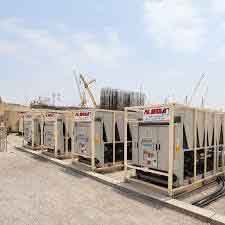
Commercial buildings, warehouses, factories, construction projects, hotels, events and other large facilities in the UAE can sometimes need more cooling than their permanent HVAC system can provide. A rental chiller may fail unexpectedly, planned maintenance may require equipment to be taken offline, a new facility may not yet have its permanent cooling system, or summer demand may temporarily exceed installed capacity.
In these situations, commercial cooling equipment rental in the UAE provides a temporary way to maintain the required indoor or process temperature without purchasing and permanently installing another cooling system.
Commercial cooling rental can include equipment such as air-cooled chillers, air-handling units, packaged air conditioners, portable air conditioners and supporting equipment. Depending on the application, a rental system may work alongside an existing HVAC installation or operate as a temporary independent cooling system.
The basic concept is simple: a business identifies its cooling requirement, a rental provider assesses the site and required capacity, suitable equipment is delivered and installed, the system is commissioned and supported during the rental period, and the equipment is removed when it is no longer required.
The exact arrangement depends on the building, cooling load, available electrical supply, installation conditions, rental duration and type of equipment required. UAE rental providers currently describe applications ranging from emergency cooling and planned maintenance to construction, events, warehouses, industrial facilities and data centres.
What Is Commercial Cooling Equipment Rental in the UAE?
Commercial cooling equipment rental means temporarily hiring professional cooling or HVAC equipment instead of buying a permanent system.
The equipment can be used for a few days, several weeks, a season or a longer project period. Rental arrangements are particularly useful when the need for additional cooling is temporary or uncertain.
For example, a commercial building might normally depend on its installed chillers. If one chiller needs major maintenance, the building could temporarily rent a chiller and associated equipment to maintain cooling while the permanent system is unavailable.
A warehouse may need additional cooling during a temporary operational change. A construction project may require temporary air conditioning before the permanent HVAC system is commissioned. An event may need cooling for only the duration of the event.
The important point is that commercial cooling equipment rental is not simply renting an air conditioner. Large commercial requirements can involve a complete temporary HVAC arrangement consisting of cooling equipment, pumps, hoses, air-handling units, ducting, electrical distribution, controls and other accessories.
For example, Al Shola’s UAE rental offering includes air-cooled chillers, AHUs, packaged AC units, portable AC units, refrigerated containers and supporting accessories. Atlas Copco’s UAE rental offering similarly includes chillers, air-conditioning equipment, air-handling units and related installation and monitoring services.
Why Do UAE Businesses Need Temporary Cooling?
Cooling is not an optional requirement for many UAE businesses. Commercial and industrial facilities can depend on controlled temperatures for occupant comfort, equipment operation, production processes, storage and business continuity.
Rental cooling becomes particularly useful when the permanent HVAC system cannot temporarily meet the requirement.
One common situation is an unexpected equipment breakdown. If a critical chiller stops working during a period of high cooling demand, waiting for a permanent repair can create operational problems. Temporary cooling can provide an interim source of capacity while technicians repair or replace the failed equipment.
Another situation is planned maintenance. HVAC equipment needs maintenance, but shutting down a cooling system can be difficult for an occupied building or operating facility. Rental cooling can provide temporary capacity while the permanent equipment is offline.
Businesses may also use rental cooling when they need additional capacity. Daikin describes temporary rental solutions for situations such as cooling-load fluctuations, facility expansion, peak demand, special events and emergency equipment failures.
Construction and refurbishment are another important application. A building may be occupied or partially operational before its final HVAC system is available. Temporary equipment can provide cooling during the transition.
What Types of Commercial Cooling Equipment Can Be Rented?
The appropriate equipment depends on the size and nature of the cooling requirement. There is no single cooling machine that is suitable for every commercial application.
Air-Cooled Chillers
Air-cooled chillers are commonly used for larger temporary cooling requirements.
A chiller cools water through a refrigeration cycle. The chilled water can then be circulated to air-handling units, fan-coil systems or other heat exchangers that transfer cooling into the required space or process.
The U.S. Department of Energy explains that chillers use a refrigeration cycle to cool water, with heat rejected either to a condenser-water loop in water-cooled systems or directly to ambient air in air-cooled systems.
Air-cooled rental chillers can be useful where a cooling tower and condenser-water system are not available or where fast temporary deployment is important.
UAE suppliers currently advertise high-ambient air-cooled chillers for temporary commercial and industrial applications. For example, Al Shola lists air-cooled rental chillers from 50 TR to 400 TR and states that its high-ambient units are designed for GCC conditions.
The final equipment selection should not be based only on the advertised tonnage. The actual heat load, required leaving-water temperature, water flow, ambient conditions, electrical supply and connection arrangement need to be considered.
Water-Cooled Chillers
Water-cooled chillers reject heat through a condenser-water system, normally involving a cooling tower or another heat-rejection arrangement.
They can be appropriate for larger installations where suitable water-side infrastructure is available.
The Department of Energy notes that air-cooled systems avoid the need for a cooling tower and can reduce installation and maintenance requirements, while water-cooled systems can offer efficiency advantages. The correct choice therefore depends on the specific project rather than assuming one type is universally better.
For a temporary project, the availability of water, cooling-tower infrastructure, space, electrical power and installation time can all affect the practical choice.
Air Handling Units
An air-handling unit (AHU) can distribute conditioned air through a commercial space.
AHUs are often used together with chillers. Chilled water passes through cooling coils inside the AHU, while fans move air across the coils and distribute the conditioned air through ductwork.
This makes an AHU useful when a temporary cooling project needs more than simply producing chilled water.
Current UAE rental offerings include AHUs for commercial buildings, warehouses, construction projects, factories, events and other applications.
Packaged Air Conditioners
Packaged AC units are self-contained or packaged cooling systems that can be used for temporary commercial and project applications.
They can be appropriate when a site needs a larger amount of direct air conditioning but does not require a complete chilled-water installation.
Al Shola currently lists packaged AC rental equipment in the 10–30 TR range for applications including commercial spaces, warehouses, construction sites, labour accommodation, tents and events.
Portable Air Conditioners
Portable AC units are useful when cooling needs to be concentrated in a particular area.
They can be used for offices, server rooms, temporary rooms, site cabins, events or other areas where a large central system would be unnecessary or impractical.
Current UAE rental fleets include portable units designed for targeted cooling, with some providers listing units in the 3–8 TR range.
Supporting Equipment
A commercial cooling rental may also require equipment that is not itself a cooling machine.
Depending on the project, this can include chilled-water pumps, flexible hoses, headers, valves, reducers, electrical distribution equipment, cables, ducting, controls and monitoring systems.
This is why a commercial cooling requirement should be considered as a complete temporary system, rather than simply selecting a machine based on its cooling capacity.
How Does Commercial Cooling Equipment Rental Work?
Although every project is different, the rental process generally follows several stages.
Step 1: Identify the Cooling Requirement
The first stage is understanding what needs to be cooled and why.
A business should establish whether it needs temporary comfort cooling, process cooling, emergency backup, additional seasonal capacity or cooling during planned maintenance.
The rental provider may ask about the building or process, operating schedule, target temperature, existing HVAC system and expected rental duration.
Step 2: Assess the Cooling Load
The next step is determining the required cooling capacity.
Cooling load is not determined simply by the floor area.
Factors can include the building size, occupancy, equipment generating heat, lighting, solar gains, outdoor conditions, process loads and required indoor temperature.
For process cooling, the characteristics of the process and required fluid temperatures can be especially important.
Daikin’s rental guidance identifies cooling-load requirements, space constraints, duration, and installation or integration conditions as important factors when choosing temporary cooling equipment.
Step 3: Check the Existing System
If the rental equipment will work with an existing HVAC system, the provider needs to understand how the temporary equipment will connect.
For a chiller installation, this may involve chilled-water supply and return connections.
For an AHU, the assessment may involve airflow, ducting and available space.
For packaged or portable AC, the focus may instead be on placement, electrical supply, airflow and heat rejection.
The connection method can significantly affect installation time and equipment selection.
Step 4: Select the Equipment
After the site requirements are understood, the provider can select the appropriate equipment.
A small office may require portable or packaged equipment.
A larger commercial building may require chillers and AHUs.
An industrial facility may need a process-cooling configuration involving chillers, pumps, heat exchangers or buffer tanks.
Atlas Copco describes temporary industrial cooling systems that can include chillers, pumps, buffer tanks, heat exchangers and power-supply integration depending on the application.
Step 5: Plan Delivery and Installation
The physical site also matters.
The provider needs to consider access for delivery vehicles, equipment positioning, electrical connections, piping or hose routes, ventilation, drainage and safe operating clearances.
For a large chiller, for example, the available installation area and access route may be completely different from those required for a portable AC unit.
Step 6: Installation and Commissioning
Once the equipment reaches the site, it is installed and connected according to the planned configuration.
Commissioning is important because the system should be checked before it becomes responsible for the building or process cooling requirement.
Rental providers may also provide ongoing monitoring, maintenance and technical support during the rental period. Atlas Copco, for example, describes installation, commissioning and remote monitoring as part of its industrial cooling rental service.
Step 7: Operation and Support
During the rental period, the equipment needs to continue operating under the expected site conditions.
A professional rental arrangement can include technical support and maintenance.
This becomes particularly important for long-term rentals or applications where cooling failure could affect production, equipment or occupied spaces.
Step 8: Removal After the Rental Period
When the permanent HVAC system is operational again or the project has finished, the temporary equipment can be disconnected and removed.
This is one of the main differences between temporary rental and permanent HVAC installation: the equipment can leave the site when the temporary requirement ends.
What Determines the Size of a Rental Cooling System?
Choosing the right size is one of the most important parts of commercial cooling equipment rental.
An oversized system can mean unnecessary equipment and operating costs, while an undersized system may not maintain the required conditions.
The calculation should therefore be based on the actual cooling requirement.
Important factors include:
Building size: The area and volume of the space provide a starting point but do not determine the final cooling capacity on their own.
Occupancy: People release heat, so a crowded facility can have a significantly different cooling requirement from an occasionally occupied space.
Equipment heat: Computers, production machinery, lighting and other equipment can contribute to the cooling load.
Outdoor conditions: UAE outdoor temperatures can have a major impact on cooling equipment performance.
Solar heat gain: Windows, roofs and exposed building surfaces can introduce additional heat.
Process requirements: Industrial applications may have specific temperatures and flow requirements that differ from normal comfort cooling.
Target temperature: Maintaining a particular temperature can require a different system from simply improving comfort.
Operating hours: A system running continuously has different operational requirements from one used for a short event.
For these reasons, a rental provider should ideally assess the project rather than selecting equipment only from a generic square-metre calculation.
Air-Cooled vs Water-Cooled Chiller Rental
Businesses sometimes ask whether they should rent an air-cooled or water-cooled chiller.
The answer depends on the project.
An air-cooled chiller rejects heat directly to outdoor air. It generally does not require a cooling tower or condenser-water circuit, which can simplify temporary installation.
A water-cooled chiller transfers heat to condenser water, normally requiring additional water-side equipment such as a cooling tower.
The Department of Energy identifies the absence of a cooling tower as one of the installation advantages of air-cooled systems, while also noting that water-cooled systems can be more efficient.
In UAE temporary applications, the decision can also be influenced by available space, water availability, installation time, ambient temperature, existing infrastructure and required operating efficiency.
There is no universal answer. The correct selection is the one that fits the project’s technical conditions.
When Should a Business Rent Commercial Cooling Equipment?
There are several situations where rental can make practical sense.
During Chiller or HVAC Breakdown
A failed cooling system can interrupt normal operations.
Temporary equipment can act as a bridge while the permanent system is repaired.
During Planned Maintenance
Maintenance sometimes requires equipment to be shut down.
Temporary cooling can help maintain operations while the permanent equipment is being serviced.
During HVAC Replacement
Replacing a major HVAC system can take time.
A rental system can provide temporary capacity during the transition between the old and new systems.
During Building Expansion
An existing HVAC system may not immediately have enough capacity for a building expansion.
Temporary cooling can help cover the additional requirement while the permanent system is being developed.
Daikin specifically identifies facility expansion and cooling-load fluctuations as situations where rental cooling can be useful.
For Construction Projects
Construction and refurbishment sites may need temporary temperature control before permanent HVAC systems are ready.
Temporary AC, packaged units, chillers and AHUs can be selected according to the project stage and cooling requirement.
For Events
Exhibitions, temporary structures, corporate events and other gatherings may require cooling for a limited period.
Renting equipment avoids installing a permanent HVAC system for an event that may last only days or weeks.
For Seasonal Demand
Some facilities may require additional cooling capacity during periods of particularly high demand.
Rental equipment can provide temporary capacity without permanently increasing the installed plant.
For Critical Operations
Certain industrial, healthcare, technology and process applications may need backup cooling when their normal system is unavailable.
Daikin and Atlas Copco both describe temporary cooling as a solution for emergency situations, planned shutdowns, peak demand and critical applications.
What Are the Main Benefits of Commercial Cooling Equipment Rental?
Lower Upfront Capital Requirement
Buying a commercial chiller or complete HVAC system can require substantial capital expenditure.
Rental provides access to equipment without requiring the business to purchase the temporary equipment outright.
Daikin positions rental solutions as a way of addressing temporary cooling needs while reducing capital expenditure and managing operating expenditure.
Flexibility
A rental system can be used for the actual period required.
A business needing cooling for a maintenance shutdown does not necessarily need to own a cooling system for the rest of the year.
Faster Temporary Deployment
Rental providers maintain equipment fleets that are specifically intended for temporary requirements.
This can make rental particularly useful when a business needs cooling quickly after an equipment failure or before permanent equipment is available.
Actual deployment time depends on equipment availability, site conditions, access, installation complexity and the size of the project.
Scalability
A temporary cooling system can sometimes be expanded or reduced as the requirement changes.
Multiple units can also be combined for larger cooling requirements. Atlas Copco, for example, describes multiple units operating in parallel for multi-megawatt cooling applications.
Reduced Equipment Ownership Responsibilities
With rental, the business does not need to retain the equipment permanently.
Depending on the rental agreement, equipment maintenance, technical support, logistics and eventual removal may be handled by the rental provider.
The exact responsibilities should always be confirmed in the rental contract.
Is Commercial Cooling Equipment Rental Cost-Effective?
There is no universal commercial cooling rental price in the UAE.
The final cost depends on the equipment, capacity, rental period, installation requirements, transportation, accessories, site conditions and technical support.
For example, a small portable cooling requirement will have very different costs from a large chiller-and-AHU installation.
Rental Power identifies factors such as chiller capacity, rental duration, delivery distance, accessories, power requirements and installation complexity as factors that influence rental cost.
This is why businesses should compare complete quotations rather than comparing only the daily rental price of the main machine.
A quotation should make it clear whether it includes delivery, installation, commissioning, hoses, pumps, electrical equipment, technical support, maintenance and removal.
What Should You Ask Before Renting Cooling Equipment?
Before signing a rental agreement, businesses should confirm several technical and commercial details.
Ask what cooling capacity is being supplied and how it was calculated.
Confirm the type and model of equipment.
Check the required electrical supply.
Ask how the equipment will connect to the existing HVAC or process system.
Confirm whether pumps, hoses, headers, ducting and electrical distribution are included.
Clarify who is responsible for installation and commissioning.
Ask what technical support is available during the rental.
Confirm the rental duration and extension terms.
Check what happens if the equipment experiences a fault.
Confirm delivery and collection arrangements.
Ask whether the quoted price includes transportation and installation.
This information helps prevent a situation where the main cooling machine is available but essential supporting equipment is missing.
Commercial Cooling Rental for Different UAE Industries
Commercial cooling equipment rental can be adapted to many types of facilities.
Offices and Commercial Buildings
Offices can use temporary cooling during HVAC failures, maintenance, refurbishment or capacity upgrades.
The equipment may range from portable units for individual areas to packaged systems or larger chiller-based solutions.
Warehouses
Warehouses may require temporary cooling for staff areas, storage zones, operational spaces or specific temperature-sensitive applications.
The appropriate solution depends heavily on warehouse size, ceiling height, heat sources, ventilation and required temperature.
Hotels
Hotels have high expectations for occupant comfort and often cannot simply shut down their entire HVAC system during maintenance.
Temporary cooling can provide additional or replacement capacity during planned works or unexpected failures.
Shopping Centres and Retail Facilities
Large retail facilities can have substantial cooling requirements.
Temporary chillers and AHUs can be considered when part of the cooling plant is unavailable or when additional capacity is required.
Construction Sites
Temporary AC and packaged cooling equipment can provide climate control for site offices, temporary buildings and working areas.
Manufacturing and Industrial Facilities
Industrial cooling can be different from comfort cooling because manufacturing processes may require specific temperatures and flow conditions.
Atlas Copco describes rental process cooling applications for manufacturing, pharmaceutical production, food and beverage processing, chemical and petrochemical facilities, process-water cooling and data centres.
Data Centres
Data centres can have continuous cooling requirements because IT equipment generates substantial heat.
Temporary cooling can be used during maintenance, upgrades or emergencies, but the equipment must be selected and integrated carefully according to the facility’s redundancy and temperature requirements.
Commercial Cooling Equipment Rental vs Buying
The decision between renting and buying depends mainly on how long the equipment is needed and what the business expects to do with it.
Rental can make sense when:
The requirement is temporary.
The permanent system is being repaired.
A project has a defined end date.
Cooling demand is seasonal or uncertain.
The business needs emergency backup.
A permanent installation has not yet been completed.
Buying may make more sense when:
The cooling requirement is permanent.
The equipment will be used consistently for many years.
The business wants direct ownership.
There is a clear long-term return on the investment.
The building has the infrastructure required for permanent installation.
For short-term and uncertain requirements, rental can avoid purchasing equipment that may later sit unused.
How UAE Climate Conditions Affect Cooling Equipment Selection
The UAE presents demanding outdoor conditions for HVAC equipment, particularly during summer.
This makes equipment selection important.
A cooling machine that performs well under moderate ambient conditions may not provide the same capacity under extreme outdoor temperatures.
For this reason, UAE rental suppliers specifically market high-ambient equipment for Gulf conditions. Al Shola, for example, states that its high-ambient air-cooled chillers are designed to operate in ambient temperatures up to 55°C.
That does not mean every project requires equipment rated to the same temperature. The appropriate rating depends on the actual site, expected ambient conditions and manufacturer’s performance data.
Businesses should therefore ask for the equipment’s technical data and confirm the expected performance under the project’s design conditions.
What Makes a Commercial Cooling Rental Reliable?
Reliability is not determined only by the brand of the cooling equipment.
A dependable rental solution also depends on correct sizing, suitable equipment selection, proper installation, commissioning, preventive maintenance and technical support.
A high-capacity chiller will not solve the problem if the connected pipework is incorrectly sized or the available electrical supply is inadequate.
Similarly, an efficient cooling unit may not deliver the expected result if the cooling load has been underestimated.
A professional rental approach therefore considers the complete system.
Daikin describes rental solutions that combine equipment with installation, maintenance and monitoring, while Atlas Copco describes site assessment, installation, commissioning and remote monitoring for its cooling rental solutions.
How Long Can Commercial Cooling Equipment Be Rented?
Rental periods can vary significantly.
Some requirements last only a few days, such as an event or emergency repair.
Others may last several weeks during maintenance or refurbishment.
Longer projects may require equipment for several months or more.
UAE rental providers advertise both short-term and long-term arrangements, but the available rental period and commercial terms depend on the equipment and provider.
For long-term requirements, it is important to consider total operating costs, maintenance arrangements, energy consumption and contract terms rather than looking only at the daily rental rate.
Commercial Cooling Equipment Rental in Dubai, Abu Dhabi and Across the UAE
Commercial cooling rental is available for projects across the UAE, although the equipment available and deployment arrangements vary between providers.
Dubai has extensive demand from commercial buildings, events, construction, hospitality and industrial facilities.
Abu Dhabi has significant industrial, energy and commercial requirements, including projects in areas such as Mussafah.
Other emirates can also require temporary cooling for warehouses, factories, commercial buildings, events and construction projects.
When requesting a quote, the location should be provided together with the cooling requirement because transportation, access and installation conditions can affect the overall project.
A Simple Example of How Temporary Cooling Works
Consider a commercial building whose primary chiller requires major maintenance.
The building normally receives chilled water from its permanent chiller plant. During maintenance, the facility cannot simply lose cooling for several days.
The facility manager contacts a commercial cooling equipment rental company.
The rental provider reviews the building’s cooling load and existing chilled-water connections.
A suitable temporary chiller is selected.
The equipment is transported to the site and positioned in an appropriate location.
Temporary pipework, hoses, pumps or other required accessories are connected.
The system is commissioned and tested.
The temporary chiller then supplies the required cooling while the permanent chiller is unavailable.
Once maintenance is completed and the permanent system has been tested, the temporary equipment is disconnected and removed.
This example illustrates the main purpose of rental cooling: providing temporary capacity without requiring the business to permanently purchase another cooling plant.
How to Choose a Reliable Commercial Cooling Equipment Rental Provider in the UAE
The rental company should be evaluated on more than equipment availability.
First, check whether it has equipment suitable for the required capacity and application.
Second, ask whether the company provides site assessment and technical sizing.
Third, confirm that installation and commissioning are handled by qualified personnel.
Fourth, ask about emergency support and maintenance during the rental period.
Fifth, review the quotation carefully to understand what is included.
Finally, make sure the provider understands the UAE environment and the operating conditions of the project.
A good rental arrangement should make the complete process clear from initial assessment through delivery, commissioning, operation and collection.
Final Thoughts
Commercial cooling equipment rental in the UAE is a practical temporary solution for businesses that need reliable cooling without committing to a permanent equipment purchase.
The rental market covers a broad range of equipment, from portable AC units and packaged systems to large chillers and AHUs. The correct solution depends on the cooling load, building or process requirements, available infrastructure, site conditions, duration and operating environment.
The process normally begins with understanding the cooling requirement and assessing the site. The rental provider then selects the equipment, plans the installation, delivers and commissions the system, provides support during operation and removes the equipment when the temporary requirement ends.
Rental cooling can be particularly useful during HVAC breakdowns, planned maintenance, construction, refurbishment, seasonal demand, facility expansion and temporary events.
For UAE businesses, the most important consideration is not simply finding the largest or cheapest cooling machine. It is selecting a properly sized and suitable system that can operate under the project’s actual conditions and be installed and supported correctly.
When those factors are considered together, temporary cooling equipment can help businesses maintain temperature control while reducing the disruption associated with HVAC failures, maintenance and changing cooling requirements.
Frequently Asked Questions
What is commercial cooling equipment rental in the UAE?
Commercial cooling equipment rental is the temporary hire of cooling and HVAC equipment such as chillers, AHUs, packaged AC units and portable air conditioners for commercial, industrial, construction, event or emergency applications.
How does commercial cooling equipment rental work?
The process normally involves assessing the cooling requirement, calculating or confirming the required capacity, selecting suitable equipment, delivering and installing it, commissioning the system, providing support during the rental period and removing the equipment when it is no longer required.
What cooling equipment can businesses rent in the UAE?
Depending on the provider, businesses can rent air-cooled chillers, water-cooled chillers, AHUs, packaged AC units, portable AC units and supporting equipment such as pumps, hoses, ducting and electrical equipment.
When should a business rent cooling equipment?
Common situations include HVAC breakdowns, planned maintenance, building refurbishment, construction, seasonal peak demand, temporary events, facility expansion and emergency cooling requirements.
Is commercial cooling rental available for short-term projects?
Yes. Rental providers offer temporary cooling arrangements for short projects as well as longer-term requirements. The available rental period depends on the equipment and provider.
Can rental chillers work with an existing HVAC system?
They can, provided the temporary equipment is correctly selected and the existing system has suitable connection points and infrastructure. A site assessment is important before installation.
What determines the required chiller size?
Cooling load, building size, occupancy, equipment heat, outdoor conditions, target temperature, process requirements and operating conditions can all affect the required capacity.
Are air-cooled chillers suitable for UAE conditions?
Air-cooled chillers can be used in UAE applications, but the equipment must be selected according to the expected ambient conditions and manufacturer’s performance specifications. Some UAE suppliers offer high-ambient equipment specifically intended for Gulf conditions.
How much does commercial cooling equipment rental cost in the UAE?
There is no single rental price. Cost can depend on capacity, equipment type, rental duration, delivery, installation, accessories, power requirements, site conditions and technical support.
Can cooling equipment be rented for an emergency?
Yes. Emergency cooling is one of the major applications described by UAE rental providers and international HVAC rental companies. Availability and deployment time depend on the equipment, location and site requirements.
Is renting cooling equipment better than buying?
It depends on the project. Rental can be attractive for temporary, seasonal, emergency or uncertain requirements, while purchasing may make more sense for a permanent long-term cooling requirement.
Can commercial cooling rental support industrial applications?
Yes. Industrial rental cooling can be configured for process cooling as well as building comfort. Applications described by rental providers include manufacturing, food and beverage, pharmaceutical, chemical and petrochemical operations and process-water cooling.
What should I provide when requesting a cooling rental quotation?
Useful information includes the site location, application, required temperature, approximate cooling load or existing equipment capacity, available electrical supply, connection details, rental duration and any site access restrictions.
Does rental include installation?
It depends on the rental agreement. Many professional rental providers offer installation and commissioning, but businesses should confirm exactly what is included in the quotation.
Can rental cooling equipment operate alongside permanent equipment?
Yes, temporary equipment can be used as additional capacity or as a temporary replacement, provided the system is correctly designed and integrated with the existing installation.