

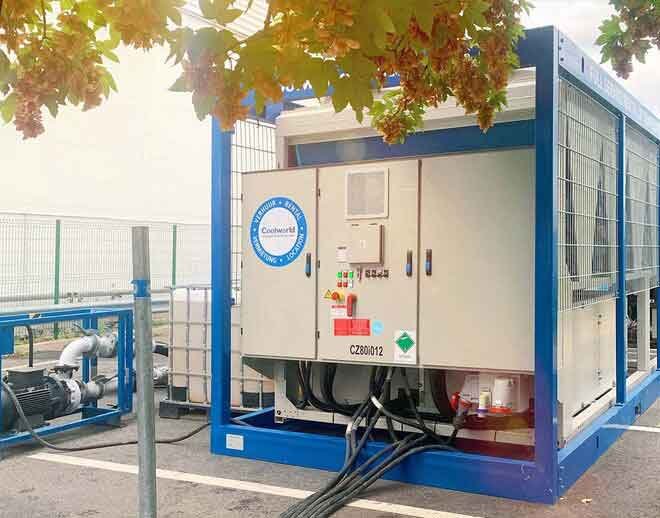
Choosing a rental chiller in the UAE is not simply a matter of selecting the required tonnage. The country’s hot climate, high summer temperatures and, in coastal areas, humid conditions can influence chiller capacity, efficiency, condenser performance, water requirements and operating costs.
ASHRAE guidance confirms that chiller performance changes with operating temperatures. For air-cooled chillers, outdoor dry-bulb temperature is an important performance input, while water-cooled systems are affected by condenser-water temperature.
For businesses renting temporary cooling in Dubai, Abu Dhabi, Sharjah or other parts of the UAE, the local climate should therefore be considered before equipment is selected.
High Outdoor Temperatures Can Affect Chiller Performance
One of the most important factors in the UAE is high ambient temperature.
An air-cooled chiller rejects heat directly into the outdoor air. As the surrounding air becomes hotter, rejecting that heat becomes more difficult. ASHRAE explains that entering air temperature above the expected design condition can cause compressor discharge pressure and power consumption to increase, potentially affecting equipment operation.
This is why a chiller that provides a particular capacity under moderate conditions should not automatically be assumed to provide exactly the same performance during the hottest UAE operating conditions.
When requesting a rental chiller, ask the supplier for the unit’s rated cooling capacity and power consumption at the actual expected ambient temperature, rather than relying only on the nominal TR rating.
Air-Cooled Chillers Need Careful High-Ambient Selection
Air-cooled chillers are often attractive for temporary applications because they do not require a cooling tower and condenser-water circuit.
However, their performance is directly influenced by outdoor air temperature. ASHRAE notes that air-cooled condenser performance depends on outdoor conditions and that higher entering-air temperatures can increase compressor discharge pressure and power.
For a UAE rental project, ask:
- What is the chiller’s maximum rated ambient temperature?
- What cooling capacity is available at the expected ambient?
- How much electrical power will it consume?
- Is the unit designed for high-ambient operation?
- What happens to capacity at peak outdoor temperature?
HVAC Clinic’s recent UAE guidance similarly highlights high ambient temperature as an important consideration when selecting rental chillers for Dubai projects.
Humidity Matters for Cooling and Dehumidification
Temperature is only part of the UAE climate challenge. Humidity can also influence cooling requirements, particularly in coastal locations.
A chilled-water system does more than lower sensible temperature. Cooling coils can also remove moisture from indoor air. ASHRAE’s discussion of hot, humid climates notes that chilled-water supply temperature affects both chiller efficiency and the cooling coil’s ability to handle latent loads.
This means a rental chiller should not be selected only according to room temperature.
For offices, hotels, retail spaces, hospitals and other occupied buildings, the required indoor humidity level and dehumidification requirement should be considered when determining the chilled-water temperature and system capacity.
Chilled-Water Temperature Should Match the Application
The required chilled-water supply temperature is another important part of rental chiller selection.
Different applications have different cooling requirements. An office building may have different chilled-water requirements from an industrial process, temporary event or data-centre application.
ASHRAE notes that chilled-water supply temperature has an impact on cooling performance, dehumidification and system energy use.
Therefore, when requesting a quotation, provide the supplier with the required:
- Chilled-water supply temperature
- Return-water temperature
- Water flow rate
- Required cooling capacity
- Operating hours
- Indoor temperature requirements
This gives the supplier enough information to evaluate the actual application instead of selecting equipment based only on tonnage.
Consider the Difference Between Air-Cooled and Water-Cooled Chillers
Climate conditions can also influence the choice between air-cooled and water-cooled equipment.
Air-cooled chillers reject heat directly into the atmosphere, while water-cooled chillers transfer heat to condenser water, normally connected to a cooling tower or another heat-rejection system. DEWA’s energy-efficiency handbook describes this fundamental difference between the two chiller types.
ASHRAE explains that both types have different operating and maintenance considerations. Water availability, cooling-tower requirements, maintenance and local conditions should all be considered when making the selection.
For temporary cooling, this distinction is particularly relevant because a water-cooled system can require additional equipment such as cooling towers, pumps, piping and water-treatment arrangements.
Water Availability and Quality Can Affect the Choice
If a water-cooled rental chiller is being considered, the cooling-water system needs additional attention.
ASHRAE recommends appropriate water treatment and regular condenser-tube cleaning because fouling can increase power consumption and create operating problems. It also recommends monitoring condenser-water quality.
This means the rental quotation should not be based only on the chiller itself.
Ask whether the proposed package includes or requires:
- Cooling tower
- Condenser-water pumps
- Temporary piping
- Water treatment
- Make-up water
- Blowdown arrangements
- Regular cleaning and maintenance
For some projects, the additional infrastructure may make an air-cooled configuration more practical. For others, a properly designed water-cooled system may be appropriate.
Site Location Can Change the Actual Operating Conditions
The weather station’s outdoor temperature is not necessarily the same as the temperature surrounding a chiller at the installation site.
ASHRAE specifically warns that congested or unusual locations can produce higher entering-air temperatures than general ambient conditions. Recirculation of hot condenser air is one possible cause.
This matters on construction sites, rooftops, enclosed plant areas and locations where several pieces of equipment operate close together.
When arranging a rental chiller, the supplier should consider where the equipment will actually be installed and whether there is sufficient airflow around the condenser.
Avoid Placing Air-Cooled Chillers Where Hot Air Can Recirculate
Airflow is particularly important for air-cooled rental chillers.
If hot condenser air is discharged into an area where it can return to the chiller’s air intake, the equipment may effectively be operating in a hotter environment than the general outdoor temperature suggests.
ASHRAE identifies recirculated condenser air as a potential result of poor equipment location and notes that higher entering-air temperatures can increase compressor discharge pressure and power.
Before delivery, check the proposed installation location and make sure there is adequate clearance for airflow and maintenance access.
Dust and Site Conditions Also Matter
Climate is not limited to temperature and humidity. Temporary rental equipment can also operate in dusty outdoor environments, particularly on construction and industrial sites.
Dust accumulation on condenser coils can reduce heat-transfer performance and increase the load on the refrigeration system. This makes regular inspection and cleaning important for equipment operating in demanding outdoor conditions.
ASHRAE’s chiller guidance emphasizes maintenance, condenser cleanliness and water quality as factors affecting efficient operation.
When renting equipment for a construction site, ask the supplier how frequently condenser coils will be inspected and cleaned during the rental period.
Consider Energy Consumption at Peak Conditions
A chiller’s electricity consumption can change as operating conditions change.
ASHRAE’s energy modelling guidance identifies outdoor dry-bulb temperature as an input affecting air-cooled chiller performance, along with chilled-water temperature and part-load ratio.
For a short emergency rental, electricity consumption may not be the largest consideration. But for a project lasting several weeks or months, the difference can become significant.
Ask the supplier for performance information at both expected full-load and part-load conditions. This gives you a better understanding of the potential operating cost rather than comparing rental rates alone.
Don’t Oversize the Chiller Just Because the UAE Is Hot
The hot UAE climate does not mean that every project should simply rent a much larger chiller.
The correct approach is to calculate the actual cooling load and then select equipment that can meet the required load under the project’s design conditions.
Oversizing can result in unnecessary rental capacity and potentially higher operating costs, while undersizing can leave the building or process unable to maintain the required temperature.
ASHRAE’s guidance emphasizes evaluating chiller performance across different temperatures and part-load conditions rather than relying on one nominal capacity figure.
Ask for Performance Data at Your Actual Conditions
One of the most useful questions to ask a rental chiller supplier is:
“What capacity will this chiller deliver at my required chilled-water temperature and expected outdoor ambient temperature?”
This question is more useful than simply asking, “How many tons is the chiller?”
A proper technical proposal should ideally identify the operating conditions used for the quoted capacity, including chilled-water temperatures, condenser conditions and electrical requirements.
HVAC Clinic’s current guidance for Dubai rental chillers similarly recommends looking at water flow, condenser conditions, part-load operation, electrical conditions and equipment configuration when selecting a rental unit.
Climate Should Be Considered Alongside Rental Duration
The importance of climate conditions can also depend on how long the chiller will operate.
For a short emergency rental, the priority may be maintaining cooling reliably during a specific period of high demand.
For a long-term rental, efficiency, maintenance, water consumption and operating costs become increasingly important.
A supplier should therefore understand not only the location and cooling load but also how many hours per day the chiller will operate and how long the rental will continue.
Questions to Ask Your UAE Rental Chiller Supplier
Before confirming a rental chiller, ask the supplier:
What ambient temperature is the equipment rated for?
What cooling capacity will it provide at the expected peak temperature?
What are the chilled-water supply and return temperatures?
What water flow rate is required?
Is the proposed unit air-cooled or water-cooled, and why?
What electrical supply does the chiller require?
How will condenser airflow be managed at the site?
If water-cooled, what cooling tower and water-treatment equipment is required?
What maintenance is included during the rental period?
What happens if the chiller loses capacity or stops during peak demand?
Getting these answers before signing the rental agreement can prevent many technical and cost-related surprises.
Final Thoughts
The UAE’s hot and, in some areas, humid climate makes environmental conditions an important part of rental chiller selection. High ambient temperature, humidity, chilled-water temperature, condenser conditions, airflow, water availability and site conditions can all influence how effectively a chiller performs.
ASHRAE guidance supports evaluating chiller performance according to actual temperature, condenser and part-load conditions rather than relying only on nominal capacity.
For UAE projects, the most useful rental quotation is therefore one that explains how the proposed chiller will perform under the actual conditions of your site. Comparing only rental prices or advertised tonnage can leave important differences hidden.
A reliable rental supplier should be able to assess the cooling load, site conditions, required chilled-water temperatures and available utilities before recommending equipment. That technical assessment is what helps turn a nominal chiller rental into a cooling solution that is suitable for the UAE environment.