

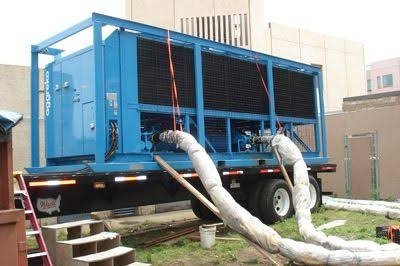
Construction projects often have cooling requirements before a permanent HVAC system is available, while a building is being renovated, or when existing cooling equipment cannot meet the conditions on site. A construction project may also have temporary offices, cabins, worker facilities, enclosed work areas, warehouses or partially completed buildings that need temperature control during different stages of the project.
This is where temporary cooling systems for construction sites are used.
Temporary cooling is not simply a matter of placing a portable air conditioner inside a building. Depending on the size of the project, site conditions and required temperature, rental chiller in UAE the solution can range from portable air conditioning and spot coolers to packaged air conditioners, air handling units and large air-cooled chillers connected to temporary ducting or chilled-water systems.
Industry sources describe temporary HVAC as particularly useful when permanent systems are unavailable, insufficient or temporarily out of service. Construction, refurbishment, infrastructure replacement, emergency cooling and temporary facilities are among the situations where mobile or temporary cooling equipment can be deployed.
For construction projects in the UAE, temporary cooling can be especially important because equipment selection has to account for high outdoor temperatures, solar heat gain, site dust, changing building conditions and the availability of electrical power.
This guide explains what temporary cooling systems are, how they work, which types are available, where they are used on construction sites and what should be considered before selecting a system.
What Are Temporary Cooling Systems for Construction Sites?
Temporary cooling systems are portable, mobile or modular HVAC systems used to provide cooling for a limited period or during a temporary phase of a project.
Unlike permanent HVAC installations, temporary systems can generally be delivered, positioned and commissioned for the period in which cooling is required. Once the construction phase, maintenance work, building transition or temporary requirement is finished, the equipment can be removed or relocated.
Temporary cooling equipment can include portable air conditioners, spot coolers, packaged air conditioners, air handling units, chillers, pumps, ducting and other supporting components. Advanced Cooling, for example, describes temporary cooling equipment as including portable air conditioners as well as water chillers and HVAC air handling units for larger applications.
The exact arrangement depends on the cooling requirement.
A small site office may only require a portable AC unit. A larger temporary facility could need packaged air conditioning with flexible ducting. A major construction project with a large enclosed area may require chillers, air handling units, pumps and a temporary distribution network.
The important point is that temporary cooling is a system designed around the application, rather than one particular type of air conditioner.
Why Do Construction Sites Need Temporary Cooling?
A construction site changes continuously.
At the beginning of a project, there may be temporary offices and accommodation cabins but little enclosed construction space. As the building progresses, larger areas become enclosed and may require cooling before the permanent HVAC system is commissioned.
At another stage, permanent HVAC equipment may be installed but not yet ready for operation. There can also be situations where part of an existing building needs to remain operational while another section is under construction or refurbishment.
Temporary HVAC systems can address these transitional requirements. ACHR News identifies construction and renovation, infrastructure replacement and failed chiller plants among common situations in which temporary air conditioning or cooling equipment may be required.
Construction sites may therefore require temporary cooling for:
- Site offices
- Construction cabins
- Worker welfare areas
- Temporary accommodation
- Enclosed work areas
- Warehouses
- Temporary buildings
- Commercial buildings under construction
- Renovation and refurbishment projects
- Commissioning areas
- Equipment rooms
- Large temporary structures
- Areas waiting for permanent HVAC commissioning
In the UAE, the requirement can become more demanding during periods of high ambient temperature. UAE cooling providers specifically list construction sites among applications for temporary chillers, air handling units, packaged AC systems and portable AC equipment.
How Do Temporary Cooling Systems Work?
The basic principle is similar to conventional air conditioning: heat is removed from an area and rejected somewhere else.
However, the way this is achieved depends on the equipment.
A portable air conditioner typically uses a refrigeration cycle to extract heat from indoor air. The cooled air is supplied back into the occupied area, while the heat removed from the space has to be discharged outside, commonly through ducting.
A larger temporary air conditioning system can use an outdoor unit connected to an indoor unit, while some systems use ducted arrangements to distribute cooled air to several areas.
For larger projects, a chiller can produce chilled water. Pumps circulate that chilled water through a temporary or existing distribution system, while air handling units use the chilled water to cool air before distributing it through ducts.
Dantherm identifies two common mobile AC arrangements: a ducted outdoor-unit concept and a split system consisting of indoor and outdoor units. The company also notes that selection depends on factors such as cooling capacity, installation space, ambient temperature, air exchange, controls and available power.
The basic process can therefore be understood as
The size and complexity of the system increase as the cooling requirement increases.
Main Types of Temporary Cooling Systems for Construction Sites
There is no single temporary cooling system suitable for every construction project. The appropriate equipment depends on the size of the area, heat load, occupancy, available power, ventilation requirements, site layout and duration of use.
Portable Air Conditioners
Portable AC units are suitable for smaller enclosed spaces where targeted cooling is required.
They can be useful for site offices, small cabins, temporary rooms and specific work areas. Because the units are relatively mobile, they can be repositioned when the site layout changes.
UAE rental providers list portable air conditioners for applications including construction-site cabins, offices, server rooms, tents and temporary facilities.
However, portable AC should not automatically be treated as the solution for an entire construction project. A large building or high-heat-load space may require a much larger system.
Spot Cooling Systems
Spot cooling focuses cooling directly on a particular area rather than attempting to condition an entire building.
This can be useful when only one section of a construction environment requires cooling or when the entire structure cannot yet be enclosed and conditioned efficiently.
Spot coolers are also useful where equipment or a particular work zone needs temperature control.
The advantage is that cooling can be directed toward the area that needs it most rather than conditioning unnecessary space.
Packaged Air Conditioners
Packaged air conditioning units provide higher-capacity cooling than many portable systems and can be used for larger temporary spaces.
They are commonly installed outside the occupied area and connected through flexible ducting to deliver conditioned air.
Al Shola lists packaged AC rental equipment for construction sites, warehouses, labour accommodation, tents and other temporary applications, with flexible ducting used for air distribution.
This arrangement can be particularly useful where a temporary structure needs centralized cooling but a permanent HVAC installation is not yet practical.
Air Handling Units
An Air Handling Unit (AHU) can be used when a project requires larger-scale air distribution.
An AHU can receive chilled water from a temporary chiller and use a heat exchanger to cool the air before distributing it through ductwork.
For larger temporary cooling systems, the AHU becomes an important part of the overall system because the chiller produces cooling while the AHU helps distribute that cooling to the required spaces.
UAE temporary cooling providers list AHUs for construction sites, commercial buildings, warehouses and industrial applications.
Air-Cooled Chillers
Air-cooled chillers are used when a project requires substantial cooling capacity.
An air-cooled chiller removes heat from chilled water through a refrigeration process and rejects the heat directly into surrounding air through condenser fans. The chilled water can then be circulated to AHUs or other cooling equipment.
Because an air-cooled chiller does not require a cooling tower for heat rejection, the overall temporary installation can be simpler than a water-cooled arrangement in applications where air-cooled equipment is appropriate.
Current UAE rental providers list air-cooled chillers for construction, commercial and industrial applications, including equipment designed for high-ambient conditions.
Water-Cooled Chillers
Water-cooled chillers use water as part of the heat-rejection process and normally require associated equipment such as cooling towers or another appropriate heat-rejection arrangement.
They can form part of larger temporary cooling installations, particularly where the project infrastructure and water availability make this arrangement appropriate.
Because water-cooled systems involve additional components and site requirements, the complete installation needs to be assessed rather than selecting the chiller based only on its cooling capacity.
Evaporative Coolers
Evaporative cooling works differently from refrigerated air conditioning.
Air passes over or through a wetted medium, allowing water evaporation to reduce the air temperature. Andrews Sykes notes that evaporative coolers can be suitable for smaller to medium areas and applications such as temporary offices, site cabins and outdoor areas, while their effectiveness depends on the environment.
For UAE construction projects, environmental conditions and humidity should be considered before selecting evaporative cooling. It is not interchangeable with refrigerated AC in every application.
Temporary Chiller and AHU Systems: How Do They Work Together?
For larger construction projects, a temporary cooling system can operate as a complete cooling plant rather than as individual portable air conditioners.
A typical arrangement may include:
Temporary chiller → chilled-water pumps → chilled-water piping or hoses → AHU → temporary ductwork → conditioned space
The chiller produces chilled water. Pumps move the water through the temporary distribution network. The AHU uses the chilled water to remove heat from the air, and the cooled air is then delivered to the required spaces through ductwork.
RSS describes temporary cooling systems that combine chillers, air handlers, pumps and associated equipment for large applications. Its published temporary cooling project also demonstrates how a large-scale temporary cooling plant can combine air-cooled chillers, AHUs, pumps and temporary power.
This type of system is fundamentally different from putting portable AC units into individual rooms. It is engineered as a coordinated HVAC installation.
Where Are Temporary Cooling Systems Used on Construction Sites?
Temporary cooling can support several phases of construction.
Site Offices
Construction management teams often work from temporary offices before the permanent building is completed.
Portable AC, packaged AC or other temporary systems can provide cooling for these enclosed spaces.
Worker Welfare Areas
Temporary welfare facilities need suitable environmental conditions for occupants. Depending on the structure and size, portable AC, packaged systems or larger temporary HVAC arrangements may be considered.
Construction Cabins
Cabins are frequently used for offices, meeting rooms, storage or other site functions. Their relatively defined spaces can make them suitable for localized temporary cooling.
Temporary Accommodation
Where construction projects include temporary accommodation or welfare facilities, the cooling requirement can extend across multiple rooms or buildings.
The appropriate equipment depends on occupancy, building construction, insulation, solar exposure and available power.
Large Enclosed Areas
As a construction project progresses, large sections of a building may become enclosed before the permanent HVAC system is fully commissioned.
A temporary chiller and AHU arrangement can provide cooling during this transitional period.
Renovation Projects
Temporary cooling can also be used when an existing HVAC system is being replaced or when sections of a facility must remain operational during renovation.
Temporary HVAC design literature identifies renovation and infrastructure replacement as established applications for temporary cooling systems.
Temporary Cooling During HVAC Installation or Replacement
One of the most important uses of temporary cooling is maintaining usable conditions while permanent HVAC equipment is unavailable.
For example, a construction or refurbishment project may involve removing an old chiller before the new system is commissioned.
If the building must remain operational during that period, a temporary cooling plant can bridge the gap.
The temporary system may be connected to the existing chilled-water distribution network, or a separate temporary distribution arrangement may be created depending on the project.
The engineering approach depends on the existing system, connection points, required cooling capacity and site conditions.
This is why temporary HVAC should be planned as part of the project rather than treated as an emergency purchase at the last moment.
How Do You Choose the Right Temporary Cooling System?
Choosing equipment based only on floor area can result in an unsuitable system.
A proper assessment should consider the actual cooling load and operating conditions.
Cooling Load
The cooling load is affected by more than the size of the room.
Important contributors can include outdoor conditions, solar radiation, building envelope, occupancy, lighting, equipment and air infiltration.
A construction environment can also have unusual heat loads compared with a finished building.
Ambient Temperature
The outdoor design condition matters because cooling equipment must operate against the actual environmental conditions.
Dantherm specifically identifies ambient operating temperature as one of the factors that should be considered when selecting mobile AC technology.
For UAE projects, high-ambient performance should therefore be checked rather than assuming that equipment designed for a different climate will deliver the expected capacity under local conditions.
Building Condition
An unfinished construction project can behave very differently from a completed building.
Open doors, temporary walls, missing glazing, poor insulation and construction openings can increase heat gain and air infiltration.
As the building envelope changes, the cooling requirement can also change.
Occupancy
People generate heat, so the number of workers or occupants in a cooled area forms part of the cooling-load assessment.
A temporary office with several occupants can require different cooling than an empty storage area of the same size.
Equipment and Internal Heat
Construction equipment, electrical equipment, lighting and other heat-producing sources can add to the cooling requirement.
The system should therefore be sized based on the actual conditions expected during operation.
Air Exchange and Ventilation
Ventilation requirements can have a significant impact on cooling demand.
Dantherm identifies air exchange requirements as an important consideration when choosing mobile air-conditioning technology.
If hot outdoor air continually enters a space, the cooling system has to remove that additional heat.
Available Electrical Power
A temporary cooling system requires a suitable power supply.
The available electrical capacity should be checked before equipment is selected.
If the construction site does not have sufficient electrical capacity, the project may need additional temporary power generation or another suitable power arrangement.
This is particularly important for larger chillers, pumps and AHUs.
Space for Equipment
The site needs enough space for the cooling equipment, access, ductwork, hoses, electrical connections and maintenance.
Outdoor equipment also needs appropriate positioning so that rejected heat does not simply return into the building or interfere with other site activities.
What Factors Affect Temporary Cooling Performance?
The rated capacity of equipment is only one part of the equation.
Actual performance can be influenced by:
- Outdoor temperature
- Humidity
- Solar exposure
- Building insulation
- Air leakage
- Number of occupants
- Internal heat sources
- Ventilation requirements
- Equipment positioning
- Duct length and configuration
- Available power
- Maintenance condition
- Required indoor temperature
- Operating hours
A temporary system should therefore be selected based on the complete application rather than simply matching a machine’s advertised capacity to the approximate building area.
Temporary Cooling for the UAE’s Construction Environment
The UAE presents specific challenges for temporary cooling.
Construction projects may operate through periods of very high outdoor temperatures, while unfinished structures can have substantial solar exposure and air leakage.
The regional rental market consequently includes equipment designed for construction, industrial facilities, warehouses, tents and other demanding temporary applications. UAE suppliers currently list combinations of high-ambient chillers, AHUs, packaged AC and portable AC equipment for these environments.
Daikin’s UAE announcement concerning its partnership with Al Shola also identifies growing demand for temporary cooling in areas including construction, infrastructure, energy, healthcare and large events across the Gulf region.
For a UAE construction project, the equipment specification should therefore take local operating conditions into account instead of relying solely on a generic temporary AC specification.
Temporary Cooling vs Permanent HVAC
Temporary cooling and permanent HVAC serve different project requirements.
A permanent HVAC system is designed as part of the building’s long-term mechanical infrastructure. It may include fixed chillers, pumps, AHUs, ductwork, controls and other permanently installed components.
A temporary system is intended to provide cooling during a limited project period or while permanent equipment is unavailable.
Temporary cooling can therefore be useful when:
- The permanent HVAC system has not yet been commissioned.
- A building is undergoing renovation.
- Existing cooling equipment is being replaced.
- Additional cooling is required temporarily.
- A project needs cooling before permanent infrastructure is ready.
- An emergency cooling requirement develops.
Temporary HVAC design guidance specifically discusses temporary systems during construction, renovation, chiller replacement and equipment failure.
What Are the Benefits of Temporary Cooling for Construction Projects?
The primary benefit is flexibility.
Construction projects rarely remain static. Cooling requirements can change as new areas are enclosed, temporary facilities are moved or project phases are completed.
Temporary systems can be adapted to these changing requirements.
Another advantage is speed. Rental cooling equipment can be mobilized without waiting for a permanent HVAC installation to be designed and constructed from the beginning.
Temporary cooling can also reduce the impact of HVAC replacement or construction delays by providing an interim cooling arrangement.
For larger projects, systems can be scaled through combinations of chillers and air handling equipment. UAE rental providers describe temporary cooling packages ranging from portable equipment to large chiller and AHU systems.
Is Temporary Cooling Suitable for Short-Term and Long-Term Projects?
Yes. Temporary cooling is not limited to projects lasting only a few days.
The rental market includes solutions for short emergency requirements as well as longer construction and infrastructure projects.
RSS states that its temporary cooling services can be supplied for periods ranging from several days to several years, demonstrating that temporary equipment can support both short-duration and extended project requirements.
The important consideration is whether the equipment and system design remain appropriate for the duration and operating conditions of the project.
How Is Temporary Cooling Installed on a Construction Site?
Installation depends on the equipment.
A small portable AC unit may require positioning, electrical connection and suitable heat exhaust arrangements.
A larger packaged system may require outdoor positioning, electrical connection and flexible ducting.
A temporary chiller system is more involved. It may require:
Chiller placement → electrical connection → pumps → chilled-water hoses or pipework → AHUs → ductwork → controls → testing and commissioning
The installation team must also consider safe access, equipment clearances, cable routing, hose routing and protection from construction activity.
For large systems, commissioning should confirm that chilled-water flow, air distribution, controls and cooling performance are functioning as intended.
Why Power Supply Matters
Cooling equipment cannot operate effectively without a suitable power source.
The electrical requirement depends on the type and capacity of equipment.
A small portable AC may have a relatively straightforward electrical requirement, while a large temporary chiller plant can require substantial electrical capacity for compressors, pumps, fans and associated equipment.
Where site power is insufficient, temporary generators may be considered as part of the overall temporary infrastructure.
This is one reason temporary cooling projects should be assessed as complete systems rather than treating the cooling machine as an isolated item.
Temporary Cooling and Construction Site Safety
Cooling is also connected to the working environment.
Construction sites can expose workers to significant heat, particularly during periods of high outdoor temperature. Maintaining appropriate conditions in enclosed site facilities and cooled work areas can help create a more usable working environment.
Herc Rentals describes jobsite air conditioning as important for maintaining safe and productive working conditions in hot environments.
However, cooling equipment does not replace a complete heat-management program. Construction companies still need to follow applicable workplace safety requirements, provide appropriate rest arrangements and manage work according to local requirements and site conditions.
Common Mistakes When Selecting Temporary Cooling
One common mistake is choosing equipment only by room size.
A second is ignoring the outdoor design temperature. A system that appears adequate under mild conditions may not deliver the expected performance during severe heat.
Another mistake is overlooking ventilation and air leakage. If a large amount of hot outdoor air enters a space, the cooling load increases.
Insufficient electrical capacity is another practical problem.
Construction teams can also underestimate the importance of equipment placement. A poorly positioned condenser or temporary cooling unit can have difficulty rejecting heat effectively.
Finally, selecting equipment before understanding how the building will actually be used can result in an inefficient or inadequate system.
What Information Should You Give a Temporary Cooling Provider?
Before requesting a temporary cooling system, it is useful to provide as much project information as possible.
Important information includes:
- Location of the project
- Type of construction facility
- Area requiring cooling
- Ceiling height
- Number of occupants
- Expected operating hours
- Required indoor conditions
- Construction stage
- Existing HVAC arrangement
- Available electrical supply
- Cooling start date
- Expected rental duration
- Access restrictions
- Available equipment space
- Ducting requirements
- Whether cooling is required for one area or the entire facility
This information helps the cooling provider determine whether portable AC, spot cooling, packaged AC, AHUs, chillers or a combination of equipment is appropriate.
Temporary Cooling Systems for Construction: A Practical Example
Consider a commercial building under construction in the UAE.
The permanent chiller plant has not yet been commissioned, but several internal areas have already been enclosed. Construction management offices and worker welfare facilities also need cooling.
A small portable system could serve individual offices, while a larger temporary HVAC arrangement could serve a substantial enclosed floor.
If the required cooling load is large, a temporary air-cooled chiller could supply chilled water to AHUs. The AHUs would distribute conditioned air through temporary ductwork.
As construction progresses, additional areas may become enclosed and the cooling arrangement could be modified or expanded.
Once the permanent HVAC system is commissioned and tested, the temporary equipment can be removed.
This illustrates why temporary cooling is particularly useful during transitional stages of construction: the cooling system can exist only for as long as the project needs it.
Frequently Asked Questions
What is a temporary cooling system?
A temporary cooling system is portable, mobile or modular HVAC equipment used to provide cooling for a limited period or during a transitional project phase. It can include portable AC units, spot coolers, packaged AC, AHUs and temporary chillers.
What is the best temporary cooling system for a construction site?
There is no single system that is suitable for every construction site. The appropriate equipment depends on cooling load, area, outdoor conditions, building condition, occupancy, power availability and project duration.
Can portable AC units cool a construction site?
Portable AC units can be suitable for smaller enclosed areas such as site offices and cabins. Larger construction areas may require packaged systems, AHUs, chillers or a combination of equipment.
Can temporary chillers be used on construction sites?
Yes. Temporary chillers can provide cooling for larger areas and can supply chilled water to AHUs or other compatible cooling equipment. UAE cooling providers specifically list construction sites among applications for temporary chiller systems.
How does a temporary chiller work?
A temporary chiller uses a refrigeration cycle to remove heat from chilled water. The chilled water is circulated to cooling equipment such as AHUs, where heat is removed from the air before the conditioned air is distributed to the required area.
Can temporary cooling be used before permanent HVAC is installed?
Yes. This is one of the main applications of temporary HVAC during construction. Temporary cooling can bridge the period between the start of occupancy or construction activities and commissioning of the permanent HVAC system.
Can temporary cooling be used during chiller replacement?
Yes. Temporary cooling systems can provide an interim source of cooling while an existing chiller is being replaced or rebuilt. Temporary HVAC design guidance specifically identifies infrastructure replacement and chiller replacement as applications.
How long can a temporary cooling system be used?
The duration can range from a short emergency period to an extended construction project. Rental providers offer temporary cooling for both short-term and long-term requirements.
Does temporary cooling require a generator?
Not necessarily. The requirement depends on the available site electrical supply and the power demand of the cooling equipment. If existing electrical capacity is insufficient, an appropriate temporary power arrangement may be needed.
Is temporary cooling suitable for UAE construction sites?
Yes, provided the equipment is correctly selected for the project’s cooling load and local operating conditions. UAE providers offer temporary cooling equipment specifically for construction and other demanding applications, including chillers, AHUs, packaged AC and portable AC.
Final Thoughts
Temporary cooling systems for construction sites provide a practical way to maintain suitable temperature conditions when permanent HVAC is unavailable, incomplete, under replacement or unable to meet temporary demand.
The technology can range from portable air conditioners and spot coolers to packaged AC systems, air handling units and large temporary chiller plants. The right choice depends on the actual cooling load, outdoor conditions, building condition, occupancy, ventilation, power supply and project duration.
For smaller enclosed spaces, portable or spot cooling may be sufficient. Larger construction facilities can require engineered systems combining chillers, pumps, AHUs and temporary ductwork.
In the UAE, selecting equipment for high-ambient operating conditions is particularly important. Rather than choosing a cooling unit based solely on floor area or advertised capacity, construction teams should assess the complete application and determine how the cooling system will operate throughout the relevant phase of the project.
When properly planned, temporary cooling can provide the bridge between construction progress and permanent HVAC commissioning while helping construction facilities remain usable during demanding project conditions.