

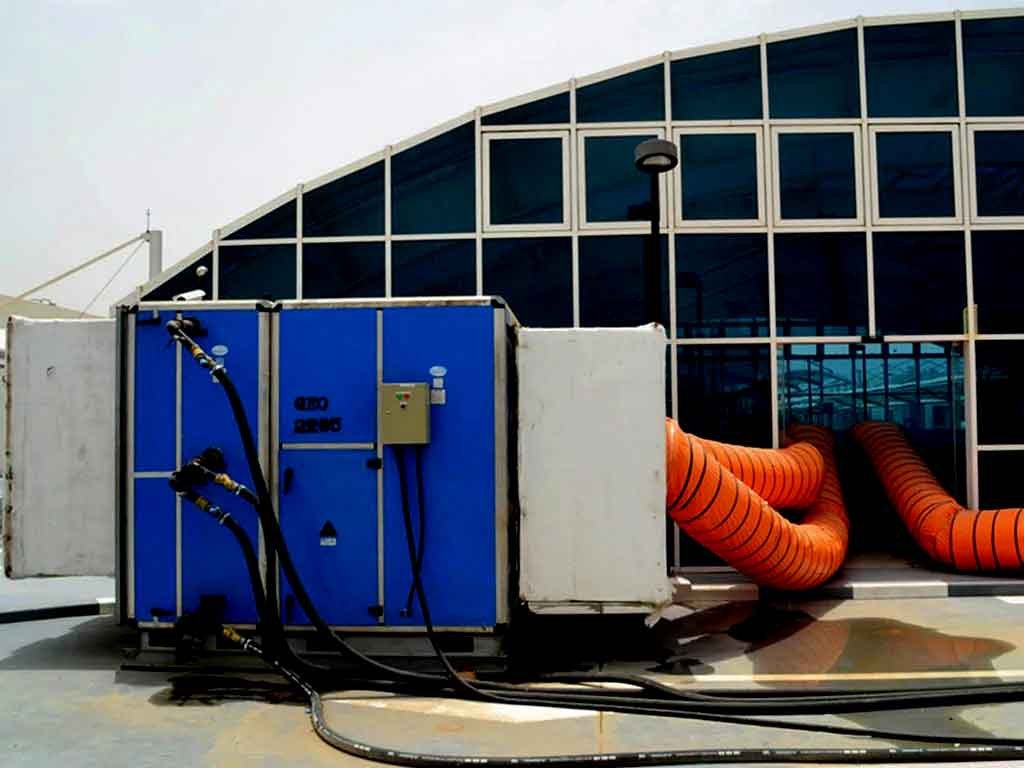
Choosing the right rental chiller in the UAE is not simply a matter of selecting the largest available cooling capacity or comparing rental prices. A temporary cooling system must match the actual cooling load, chilled-water requirements, site conditions, available electrical infrastructure, operating schedule, and project duration.
This is particularly important in the UAE, where cooling is a major part of building and industrial energy consumption. Dubai’s Regulatory and Supervisory Bureau states that cooling represents almost half of the emirate’s total electricity demand, highlighting how important efficient and reliable cooling systems are for businesses and facilities.
Whether the requirement is for a commercial building, construction project, industrial facility, data centre, event, hotel, warehouse, or emergency replacement, selecting the appropriate rental chiller can help maintain stable temperatures while avoiding unnecessary equipment and operating costs.
Understand Your Cooling Requirement First
The first step in selecting a rental chiller is determining how much cooling the application actually requires. Chiller capacity is commonly expressed in refrigeration tons (TR), kilowatts (kW), or BTU/h.
The required capacity depends on several factors, including the size and type of the facility, indoor temperature requirements, occupancy, equipment loads, outdoor conditions, operating hours, heat generated by machinery, ventilation requirements, and the characteristics of the existing chilled-water system.
ASHRAE identifies accurate cooling-load calculation as one of the most important factors in chiller selection. It specifically cautions against simply adding a large percentage to an estimated load because oversized chillers can increase equipment costs and may operate inefficiently at low loads.
For a rental project, the supplier should therefore assess the actual application rather than recommending capacity based only on the building’s floor area.
Calculate the Required Chiller Capacity
Once the cooling load has been established, the next step is selecting the appropriate chiller capacity.
For example, a project may require a temporary cooling system capable of handling a 500-ton load. The rental provider may recommend one 500 TR chiller, multiple smaller chillers, or additional standby capacity depending on the project’s operating requirements and redundancy needs.
Using several chillers can sometimes provide greater flexibility. Multiple units can be staged according to demand, allowing the system to operate more efficiently when the cooling requirement changes throughout the day.
ASHRAE guidance also emphasizes that cooling plants should be evaluated according to both peak loads and load patterns over time rather than considering only the maximum load.
For critical facilities, redundancy can be particularly important. A backup chiller or additional capacity can help reduce the impact of a mechanical failure or unexpected increase in cooling demand.
Choose Between Air-Cooled and Water-Cooled Chillers
The choice between an air-cooled and water-cooled rental chiller depends heavily on the project and site conditions.
Air-cooled chillers reject heat directly to the outdoor air through condenser coils and fans. They generally require less auxiliary equipment and can be easier to deploy where cooling-tower infrastructure or condenser-water systems are unavailable.
Water-cooled chillers reject heat through condenser water and normally operate with cooling towers or another heat-rejection arrangement. They can be suitable for larger installations where the required infrastructure, water supply and maintenance arrangements are available.
The correct option therefore depends on more than rated capacity. Site access, available space, water availability, electrical supply, ambient conditions, noise requirements, installation arrangements and project duration should all be evaluated before selecting the equipment.
Check the Chilled-Water Supply and Return Temperatures
Cooling capacity alone does not tell you whether a rental chiller will work with an existing HVAC system.
The supplier needs to understand the required chilled-water supply temperature and return temperature. Conventional chilled-water systems commonly operate with supply temperatures around 5–7°C, although actual requirements vary according to the application and system design.
The temperature difference, or Delta T, between supply and return water is also important because it affects chilled-water flow and pumping requirements.
For example, a temporary chiller connected to an existing air-handling system should be selected according to the system’s actual design conditions rather than assuming that every HVAC system operates at the same chilled-water temperature.
Providing the rental company with existing system drawings, equipment schedules, flow requirements and operating temperatures can make the selection process considerably more accurate.
Consider UAE Ambient Conditions
A rental chiller operating in the UAE must be capable of performing under demanding outdoor conditions.
High ambient temperatures increase the challenge faced by refrigeration equipment, particularly during summer. The selected chiller should therefore have performance data appropriate to the expected site conditions.
ASHRAE’s chiller-selection guidance highlights the importance of evaluating equipment performance under both full-load and part-load conditions and considering the entering condenser-water or outdoor conditions applicable to the climate and application.
This is one reason why a chiller that appears suitable based on its nominal capacity may not necessarily deliver the expected performance at the actual project site.
A professional rental supplier should provide capacity and operating information based on the conditions under which the equipment will actually operate.
Compare Efficiency, Not Just Rental Price
A low daily or monthly rental rate does not necessarily mean that a chiller is the most economical option.
Energy consumption can represent a substantial portion of the total cost of operating temporary cooling equipment. A slightly more expensive chiller with better operating efficiency may cost less overall if it consumes significantly less electricity throughout the rental period.
Efficiency should therefore be evaluated alongside rental price, expected operating hours, electrical consumption, maintenance requirements and installation costs.
ASHRAE recommends considering life-cycle costs when selecting chilled-water equipment rather than looking only at the initial equipment cost.
For larger projects, ask the rental provider for available efficiency data at the expected operating conditions rather than relying only on a nominal efficiency figure.
Check Part-Load Performance
Many temporary cooling applications do not operate at maximum capacity all day.
A commercial building may have different cooling requirements during occupied and unoccupied periods. Industrial processes can also experience changing production loads. Events may require high cooling capacity for only certain hours.
This makes part-load performance important when choosing rental equipment.
ASHRAE notes that some chillers perform differently at peak and off-peak conditions, making an accurate load profile important when selecting equipment.
A rental system that can efficiently adjust its capacity to changing demand may therefore be more economical than a substantially oversized unit operating continuously at low load.
Evaluate Electrical Requirements
Before bringing a rental chiller to site, confirm that the electrical infrastructure can support it.
The rental provider should identify the required voltage, phase, frequency, starting characteristics and connected electrical load. The project team should also confirm whether sufficient electrical capacity is available from the building, temporary power system or generator.
If a rental generator will also be required, the chiller’s electrical characteristics should be considered when sizing the generator. Starting and operating loads should be coordinated rather than treating the chiller and generator as completely separate requirements.
This is especially important for temporary installations where the available electrical infrastructure may be more limited than that of a permanent HVAC plant.
Consider the Available Space and Site Access
A technically suitable chiller still needs to be physically installable at the project site.
Before selecting the equipment, check the available area, access route, lifting requirements, ground conditions, ventilation clearance and distance between the chiller and the point of connection.
For larger units, transportation and crane requirements can influence the overall project cost. Equipment dimensions and weight should therefore be confirmed before the rental agreement is finalized.
The supplier should also determine how chilled-water hoses or temporary pipework will be routed and whether additional pumps, headers, valves, strainers or other accessories are required.
Check Noise and Environmental Conditions
Noise can become an important consideration when temporary chillers are installed close to offices, hotels, residential buildings, hospitals or public areas.
Air-cooled chillers contain condenser fans that generate operational noise. Depending on the application, the installation may require careful positioning or additional noise-control measures.
Environmental conditions should also be considered. Dust, humidity, high ambient temperatures and exposure to outdoor conditions can affect equipment operation and maintenance requirements.
The rental provider should explain the equipment’s operating limitations and recommended maintenance arrangements for the site environment.
Look Beyond the Chiller Itself
A temporary cooling system is normally more than a chiller.
Depending on the project, the complete package may include chilled-water pumps, temporary pipework or hoses, valves, flexible connections, control equipment, electrical distribution, cooling towers for water-cooled systems, heat exchangers, buffer tanks and monitoring equipment.
For this reason, it is important to clarify whether the rental quotation covers only the chiller or the complete temporary cooling solution.
A lower equipment price can become considerably more expensive if essential accessories, transportation, installation, commissioning or removal are charged separately.
Ask About Installation and Commissioning
Professional installation is an important part of a temporary cooling project.
The rental provider should have a clear process for equipment delivery, positioning, connection, pressure testing, electrical checks, flushing where applicable, commissioning and performance verification.
Commissioning helps confirm that the system is operating according to the agreed requirements before it is placed into normal service.
ASHRAE identifies commissioning as an important part of ensuring that chilled-water plants meet their intended design performance.
For a temporary system supporting critical operations, commissioning should not be treated as an optional extra.
Consider Maintenance and Technical Support
A rental chiller can be required to operate continuously for weeks or months, so technical support should be considered before signing the rental agreement.
Ask the supplier about preventive maintenance, emergency response, technician availability, replacement parts and monitoring.
A supplier that can provide rapid technical assistance can be particularly valuable for facilities where loss of cooling could interrupt production, affect sensitive equipment or create uncomfortable conditions for occupants.
The service agreement should clearly explain who is responsible for routine maintenance, troubleshooting, repairs and emergency call-outs.
Check Whether You Need a Backup Chiller
Not every project requires standby capacity, but critical applications may justify it.
For example, data centres, healthcare facilities, industrial processes and certain commercial operations may have little tolerance for cooling interruptions.
The appropriate redundancy strategy depends on the consequences of losing cooling, the criticality of the application and the time required to repair or replace equipment.
A rental provider can evaluate whether a second chiller, additional modular capacity or another backup arrangement is appropriate for the project.
Understand the Rental Contract
Before accepting a quotation, review the commercial terms carefully.
The agreement should clearly identify the rental period, equipment capacity, operating conditions, delivery arrangements, installation responsibilities, commissioning, maintenance, transportation, removal, payment terms and any additional charges.
It is also worth confirming what happens if the project period is extended or the required cooling capacity changes.
For long-term projects, a flexible rental arrangement can be useful because cooling requirements may change as construction progresses or occupancy increases.
Verify Local Requirements and Project Approvals
Temporary cooling installations can involve electrical, mechanical, construction-site and other project-specific requirements.
The applicable requirements depend on the emirate, project type, site and installation arrangement. Dubai, for example, has a Building Code intended to establish minimum requirements for building design, health and safety, environmental considerations and sustainable development.
District cooling is separately regulated in Dubai, with the Regulatory and Supervisory Bureau requiring relevant operators to obtain permits and comply with applicable technical and regulatory requirements.
A rental chiller installed as part of a temporary project should therefore be assessed against the requirements applicable to that specific installation rather than assuming that one set of requirements applies to every UAE project.
Questions to Ask a Rental Chiller Supplier
Before choosing a supplier, ask for clear answers to several practical questions.
What is the actual cooling capacity of the proposed equipment under the project’s expected operating conditions?
What chilled-water supply and return temperatures does it require?
Is the quoted capacity available at the expected UAE ambient conditions?
Is the equipment air-cooled or water-cooled?
What electrical supply is required?
Are pumps, hoses, pipework and controls included?
Does the quotation include delivery, installation and commissioning?
Who provides maintenance and emergency support?
What is the expected energy consumption? Is standby capacity available if required?
What happens if the rental period needs to be extended?
A professional supplier should be able to answer these questions with technical information rather than relying only on a basic price quotation.
Common Mistakes When Renting a Chiller in the UAE
One of the most common mistakes is choosing a chiller solely on its tonnage. Capacity must be evaluated together with operating temperatures, ambient conditions, flow requirements and the characteristics of the existing HVAC system.
Another mistake is selecting the cheapest rental quotation without calculating the complete project cost. Transportation, installation, electrical work, pumps, pipework, commissioning, energy consumption and maintenance can significantly affect the final cost.
Oversizing can also create unnecessary expense. ASHRAE specifically notes that excessive capacity can increase costs and reduce efficiency, particularly when equipment operates at low loads.
Finally, failing to plan for technical support can create problems when equipment operates continuously under demanding conditions. A rental agreement should provide a clear maintenance and emergency-support arrangement.
How to Choose the Right Rental Chiller in UAE
The right rental chiller should be selected through a technical assessment rather than by price or nominal capacity alone.
Start by establishing the actual cooling load and required operating temperatures. Then evaluate air-cooled versus water-cooled equipment, ambient operating conditions, part-load performance, efficiency, electrical requirements, site access and available infrastructure. Review the complete temporary cooling package, including pumps, pipework, controls and installation requirements.
Finally, compare suppliers based on equipment suitability, technical support, commissioning, maintenance and total operating cost.
For commercial and industrial projects in the UAE, this approach can help ensure that the temporary cooling system provides the required performance without paying for unnecessary capacity or infrastructure.
Conclusion
Choosing a rental chiller in the UAE requires more than finding a machine with the required number of tons. The correct solution must match the project’s cooling load, chilled-water temperatures, operating profile, ambient conditions, electrical infrastructure and site limitations.
Efficiency and part-load performance should be considered alongside the rental price, while installation, commissioning, maintenance and emergency support should be included in the overall evaluation.
For projects where cooling reliability is critical, working with an experienced rental provider that can assess the complete application is often the safest approach. A properly selected and commissioned temporary chiller can provide dependable cooling during construction, equipment replacement, seasonal demand, planned maintenance, emergencies and other situations where permanent cooling capacity is unavailable or insufficient.