

Cooling is not simply a comfort requirement in the UAE. For many commercial and industrial businesses, reliable cooling is closely connected to productivity, equipment protection, production continuity and day-to-day operations.
The scale of cooling demand in the country reflects this reality. The Abu Dhabi Department of Energy reported in July 2026 that air-conditioning systems account for around 60–70% of electricity consumption in UAE buildings. Dubai’s Regulation and Supervision Bureau similarly describes cooling as essential to life in the emirate and says it represents almost half of Dubai’s total electricity demand.
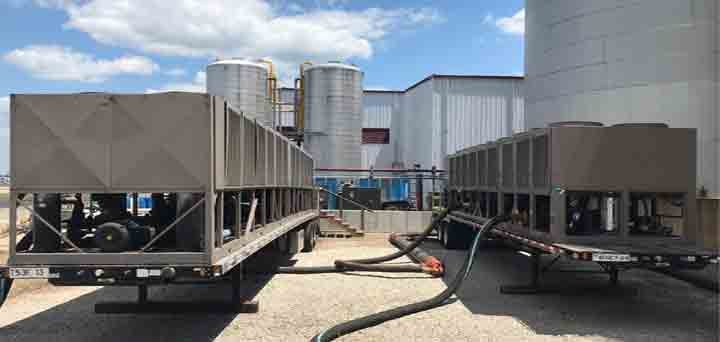
This is one reason businesses increasingly consider rental chillers in the UAE when they need temporary, additional or emergency cooling capacity. Instead of purchasing a permanent chiller for every situation, a company can bring in suitable equipment for the period it actually needs it.
But the decision is not only about avoiding equipment purchases. Chiller rental can help businesses respond to changing cooling loads, planned maintenance, unexpected breakdowns, construction schedules and short-term projects.
What Is a Rental Chiller?
A rental chiller is a temporary chilled-water cooling system supplied for a defined period. Depending on the application, a rental package can include chillers together with pumps, air handling units, cooling equipment, hoses or pipework, controls and other supporting equipment.
The exact configuration depends on the required cooling capacity and the customer’s existing HVAC system.
For some projects, the rental chiller operates alongside the permanent cooling system to provide additional capacity. In other cases, it can temporarily replace a failed or unavailable chiller.
The growing availability of professional rental solutions in the UAE also shows that temporary cooling has become a recognised part of the HVAC market. In May 2025, Daikin announced a UAE partnership focused on scalable rental cooling solutions, citing increasing demand connected with large events, infrastructure developments, construction, energy, healthcare and cultural projects.
1. Businesses Can Handle Unexpected Chiller Failures
A chiller failure can create a serious operational problem, particularly during periods of high cooling demand.
Replacing a failed permanent chiller may take time because the business might need to diagnose the fault, source replacement parts, arrange repairs or wait for a new machine. Meanwhile, the building or process still requires cooling.
A rental chiller can act as a temporary bridge.
Instead of allowing the cooling failure to interrupt operations for an extended period, businesses can install temporary capacity while their permanent equipment is repaired or replaced.
This can be particularly important for facilities where temperature control is directly connected to business operations rather than merely occupant comfort.
2. Rental Chillers Avoid Large Upfront Equipment Costs
Purchasing an industrial or commercial chiller represents a significant capital investment. The equipment itself is only part of the overall cost. Installation, pumps, electrical work, pipework, controls, commissioning and ongoing maintenance can also contribute to the project budget.
Rental changes the financial structure.
A business pays for access to cooling equipment for the period required rather than purchasing an asset that may have limited use after a particular project ends.
This can make rental particularly attractive for companies facing short-term requirements, temporary facilities or seasonal increases in cooling demand.
However, rental is not automatically cheaper than ownership in every situation. A facility requiring the same cooling capacity continuously for many years may find permanent equipment more appropriate. The financial decision should therefore consider the expected duration of use, installation costs, maintenance and the value of flexibility.
3. It Provides Extra Capacity During Peak Demand
A permanent cooling system is normally designed around expected building or process requirements. But actual cooling demand can change.
A business may expand an operation, increase occupancy, add heat-generating equipment or temporarily use additional space. In such situations, the existing chiller plant may not provide enough capacity.
Rather than immediately investing in a larger permanent system, a company can use rental equipment to cover the additional requirement.
This approach is particularly useful when the increase in demand is temporary or when the company wants to evaluate its future cooling requirements before making a major capital investment.
The importance of appropriate cooling capacity is also reflected in Abu Dhabi’s new Cooling Load Manual. The Department of Energy says HVAC systems in buildings are often oversized and that proper cooling-load calculations can improve energy and cost performance.
For businesses, this reinforces an important principle: the goal is not simply to install the biggest chiller available. The cooling system should be matched to the actual load.
4. Rental Chillers Support Planned Maintenance
Maintenance is unavoidable for large cooling systems.
A facility may need to shut down a chiller for inspection, servicing, cleaning, repairs or other planned work. In a building that depends heavily on chilled water, taking one machine offline can reduce available cooling capacity.
A temporary rental chiller can maintain cooling while the permanent equipment is being serviced.
This allows maintenance teams to work on the existing system without necessarily forcing the entire facility to operate without adequate cooling.
For businesses, that can make planned maintenance easier to schedule because the temporary system provides an additional layer of operational flexibility.
5. They Are Useful During Construction and Commissioning
Construction and development projects often have changing cooling requirements.
A completed building may eventually receive a permanent central cooling system, but temporary cooling can still be required during construction, fit-out, testing or commissioning.
Contractors may need cooling for temporary occupied areas, site facilities, equipment testing or sections of a building that are ready for use before the complete permanent HVAC system becomes operational.
A rental chiller provides a way to meet these temporary requirements without installing a permanent plant too early.
The UAE’s construction and infrastructure activity is one of the factors cited by industry participants as contributing to demand for temporary cooling solutions.
6. Businesses Can Scale Cooling More Easily
One of the biggest advantages of rental equipment is flexibility.
Suppose a company initially needs a moderate amount of cooling but expects its requirement to increase during a particular stage of a project. A rental solution can potentially be configured around the required capacity rather than forcing the business to make a permanent investment based on the highest temporary demand.
This is valuable for businesses working on projects with changing schedules and workloads.
It can also be useful for temporary facilities, exhibitions and major events where cooling requirements exist for only a limited period.
7. Rental Cooling Supports Events and Temporary Venues
The UAE hosts large-scale exhibitions, conferences, cultural activities and other events throughout the year.
Temporary venues can have substantial cooling requirements, particularly when large numbers of people occupy enclosed spaces.
A rental cooling system can be deployed for the duration of the event and removed afterwards. This avoids the need for event organisers to purchase permanent cooling equipment for a venue that may only exist for days or weeks.
Daikin’s 2025 announcement specifically identified large-scale events and cultural events among the sectors contributing to rising demand for temporary cooling solutions in the Gulf.
8. Industrial Facilities Can Use Rental Chillers During Shutdowns and Upgrades
Industrial cooling requirements can be more complex than ordinary building air conditioning.
Manufacturing processes, production equipment and temperature-sensitive operations may require controlled cooling. When a cooling plant is being upgraded, repaired or temporarily taken offline, the facility may need an alternative source of chilled water.
Rental chillers can provide temporary capacity during these periods.
They can also be considered when a plant is undergoing expansion and the permanent cooling infrastructure has not yet been completed.
The precise chiller type and configuration depend on the process, required temperatures, flow rates, operating conditions and available connection points, so industrial applications require proper engineering assessment rather than simply selecting a machine based on nominal tonnage.
9. Rental Can Reduce the Pressure of Long Equipment Lead Times
Large HVAC equipment is not always immediately available when a business needs it.
A permanent chiller replacement may involve equipment selection, manufacturing or procurement, transportation, installation and commissioning. If a critical unit fails unexpectedly, waiting for a permanent replacement can leave the facility exposed to prolonged cooling problems.
A temporary rental unit can help bridge that period.
It does not replace the need to select and install the correct permanent system, but it can give the business more time to complete the permanent solution without leaving the facility completely dependent on its damaged equipment.
10. Professional Rental Services Can Include More Than Equipment
Businesses should not view chiller rental simply as hiring a machine.
A properly planned temporary cooling project can involve site assessment, cooling-load calculations, equipment selection, delivery, positioning, connections, commissioning, monitoring, maintenance and eventual removal.
This is particularly important for large systems because the chiller’s performance depends on how the complete temporary installation is configured.
Professional rental providers may therefore offer an end-to-end service rather than simply delivering a chiller to the site. Daikin’s 2025 UAE rental-cooling partnership, for example, described a model covering equipment supply, on-site installation and ongoing maintenance.
Air-Cooled or Water-Cooled Rental Chiller?
The right type of rental chiller depends on the site and application.
Air-cooled chillers reject heat directly to the surrounding air and can be useful where water availability or cooling-tower infrastructure is limited. They can be particularly convenient for temporary installations because they can reduce the amount of supporting cooling-tower equipment required.
Water-cooled chillers can be appropriate for larger installations where suitable condenser-water infrastructure, cooling towers and water management systems are available.
Neither option is automatically better for every UAE project. The choice depends on the required capacity, ambient conditions, available space, water availability, electrical supply, connection arrangements and project duration.
A competent rental provider should evaluate these factors before recommending the equipment.
How Long Can a Business Rent a Chiller?
Rental periods can vary significantly.
Some businesses need cooling for only a few days during an event or emergency. Others may require equipment for several weeks or months while a construction project, plant upgrade or permanent HVAC replacement is completed.
Longer rental periods can also make sense when a business needs temporary cooling while deciding on a permanent capital investment.
The important point is to select the rental duration according to the actual project requirement rather than assuming that every rental arrangement is short term.
What Should Businesses Check Before Renting?
Choosing a rental chiller should involve more than comparing daily or monthly prices.
Start by determining the required cooling capacity. The supplier should understand the actual cooling load rather than selecting a unit solely from the building’s approximate size.
Next, check the chilled-water supply and return temperatures, required flow rate, available electrical supply and connection points.
The physical site also matters. There must be adequate space for the equipment, safe access for delivery and suitable arrangements for hoses, pipes, cables and other connections.
Businesses should also clarify what the quotation includes. Ask whether delivery, installation, commissioning, standby support, maintenance, breakdown response and removal are included.
Finally, establish who is responsible for operating the equipment and what response time applies if the rental system develops a fault.
Don’t Choose a Rental Chiller Based Only on Price
A cheap rental quotation can become expensive if the equipment is incorrectly sized or if important services are excluded.
For example, a low equipment price may not include transportation, installation, additional pumps, pipework or emergency support.
Businesses should therefore compare complete rental proposals rather than individual equipment prices.
A good quotation should make the cooling capacity, rental period, equipment configuration, installation scope and support arrangements clear.
Rental Chillers and Energy Efficiency
Cooling has a major impact on energy consumption in the UAE. The UAE Government’s Energy Strategy 2050 includes improving energy efficiency as one of its central objectives, while Abu Dhabi’s Department of Energy is actively promoting better cooling-load calculations and more efficient building cooling systems.
This makes equipment selection important even when the chiller is temporary.
A rental unit that is appropriately sized and properly maintained can be preferable to operating an unsuitable or heavily overloaded system. Businesses should ask suppliers about equipment efficiency, operating conditions and maintenance practices rather than treating energy performance as irrelevant simply because the equipment is rented.
When Is Chiller Rental the Right Choice?
Chiller rental can make particular sense when a business:
Needs emergency cooling after a chiller breakdown.
Requires temporary cooling during planned maintenance.
Needs additional capacity during a peak-demand period.
Is waiting for permanent HVAC equipment to arrive or be commissioned.
Is completing a construction or building project.
Requires cooling for an event or temporary facility.
Is expanding an industrial operation and needs interim cooling.
Needs a temporary solution during a plant shutdown or upgrade.
Has a seasonal or short-term cooling requirement.
For a permanent, predictable cooling requirement over many years, purchasing or installing a permanent cooling system may be more appropriate. Rental is most valuable when flexibility, speed and temporary capacity are important.
Final Thoughts
Businesses rent chillers in the UAE for a simple reason: cooling requirements do not always remain fixed.
A permanent HVAC system may be perfectly adequate under normal conditions but become unavailable during maintenance, insufficient during expansion or unsuitable for a temporary project. A rental chiller gives businesses another option when they need reliable cooling without committing immediately to permanent equipment.
The UAE’s exceptionally high cooling demand makes reliability particularly important. Government sources report that air conditioning represents a substantial share of electricity consumption across the country and in Dubai, while current energy strategies place increasing emphasis on efficiency and sustainable cooling.
For businesses considering rental, the best approach is to start with the actual cooling requirement, site conditions and project duration. From there, a qualified provider can determine the appropriate chiller type, capacity and supporting equipment.
In the right situation, rental chillers in the UAE are not simply a temporary replacement for permanent equipment. They are a practical way for businesses to manage cooling capacity, reduce operational risk and respond quickly when their cooling requirements change.