

Choosing an industrial chiller rental company in the UAE is not simply a matter of finding the lowest rental price. Industrial facilities often depend on stable cooling for production processes, machinery, storage, controlled environments, or business continuity. If a temporary chiller is incorrectly sized, poorly installed, or inadequately supported, the problem can become more expensive than the original rental.
A better approach is to compare the complete cooling solution. This means looking at the equipment, cooling capacity, operating conditions, installation requirements, technical support, maintenance, response time, and the total scope included in the quotation.
Dubai Municipality’s Building Code provides minimum requirements for building design, health and safety, environmental considerations, and building services, while its published resources include AC equipment schedules and related calculations.
Start With Your Actual Cooling Requirement
Before comparing suppliers, define what the chiller needs to accomplish.
Industrial applications can have very different cooling requirements. A manufacturing process may require chilled water at a specific temperature and flow rate, while a warehouse or commercial facility may primarily require comfort cooling. A temporary chiller may also be required during planned maintenance, equipment replacement, production expansion, commissioning, or an unexpected breakdown.
The supplier should therefore understand the actual application rather than simply being asked to provide the largest available chiller.
Cooling capacity, chilled-water temperature, flow rate, operating hours, ambient conditions, and the required rental period all affect equipment selection. Current UAE industrial rental guidance also recommends starting with the application and cooling load before selecting the equipment.
Compare Chiller Capacity, Not Just the Model
A reliable rental company should be able to explain why a particular chiller capacity has been recommended.
Oversizing is not automatically better. An excessively large unit can mean paying for capacity that the facility does not need, while an undersized system may fail to maintain the required operating conditions.
For industrial applications, the cooling requirement should be evaluated against actual operating conditions. Dubai’s published technical requirements show that heat-load calculations consider outdoor conditions, indoor conditions, heat transmission, and ventilation. For industrial facilities specifically, indoor temperature and humidity requirements can vary according to the activity taking place.
Ask each supplier to clearly state the proposed cooling capacity and the assumptions behind its selection.
Check Whether the Chiller Is Suitable for UAE Conditions
The UAE’s high ambient temperatures make operating conditions an important part of chiller selection.
A chiller’s nominal capacity alone does not tell you how it will perform under the actual conditions at your facility. The supplier should consider the site’s ambient temperature, installation location, available airflow, electrical supply, and the required chilled-water conditions.
For industrial projects, it is especially important to ask what operating conditions the quoted equipment is designed for and whether any capacity adjustment is required under high-ambient conditions.
A professional supplier should be able to explain these technical considerations rather than simply quoting a nameplate capacity.
Compare Air-Cooled and Water-Cooled Options
The right chiller type depends on the facility and available infrastructure.
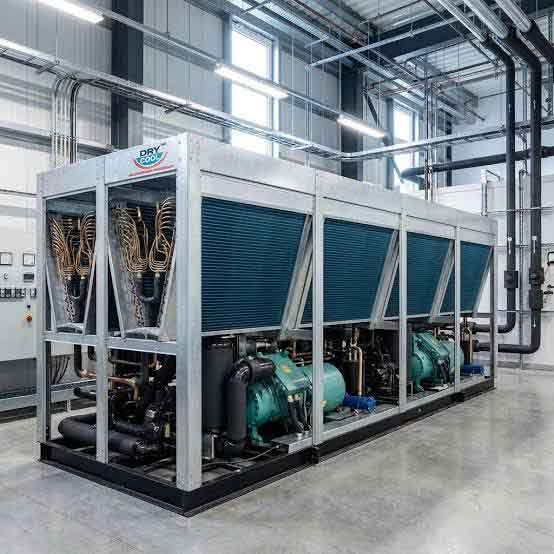
Air-cooled chillers reject heat directly to the surrounding air and can be practical for temporary installations where a suitable cooling-tower and condenser-water system is not available.
Water-cooled chillers use a condenser-water system and may be suitable where the required infrastructure already exists. However, temporary water-cooled installations can involve additional equipment and site requirements.
The important point is not to assume that one configuration is always better. Compare the complete installation, including pumps, pipework, electrical requirements, available space, and operating conditions.
Look at the Complete Rental Package
A chiller is only one part of many industrial temporary-cooling projects.
Depending on the application, the rental package may also require pumps, hoses or temporary pipework, buffer tanks, heat exchangers, air-handling equipment, electrical connections, controls, or temporary power.
Current UAE rental-chiller information shows that accessories and site complexity can have a significant effect on the overall rental quotation.
This is why equipment-only pricing can be misleading. One supplier may quote only the chiller, while another may provide a more complete turnkey package.
When comparing quotations, ask for a clear breakdown of what is included and what will be charged separately.
Evaluate Installation and Commissioning
Industrial chiller installation requires more than delivering equipment to the site.
Depending on the project, installation may involve positioning the chiller, connecting chilled-water lines, installing pumps, completing electrical connections, integrating controls, testing the system, and commissioning it before operation.
Current UAE rental service offerings commonly include site assessment, equipment selection, delivery, installation, commissioning, monitoring, maintenance, and eventual removal.
Ask suppliers whether installation and commissioning are included in the quoted rental price. Also clarify who is responsible for testing the system and confirming that the required cooling conditions have been achieved.
Consider Site Access and Logistics
Industrial sites are not always easy to access. Equipment may need to be positioned in a restricted area, transported through a particular route, or lifted into position.
The supplier should understand the site before finalizing the installation plan. Access, available space, electrical connections, connection points, pipe or hose routes, and lifting requirements can all affect the project.
Logistics can also affect the overall cost. Current UAE rental-chiller guidance identifies delivery distance, crane requirements, site access, and installation complexity as factors that can influence a quotation.
A supplier who performs a proper site assessment can usually provide a more realistic proposal than one quoting solely from basic equipment requirements.
Compare Maintenance and Technical Support
Industrial cooling may operate continuously, so technical support should be considered before signing the rental agreement.
Ask who will handle preventive maintenance, what happens if the chiller develops a fault, whether technicians are available outside standard working hours, and how emergency issues are handled.
This becomes especially important when cooling is connected to a critical production process. A low rental rate provides little value if technical assistance is difficult to obtain when the equipment stops operating.
Some UAE rental providers advertise on-site technician support, maintenance, emergency response, and managed rental solutions as part of their service offering.
Check the Rental Contract Carefully
Rental duration can significantly influence the commercial value of a temporary cooling project.
A business may need a chiller for a few days during an emergency, several weeks during maintenance, or many months while a permanent cooling system is being installed. The commercial structure can differ between short-term and long-term requirements.
Before signing, check the agreed rental period, extension terms, delivery and collection charges, installation costs, maintenance responsibilities, breakdown response, damage responsibilities, and any additional equipment included in the package.
Current UAE rental-chiller information indicates that rental pricing can vary according to rental duration as well as capacity, accessories, delivery, and technical support.
Compare Energy and Operating Requirements
The rental price is not the only operating cost.
Two chillers may have similar cooling capacities but different electrical requirements or operating characteristics. The available power supply at the facility must be suitable for the selected equipment.
For industrial facilities, it is useful to ask suppliers about expected electrical requirements, operating conditions, controls, and any additional equipment needed to operate the temporary system.
Dubai Municipality’s building requirements include technical considerations for AC equipment and building energy performance, making it important to evaluate the cooling solution as part of the wider facility requirements.
Ask About Replacement or Backup Arrangements
For critical industrial applications, it is worth discussing what happens if the rented chiller becomes unavailable.
A supplier’s emergency response process can be just as important as the equipment itself. Ask whether replacement equipment is available, how faults are escalated, and whether the company provides emergency technical assistance.
This does not mean every project needs a second standby chiller. The requirement depends on the criticality of the cooling load and the consequences of a cooling interruption.
For production facilities where cooling failure can affect operations, having a clear contingency plan can reduce operational risk.
Compare Suppliers on Total Value
The cheapest quotation is not necessarily the most economical option.
Imagine two suppliers quote different prices. Supplier A offers a lower equipment rental rate but excludes pumps, hoses, installation, commissioning, and technical support. Supplier B provides a higher initial quotation but includes the equipment, installation, commissioning, maintenance, and emergency assistance.
The second quotation may provide better overall value once all project costs are considered.
This is why businesses should compare suppliers on a like-for-like basis. The comparison should cover the chiller capacity, equipment type, accessories, installation, commissioning, maintenance, technical support, logistics, rental duration, and any additional charges.
Questions to Ask Before Choosing a Rental Chiller Company
Before placing an order, ask the supplier:
- What cooling capacity is recommended and why?
- What chilled-water temperature and flow rate can the system provide?
- Is the quoted capacity suitable for the expected ambient conditions?
- Is the chiller air-cooled or water-cooled?
- What pumps, hoses, pipework, tanks, or other accessories are included?
- Is delivery included?
- Is installation and commissioning included?
- Who handles maintenance during the rental?
- What technical support is available if the chiller fails?
- Are emergency services available?
- What are the electrical requirements?
- What happens if the rental period needs to be extended?
- Are removal and collection included at the end of the rental?
Getting clear answers to these questions makes it easier to identify differences between suppliers.
Final Thoughts
Comparing industrial chiller rental companies in the UAE should be based on the complete cooling solution rather than the headline rental price. Capacity, application, operating conditions, chiller type, site access, supporting equipment, installation, commissioning, maintenance, technical support, and contract terms all matter.
A reputable supplier should be able to understand your cooling requirement, recommend appropriate equipment, explain the technical assumptions, and provide a clear scope of work.
For businesses that depend on continuous cooling, the goal should be to select a rental partner that can provide the right capacity, reliable equipment, professional installation, and responsive technical support throughout the rental period. That approach can help reduce avoidable downtime and ensure the temporary cooling system performs as intended.