

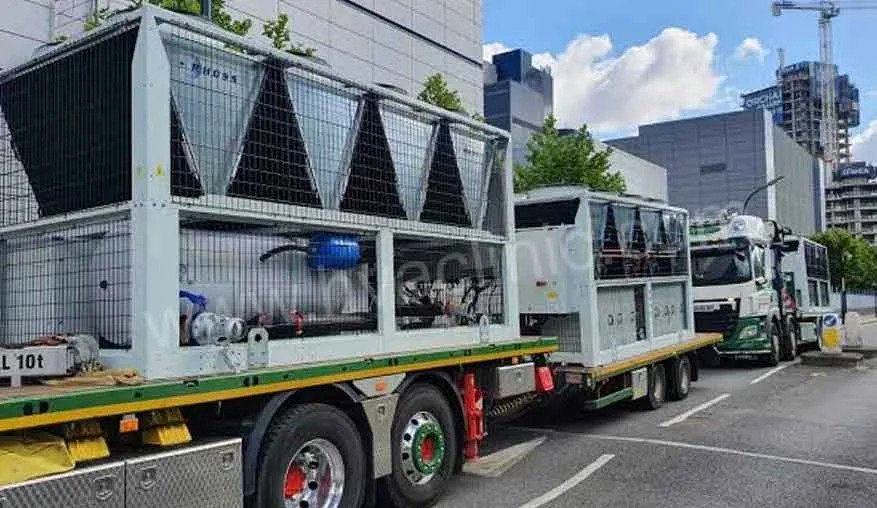
Commercial buildings in the UAE depend on reliable cooling for comfortable indoor conditions, equipment protection, and uninterrupted operations. Offices, hotels, shopping centres, hospitals, warehouses, retail spaces, educational facilities, and industrial buildings can all require substantial cooling capacity, particularly during periods of high outdoor temperatures.
One technology used for this type of centralized cooling is the air-cooled chiller. Unlike a conventional split air-conditioning system that cools indoor air directly, a chiller removes heat from water or another circulating fluid and then sends the cooled fluid to air-handling equipment or other cooling loads.
An air-cooled chiller is different from a water-cooled chiller mainly because of how it rejects heat. An air-cooled unit uses outdoor air and condenser fans to release heat, rental chillers in UAE whereas a water-cooled system normally transfers heat into condenser water that is then rejected through a cooling tower. This means an air-cooled chiller can operate without a cooling tower or condenser-water loop.
For UAE commercial facilities, that distinction can be important. A simpler heat-rejection arrangement can make air-cooled chillers attractive for certain buildings, retrofit projects, temporary cooling requirements, and sites where adding cooling-tower infrastructure is impractical.
What Is an Air-Cooled Chiller?
An air-cooled chiller is a refrigeration machine that produces chilled water while rejecting the extracted heat directly into the surrounding outdoor air.
The system uses a refrigeration cycle consisting principally of a compressor, condenser, expansion device, and evaporator. On the water side, the evaporator transfers heat from the building’s warmer return water to the refrigerant. The cooled water is then circulated back through the building’s cooling system.
The basic process can be understood as two connected loops.
The first is the refrigerant circuit, where refrigerant circulates through the compressor, condenser, expansion device, and evaporator.
The second is the chilled-water circuit, where water travels between the chiller and the building’s cooling coils.
The chiller does not simply create cold air. Instead, it removes heat from the chilled-water loop. Air-handling units (AHUs) or fan coil units (FCUs) then use that chilled water to remove heat from indoor air. LG’s UAE technical explanation describes this arrangement as chilled water leaving the chiller, travelling to AHU or FCU coils, absorbing building heat, and returning to the chiller at a higher temperature.
This approach allows one central cooling plant to serve multiple areas of a commercial facility.
How Does an Air-Cooled Chiller Work?
An air-cooled chiller normally uses a vapor-compression refrigeration cycle. The refrigerant repeatedly changes pressure and state as it transfers heat from the chilled-water loop to the outdoor environment.
The four fundamental stages are the evaporator, compressor, condenser, and expansion device.
1. The Evaporator Absorbs Heat From the Chilled Water
The process begins on the low-pressure side of the refrigeration circuit.
Warm return water from the building enters the chiller’s evaporator. This water has absorbed heat from indoor spaces through AHU or FCU coils.
Inside the evaporator, the refrigerant absorbs heat from the water. As it receives this heat, the refrigerant changes state and becomes vapour.
The result is that the water becomes colder before leaving the evaporator.
The chilled water is then circulated back toward the building, while the refrigerant continues through the refrigeration cycle. Trane describes the evaporator as the point where liquid refrigerant absorbs heat from the building water loop and boils.
2. The Compressor Raises Refrigerant Pressure
The refrigerant vapour then reaches the compressor.
The compressor increases the pressure of the refrigerant, which also raises its temperature. This prepares the refrigerant to reject the heat it collected from the chilled-water loop.
Different chiller designs can use different compressor technologies. Commercial chillers may use scroll, screw, centrifugal, or other compressor arrangements depending on capacity, application, and equipment design. Daikin UAE, for example, lists air-cooled chiller configurations using different compressor technologies across its product range.
3. The Air-Cooled Condenser Rejects Heat
After compression, the hot high-pressure refrigerant enters the condenser.
This is the stage that gives an air-cooled chiller its name.
Large fans move ambient outdoor air across the condenser coils. Heat passes from the hot refrigerant through the coil surface into the moving air. The refrigerant then condenses into a high-pressure liquid.
The rejected heat is discharged directly into the outdoor environment.
Unlike a water-cooled chiller, there is therefore no condenser-water circuit carrying heat to a cooling tower. LG’s UAE explanation specifically identifies direct outdoor-air heat rejection as the defining feature of its air-cooled configuration.
4. The Expansion Device Reduces Pressure
The high-pressure liquid refrigerant then passes through an expansion valve or another expansion device.
The device controls refrigerant flow and reduces its pressure. As the pressure falls, the refrigerant becomes much colder and enters the evaporator ready to absorb heat again.
The cycle then repeats continuously.
This continuous heat-transfer process allows the chiller to maintain the required chilled-water temperature while the building’s HVAC system continues circulating air through cooled spaces.
How Does an Air-Cooled Chiller Cool a Commercial Building?
The refrigeration cycle is only one part of the complete cooling system.
A commercial facility generally has a chilled-water distribution loop connected to air-handling equipment.
The air-cooled chiller produces chilled water. Pumps circulate that water through the building. At an AHU or FCU, air passes across a cooling coil containing chilled water. Heat from the indoor air transfers into the chilled water.
The now-warmer water returns to the chiller, where the refrigeration system removes that heat again.
The process therefore operates continuously
This arrangement is particularly useful when one cooling plant needs to serve multiple zones or areas within a commercial facility. LG notes that chilled-water systems can distribute cooling to AHUs and FCUs throughout a building.
Main Components of an Air-Cooled Chiller
Although exact construction varies by manufacturer and model, the main components normally include the following.
Compressor
The compressor raises the pressure and temperature of the refrigerant vapour. It is one of the most important components affecting the chiller’s capacity, efficiency, and operating characteristics.
Air-Cooled Condenser
The condenser transfers heat from the refrigerant into outdoor air. It normally consists of condenser coils and fans.
Because the condenser depends on outdoor airflow, its installation location and surrounding clearances are important.
Condenser Fans
Fans move ambient air across the condenser coils. Their operation is essential for removing heat from the refrigerant.
Modern systems may use variable-speed or electronically controlled fans to adjust airflow according to operating requirements. LG, for example, describes electronically commutated fan motors in one of its air-cooled chiller designs.
Expansion Valve
The expansion device controls refrigerant flow and creates the pressure drop required to produce the low-temperature refrigerant entering the evaporator.
Evaporator
The evaporator is where heat moves from the chilled water into the refrigerant.
The chilled water leaves the evaporator colder and returns to the building’s cooling coils.
Pumps and Water Circuit
The chilled-water circuit requires appropriate pumping and piping to move water between the chiller and the building’s cooling equipment.
The exact pump arrangement depends on the overall HVAC design.
Controls and Sensors
Modern chillers use controls to monitor and manage operating conditions such as temperatures, pressures, flow, compressor operation, and other parameters.
Proper control allows the chiller to respond to changing cooling demand rather than operating at maximum capacity continuously.
Why Are Air-Cooled Chillers Used in UAE Commercial Facilities?
The UAE has a large commercial and industrial building sector with substantial cooling requirements. Air-cooled chillers are available for a wide range of applications, from smaller commercial projects to larger commercial and industrial installations. Daikin UAE describes air-cooled chillers as suitable for commercial and industrial applications and lists applications ranging from retail projects to larger schemes.
An air-cooled system can be particularly attractive where a facility wants to avoid the infrastructure associated with a cooling tower and condenser-water loop.
Offices
Large office buildings can use chilled-water systems to supply cooling to multiple AHUs and FCUs. An air-cooled chiller can provide centralized cooling while allowing different areas of the building to be served through the chilled-water network.
Hotels
Hotels have varying cooling loads because guest rooms, restaurants, kitchens, conference areas, lobbies, and other spaces may have different occupancy patterns.
A centralized chilled-water system can distribute cooling across these areas according to building requirements.
Shopping Centres and Retail Facilities
Retail facilities can have substantial internal heat loads from lighting, occupants, equipment, and large glazed areas. Chillers can provide cooling through multiple air-handling systems.
Hospitals and Healthcare Facilities
Healthcare facilities require dependable environmental control and carefully managed HVAC systems. Chiller selection must be based on the facility’s engineering requirements, operating conditions, redundancy requirements, and applicable standards rather than simply selecting equipment by building size.
Warehouses
Some warehouses require general comfort cooling, while others require more controlled temperatures for products, equipment, or specialized operations.
An air-cooled chiller may be appropriate when the required system design and cooling load match its operating characteristics.
Commercial and Industrial Processes
Chillers are not limited to comfort cooling. Chilled water or another cooled fluid can also support process applications where temperature control is required.
Daikin UAE states that its air-cooled chillers can be used in process-cooling applications as well as comfort applications.
Why Is Air-Cooled Chiller Design Relevant to the UAE Climate?
The UAE climate creates an important engineering consideration for any outdoor refrigeration equipment: ambient temperature.
An air-cooled condenser releases heat into outdoor air. As outdoor temperature rises, the temperature difference available for heat rejection changes. This means equipment selection, condenser design, airflow, controls, and operating conditions all matter.
A chiller designed for one climate should not automatically be assumed to deliver the same performance under every high-temperature condition.
For UAE projects, engineers need to consider the expected outdoor design conditions and the manufacturer’s published operating envelope when selecting equipment.
Some UAE rental providers specifically market high-ambient chiller equipment for demanding GCC conditions. For example, Al Shola lists high-ambient air-cooled screw chillers for UAE applications and states that its equipment selection is assessed against cooling load, leaving-water temperature, ambient conditions, electrical supply, pumping arrangement, and other site requirements.
The important point is that high outdoor temperature should be treated as a design input, not as a reason to assume that every air-cooled chiller will perform identically.
What Are the Advantages of Air-Cooled Chillers?
Air-cooled chillers can offer several practical advantages depending on the facility.
No Cooling Tower
The most obvious difference is the absence of a cooling tower.
Because heat is rejected directly into ambient air, the system does not require the condenser-water loop and cooling tower used by a conventional water-cooled arrangement.
Reduced Water Infrastructure
An air-cooled system does not need a cooling tower to reject condenser heat. This can reduce the amount of water-side infrastructure associated with heat rejection.
For UAE projects where water availability, treatment, or cooling-tower infrastructure is an important consideration, this can be a useful factor.
Simpler Installation
The system can be simpler to install because the cooling tower, condenser-water pumps, and associated condenser-water piping are not required.
This does not mean that installation is automatically simple. Chilled-water piping, electrical supply, controls, structural requirements, access, and commissioning still need to be properly engineered.
Useful for Retrofit Projects
Air-cooled chillers can be suitable for certain retrofit situations because the facility does not need to create a complete cooling-tower system.
LG identifies retrofit-friendly applications as one area where air-cooled chillers can fit, depending on building and system requirements.
Flexible Outdoor Installation
Air-cooled chillers are generally designed for outdoor installation. Daikin UAE lists outdoor installation as a characteristic of its air-cooled chiller range.
The installation area still needs sufficient airflow, appropriate clearances, structural support, safe access, and protection from conditions that could negatively affect the equipment.
Are Air-Cooled Chillers More Efficient Than Water-Cooled Chillers?
There is no universal answer.
It is tempting to say that one chiller type is always more efficient, but real performance depends on the equipment, operating conditions, cooling load, outdoor conditions, water temperatures, controls, maintenance, and complete system design.
Water-cooled chillers can have an efficiency advantage under certain operating conditions because water can provide an effective heat-rejection medium. However, the complete water-cooled plant also includes cooling towers, pumps, water treatment, and related equipment.
Air-cooled systems eliminate those additional heat-rejection components but reject heat directly to ambient air.
LG explains that the choice between air-cooled and water-cooled systems affects piping, pumps, controls, maintenance, and system design, while the appropriate choice depends on building scale, load profile, and network requirements.
Therefore, UAE facility managers should compare whole-system performance, not just the efficiency rating of the chiller itself.
Air-Cooled vs Water-Cooled Chillers for UAE Facilities
The main distinction can be summarized as follows.
| Factor | Air-Cooled Chiller | Water-Cooled Chiller |
|---|---|---|
| Heat rejection | Outdoor air | Condenser water and cooling tower |
| Cooling tower | Not required | Normally required |
| Condenser-water loop | Not required | Required |
| Water consumption for heat rejection | No cooling-tower water requirement | Cooling-tower water required |
| Typical installation | Outdoor | Chiller plant arrangement |
| Infrastructure | Generally simpler | More extensive |
| Maintenance | No cooling-tower maintenance | Includes cooling-tower and water-system requirements |
| Potential application | Commercial, retrofit, temporary and selected industrial projects | Large continuous-load plants and other applications |
| Site selection | Requires good outdoor airflow | Requires suitable plant and cooling-tower arrangement |
Neither technology is automatically the right choice for every UAE facility. The final decision should be based on the building’s cooling load, available space, operating profile, design conditions, infrastructure, energy objectives, and project budget.
What Is the Role of Airflow Around an Air-Cooled Chiller?
Airflow is particularly important because the condenser relies on outdoor air to reject heat.
If hot discharge air is allowed to circulate back into the condenser intake, the unit may have to operate under less favourable conditions.
For this reason, air-cooled chillers should be installed with appropriate clearances and airflow paths according to the manufacturer’s requirements.
The location should also account for surrounding walls, neighbouring equipment, rooftop structures, noise considerations, service access, and the possibility of recirculated hot air.
A commercial facility should therefore avoid treating the chiller location as simply an available piece of outdoor space.
How Does Maintenance Affect Air-Cooled Chiller Performance?
Regular maintenance is important for maintaining reliable operation.
The condenser coil is exposed to outdoor conditions, meaning dirt and debris can accumulate on its surfaces. Restricted airflow can interfere with heat rejection.
Maintenance programs may include inspection and cleaning of condenser coils, checking fans, inspecting electrical connections, monitoring refrigerant-related operating conditions, checking water flow, reviewing control operation, and following the manufacturer’s service requirements.
The exact maintenance schedule should always follow the equipment manufacturer’s instructions and the operating environment.
For UAE facilities, outdoor dust and high ambient temperatures make appropriate maintenance and inspection particularly important.
What Happens If an Air-Cooled Chiller Is Undersized?
An undersized chiller may struggle to satisfy the building’s cooling demand during periods of high load.
The system may operate for extended periods while failing to achieve the required chilled-water or indoor conditions.
This is why selecting a chiller based only on floor area is not a reliable engineering method.
Cooling requirements depend on factors such as building orientation, envelope characteristics, occupancy, lighting, equipment, ventilation, outdoor conditions, process loads, desired indoor conditions, and operating schedules.
A proper load assessment is therefore more useful than simply choosing a chiller based on a building’s square footage.
What Happens If an Air-Cooled Chiller Is Oversized?
Oversizing can also create problems.
A significantly oversized chiller may cost more to rent or purchase than necessary and may operate inefficiently when the actual load is substantially below its rated capacity.
Modern equipment may use capacity control and variable-speed technologies to handle changing loads, but correct sizing remains important.
For rental applications, a professional assessment can help identify the required cooling capacity, chilled-water temperatures, flow requirements, available electrical supply, and connection arrangement before equipment is selected.
UAE rental providers similarly identify cooling load, temperatures, power availability, piping, access, and rental duration as important inputs when determining an appropriate temporary cooling package.
When Should a UAE Commercial Facility Consider Air-Cooled Chiller Rental?
Buying a permanent chiller is not always the best solution when the cooling requirement is temporary.
Air-cooled chiller rental can be useful when a commercial facility needs additional cooling capacity for a limited period or needs temporary equipment while its permanent system is unavailable.
Common situations include planned HVAC maintenance, unexpected chiller failure, building refurbishment, seasonal capacity requirements, facility expansion, temporary projects, and emergency cooling.
A rental chiller can also be used as a bridge while a permanent replacement is being procured or installed.
UAE rental companies advertise temporary air-cooled chillers for commercial buildings, industrial facilities, events, construction projects, emergency cooling, and other applications.
How Does Air-Cooled Chiller Rental Work?
A typical temporary cooling project begins with an assessment of the facility.
The rental provider needs information about the required cooling capacity, chilled-water supply and return temperatures, water flow, electrical power, connection points, available installation area, access for equipment delivery, operating schedule, and rental duration.
Once the requirement is established, the appropriate chiller and supporting equipment can be selected.
Depending on the application, the temporary system may include pumps, hoses or temporary pipework, electrical connections, control equipment, and other accessories.
The unit is then delivered to the site, connected to the cooling system, tested, commissioned, and monitored during operation.
The exact arrangement varies according to the facility and rental provider.
Why Can Air-Cooled Chillers Be Useful for Temporary Cooling?
Temporary projects often need a cooling solution that can be deployed without constructing permanent infrastructure.
An air-cooled chiller can be attractive in this situation because it does not require a cooling tower and condenser-water system.
Rental providers in the UAE market air-cooled systems specifically for quick deployment, emergency cooling, planned maintenance, additional capacity, and temporary projects.
For a commercial facility, this can allow the existing HVAC system to remain operational while maintenance or replacement work takes place.
What Factors Affect Air-Cooled Chiller Selection in the UAE?
Selecting an air-cooled chiller should involve more than choosing a tonnage number.
Important factors include:
Cooling load: The equipment must provide enough capacity for the actual heat load.
Leaving-water temperature: The required chilled-water temperature influences equipment selection and performance.
Return-water temperature: The difference between supply and return conditions affects the water-side design.
Flow rate: The system needs adequate water flow through the evaporator and building loop.
Ambient temperature: Outdoor conditions influence air-cooled condenser performance.
Electrical supply: The facility must have sufficient electrical capacity for the chiller and associated equipment.
Installation space: The unit requires suitable space, service access, and airflow.
Application: Comfort cooling and process cooling can have very different requirements.
Operating schedule: A building with changing loads may require different control and capacity characteristics from a facility with a continuous process load.
Rental period: Temporary projects may require different equipment and logistics from permanent installations.
These factors should be reviewed by qualified HVAC professionals before the final equipment is selected.
What Commercial Facilities Can Benefit From Air-Cooled Chillers?
Air-cooled chillers can be considered for a wide variety of UAE commercial environments.
Office Buildings
Chilled water can serve AHUs and FCUs across different floors and zones.
Hotels and Resorts
Centralized cooling can serve guest rooms and common areas, with the final design depending on the hotel’s HVAC infrastructure.
Shopping Malls
Large retail spaces can have substantial cooling loads, making centralized chilled-water systems suitable for many facility designs.
Schools and Educational Buildings
Chillers can serve centralized air-conditioning systems where the building’s HVAC design supports chilled-water distribution.
Hospitals
Hospitals can have continuous and critical cooling requirements. Chiller selection and redundancy need to be considered carefully for these facilities.
Warehouses
Temperature requirements vary widely between warehouses. An air-cooled chiller may be suitable where the required cooling system is designed around chilled-water distribution.
Commercial and Exhibition Facilities
Temporary or additional cooling capacity may be required for events, exhibitions, renovations, or seasonal loads.
Industrial Facilities
Air-cooled chillers can also support process cooling where the temperature and capacity requirements match the selected equipment.
Daikin UAE identifies both commercial and industrial applications for its air-cooled chiller products.
What Are the Limitations of Air-Cooled Chillers?
Air-cooled chillers have practical advantages, but they are not universally superior.
Because the condenser rejects heat directly into outdoor air, high ambient temperatures can make heat rejection more challenging.
They also require suitable outdoor space and airflow.
Noise from compressors and condenser fans can be an important consideration in some commercial locations.
In addition, a large air-cooled chiller installation may require substantial electrical capacity.
For facilities with very large and continuous cooling requirements, a water-cooled system may be more appropriate depending on the overall engineering and lifecycle analysis.
The best approach is therefore to compare the two technologies based on the actual project rather than assuming that air cooling or water cooling is always better.
How Can UAE Businesses Improve Air-Cooled Chiller Performance?
Good system design and maintenance are essential.
First, the chiller should be correctly selected for the building’s cooling requirements.
Second, condenser coils should be kept clean and airflow should remain unobstructed.
Third, chilled-water temperatures and flow should be maintained within the manufacturer’s specified operating range.
Fourth, controls should be properly configured so the equipment can respond to changing cooling demand.
Finally, facility teams should monitor operating performance and investigate unusual changes in temperature, pressure, power consumption, or cooling capacity.
Energy-efficient chiller technologies can also help. Daikin UAE lists technologies such as inverter controls, free cooling, heat recovery, and high-efficiency compressors across its chiller solutions.
Air-Cooled Chiller: A Practical Cooling Option for UAE Commercial Facilities
An air-cooled chiller works by transferring heat from chilled water into refrigerant and then rejecting that heat directly into outdoor air through an air-cooled condenser.
Its basic refrigeration cycle consists of the evaporator, compressor, condenser, and expansion device, while the chilled-water loop connects the chiller with AHUs, FCUs, or other cooling loads.
For UAE commercial facilities, air-cooled chillers can offer a practical alternative where the project benefits from avoiding cooling towers and condenser-water infrastructure. They can also be useful for certain retrofit, temporary, emergency, and additional-capacity requirements.
However, successful operation depends on selecting equipment appropriate for the cooling load and UAE operating conditions. Ambient temperature, airflow, chilled-water temperatures, flow rate, electrical supply, installation location, and maintenance all need to be considered.
For facilities that need temporary capacity rather than a permanent installation, air-cooled chiller rental in the UAE can provide another option. Rental providers can assess the cooling requirement and supply the chiller and supporting equipment needed for the specific project.
Frequently Asked Questions
What is an air-cooled chiller?
An air-cooled chiller is a refrigeration system that removes heat from chilled water and rejects that heat directly into outdoor air through a condenser and fans. Unlike a water-cooled chiller, it does not normally require a cooling tower or condenser-water loop.
How does an air-cooled chiller work?
The refrigerant circulates through four primary stages: evaporation, compression, condensation, and expansion. The refrigerant absorbs heat from chilled water in the evaporator, is compressed, releases heat through the air-cooled condenser, and then passes through an expansion device before returning to the evaporator.
Does an air-cooled chiller need a cooling tower?
No. An air-cooled chiller rejects heat directly to outdoor air through its condenser and fans, so a cooling tower and condenser-water loop are not required for the heat-rejection process.
Are air-cooled chillers suitable for UAE commercial buildings?
They can be suitable for many commercial and industrial applications, provided the equipment is correctly selected for the building’s cooling load and expected ambient conditions. Daikin UAE lists air-cooled chillers for commercial and industrial applications.
Can an air-cooled chiller be used in high UAE temperatures?
Air-cooled chillers can be designed for high-ambient applications, but suitability depends on the specific equipment’s published operating range and the project’s conditions. High outdoor temperatures should be included in equipment selection and system design.
What is the difference between an air-cooled and water-cooled chiller?
The primary difference is heat rejection. An air-cooled chiller transfers heat directly to outdoor air, while a water-cooled chiller transfers heat to condenser water, which normally carries the heat to a cooling tower.
Can air-cooled chillers be rented in the UAE?
Yes. UAE rental providers offer air-cooled chiller rental for applications including temporary cooling, emergency response, planned maintenance, additional capacity, construction, events, and industrial requirements.
How do I know what size air-cooled chiller a commercial facility needs?
The required capacity should be determined from the building’s cooling load and system conditions rather than floor area alone. Important information includes cooling load, supply and return water temperatures, flow rate, ambient conditions, application, operating schedule, and available electrical power.
What maintenance does an air-cooled chiller require?
Maintenance can include condenser-coil inspection and cleaning, fan inspection, electrical checks, refrigerant-system checks, water-side checks, controls inspection, and performance monitoring. The exact maintenance schedule should follow the manufacturer’s requirements.
Can an air-cooled chiller support an existing HVAC system?
It can, provided the chiller’s capacity, chilled-water temperatures, flow requirements, connections, controls, and other system characteristics are compatible with the existing HVAC infrastructure. A technical assessment should be completed before connection.
Is air-cooled chiller rental useful during a commercial HVAC breakdown?
Yes. Temporary chiller rental can provide cooling capacity while a permanent chiller is being repaired, replaced, or maintained. UAE rental providers specifically market temporary air-cooled chillers for emergency and planned cooling requirements.