

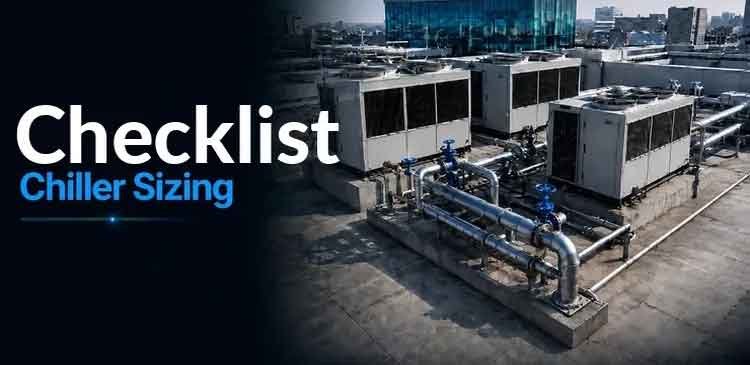
Choosing a chiller is not simply a matter of selecting the largest available unit. The right chiller capacity depends on the actual cooling demand, operating conditions, water temperatures, flow rates, ambient conditions, and how the system will be used. Whether you are planning to rent a chiller for a temporary requirement or buy equipment for a long-term installation, selecting the wrong capacity can affect comfort, efficiency, operating costs, and system reliability.
ASHRAE notes that accurate cooling-load calculation is one of the most important parts of chiller selection. It also warns that routinely adding a large percentage to the estimated load can increase equipment and operating costs and may create operating problems at low loads.
So, what should you check before choosing a chiller?
Start With the Actual Cooling Load
The first step is to determine how much cooling the project really requires. Cooling load can vary significantly between an office building, hotel, shopping facility, industrial process, warehouse, hospital, or temporary event space.
For a new project, the cooling requirement should be established through an appropriate load calculation. For an existing facility, actual operating data can also be useful when available. ASHRAE guidance on thermal storage, for example, emphasizes the importance of understanding the design-day load profile and the timing of cooling demand rather than looking only at a single nominal figure.
Important factors can include building size, occupancy, outdoor conditions, ventilation, equipment heat, lighting, solar gains, operating hours, and the required indoor temperature.
For industrial applications, the calculation may be different because the chiller could be cooling machinery, production equipment, process fluids, or another heat-producing system.
Understand What the Chiller Capacity Rating Means
Chiller capacity is commonly expressed in kW or tons of refrigeration (TR). As a general conversion, one ton of refrigeration is approximately 3.5 kW of cooling capacity.
However, the number printed on a chiller specification sheet should not automatically be treated as the capacity the unit will deliver in every situation.
Actual performance depends on operating conditions. Trane’s selection information, for example, requires factors such as design cooling load, chilled-water temperature drop, leaving chilled-water temperature, and ambient temperature when selecting a chiller.
This is particularly important when comparing different models. Two chillers with similar nominal capacities may perform differently under the exact conditions of your project.
Check the Leaving Chilled-Water Temperature
The required chilled-water temperature is another important part of equipment selection.
A conventional comfort-cooling application may have different temperature requirements from a process-cooling application. If your project needs lower water temperatures, you should confirm that the proposed chiller can provide the required temperature while maintaining acceptable performance.
Manufacturers provide performance data for different chilled-water and condenser conditions. ASHRAE explains that published chiller ratings cover different combinations of chilled-water and condensing conditions, which allows equipment to be selected according to the actual application.
Before renting or buying, clearly tell the supplier:
- Required leaving chilled-water temperature
- Entering chilled-water temperature
- Expected temperature difference
- Required flow rate
- Operating schedule
- Expected ambient conditions
Providing these details helps the supplier recommend a chiller based on actual requirements rather than simply suggesting a nominal capacity.
Check Chilled-Water Flow Rate
Cooling capacity and water flow are closely connected. Selecting the correct capacity without checking the required flow can create problems during installation and operation.
Trane’s chiller selection procedure, for example, identifies design chilled-water temperature drop as one of the required selection inputs and provides a relationship between cooling capacity, flow and temperature difference.
The project should therefore be checked for available pump capacity, pipe size, pressure drop and the flow requirements of the selected chiller.
This becomes even more important for rental projects because temporary installations may require additional hoses, pumps, manifolds, heat exchangers or temporary pipework.
Consider the Project’s Ambient Conditions
A chiller’s capacity is not independent of outdoor conditions.
For air-cooled chillers, outdoor temperature can have a significant effect on operating performance. Trane’s selection procedure specifically includes design ambient temperature among the information required for selecting an air-cooled chiller.
This matters particularly in hot climates. A chiller selected using mild-weather conditions may not provide the same cooling capacity during the hottest operating period.
When requesting a quotation, provide the supplier with the expected outdoor design conditions rather than relying only on the chiller’s advertised nominal capacity.
Do Not Automatically Oversize the Chiller
It may seem safer to choose a chiller that is considerably larger than the calculated requirement. In practice, excessive oversizing is not always beneficial.
ASHRAE states that routinely adding 10 to 20% to calculated load is unnecessary when accurate load-estimating methods are available. Oversizing can increase equipment and installation costs and may reduce efficiency. It can also contribute to operational issues such as frequent cycling or problems when equipment operates at very low loads.
That does not mean there should never be additional capacity. Certain projects may require contingency capacity, future expansion allowance, redundancy, or a specific safety margin. The important point is that any additional capacity should have a clear engineering reason.
Look at Part-Load Performance
A chiller rarely operates at exactly 100% load throughout the day.
Building cooling demand changes according to occupancy, weather, equipment operation and time of day. Therefore, evaluating only full-load capacity and efficiency may not provide a complete picture of expected operating costs.
Carrier highlights the importance of evaluating chiller performance and total cost of ownership, including operation at partial loads.
When comparing equipment, ask the supplier for available full-load and part-load performance information. A unit that looks attractive based only on its maximum capacity may not necessarily be the most economical choice for a project that spends much of its operating time at partial load.
Consider Whether You Need One Large Chiller or Multiple Units
For larger projects, selecting several chillers instead of one large unit can provide operational flexibility.
Multiple units can allow the system to match cooling output more closely to changing demand. If one unit is unavailable, the remaining equipment may also provide some level of cooling, depending on the system design.
ASHRAE’s guidance on chiller plant optimization discusses operating multiple chillers according to their load and capacity to improve power performance.
The best arrangement depends on the project’s load profile, redundancy requirements, available space, budget and control strategy.
Check the Type of Chiller You Actually Need
Capacity is only one part of the selection process. You also need to determine which type of chiller is appropriate.
Common considerations include:
Air-cooled chillers: These reject heat directly to outdoor air and can be useful where cooling-tower infrastructure or condenser-water systems are not practical.
Water-cooled chillers: These use a condenser-water system and cooling tower or another heat-rejection arrangement. They may be appropriate for larger permanent installations where the required infrastructure is available.
Temporary or rental chillers: These are commonly used for emergency cooling, planned maintenance, construction projects, supplemental capacity, temporary HVAC requirements and industrial applications. Carrier’s rental fleet, for example, includes air-cooled chillers for applications ranging from comfort cooling and emergency response to process cooling and scheduled outages.
The right choice depends on the project’s application and site conditions rather than capacity alone.
Renting a Chiller? Check More Than the Ton Capacity
For a rental project, equipment capacity is only one part of the quotation.
Before accepting a rental chiller, confirm what is included in the rental package. Depending on the application, you may need temporary pumps, hoses, cables, controls, heat exchangers, manifolds, fuel or electrical connections, and installation support.
Also ask about delivery, positioning, commissioning, monitoring, maintenance and emergency support.
For temporary cooling, the installation period matters too. A chiller needed for a few days during planned maintenance may have very different requirements from equipment needed for several months at a construction or industrial site.
A properly specified rental package should therefore consider the complete temporary cooling system, not just the chiller itself.
Buying a Chiller? Compare Total Cost, Not Just Purchase Price
For a permanent installation, the lowest purchase price is not necessarily the lowest-cost option over the equipment’s working life.
Electricity consumption, maintenance, water requirements for water-cooled systems, replacement parts, controls, installation and expected operating hours can all contribute to the total cost of ownership.
Carrier specifically identifies total cost of ownership as an important consideration when selecting between different chiller options.
This is why buyers should compare performance data under the conditions expected at the project rather than comparing equipment based solely on the initial quotation.
Ask for Performance Data at Your Actual Conditions
One of the most useful questions to ask a chiller supplier is:
“What capacity will this chiller provide at my required operating conditions?”
Do not rely only on a catalogue’s nominal capacity.
The supplier should be able to evaluate the selected unit using the required chilled-water temperatures, flow rates and ambient or condenser conditions. Trane states that its selection software provides performance data for specific chiller selections at full-load and part-load operating points, demonstrating why project-specific selection is preferable to choosing from a nominal capacity range alone.
For a major permanent installation, performance verification and appropriate testing can also be considered as part of the procurement process.
Check Existing System Conditions Before Adding Capacity
If you are buying or renting a chiller to supplement an existing system, first determine what the existing system can actually handle.
Check the available chilled-water flow, pipework, pumps, controls, electrical supply and heat-rejection arrangement. The additional chiller must work with the existing infrastructure.
For existing equipment, actual performance can also differ from original ratings because of fouling, deterioration or changed operating conditions. ASHRAE recommends verifying existing chiller performance when accurate capacity is important to system sizing.
This can prevent a situation where a new chiller has sufficient theoretical capacity but the overall system cannot deliver that cooling to the required areas.
Create a Simple Chiller Selection Checklist
Before requesting a quotation, prepare the following information:
Project type: Office, hotel, mall, hospital, warehouse, industrial facility, process application or temporary project.
Required cooling capacity: Preferably based on an engineering cooling-load calculation.
Required chilled-water temperatures: Entering and leaving temperatures.
Flow requirement: Expected chilled-water flow and available pump capacity.
Operating schedule: Hours per day, days per week and seasonal requirements.
Outdoor conditions: Expected design ambient temperature for air-cooled equipment or relevant condenser conditions for water-cooled equipment.
Installation location: Available space, access, ventilation and noise considerations.
Power supply: Available voltage, phase and electrical capacity.
Duration: Particularly important when renting a chiller.
Redundancy requirements: Whether backup capacity is required.
Future expansion: Whether the cooling load is expected to increase.
Providing this information allows suppliers to make a more accurate equipment selection and quotation.
Final Thoughts
Choosing the right chiller is fundamentally a matching exercise. The goal is not to buy or rent the biggest machine available. The goal is to match the chiller’s actual performance to the project’s cooling demand and operating conditions.
Start with an accurate cooling-load assessment, then check chilled-water temperatures, flow rates, ambient conditions, part-load performance, system infrastructure and the required operating schedule. For rental projects, also consider the temporary installation and support requirements. For permanent purchases, evaluate total cost of ownership rather than focusing only on the initial equipment price.
A properly selected chiller can provide the required cooling without unnecessary capacity, excessive energy consumption or avoidable operating problems. When the project conditions are clearly defined, a qualified chiller supplier can use manufacturer performance data to identify equipment that fits the application more accurately.