

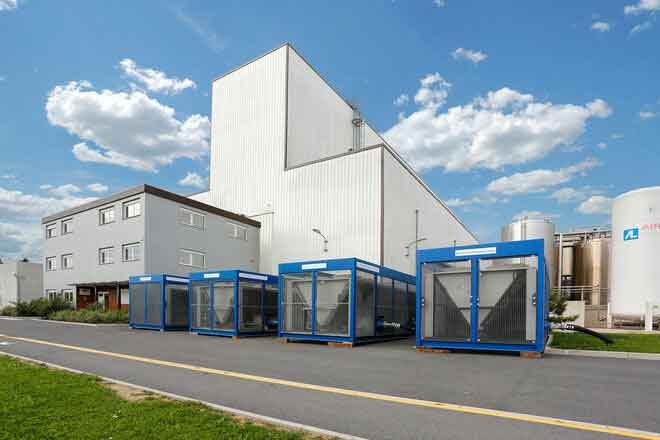
Cooling is a major operational requirement for commercial buildings in the UAE. Offices, hotels, shopping centres, healthcare facilities, retail properties and other large buildings can depend on chilled-water systems to maintain suitable indoor conditions and support daily operations.
When a building needs additional cooling or its existing chiller is unavailable, facility managers generally have two different approaches. They can install or replace permanent chiller equipment, or they can use a temporary rental chiller for a defined period.
These options serve different purposes. A permanent chiller is normally part of the building’s long-term HVAC infrastructure, while a rental chiller is intended to provide temporary or additional cooling capacity. The right choice depends on the building’s cooling load, project duration, capital plans, available infrastructure and operational requirements.
What Is a Rental Chiller?
A rental chiller is a temporary cooling unit supplied for a specific period rather than purchased as a permanent part of the building’s HVAC plant.
Commercial buildings may use rental chillers during planned maintenance, unexpected chiller failure, HVAC replacement, seasonal increases in cooling demand, building expansion or the period before a permanent cooling system becomes operational.
Depending on the site, a rental system can involve more than the chiller itself. Temporary pumps, pipework, hoses, heat exchangers, electrical equipment, controls and other accessories may be required to connect the equipment to the building’s existing cooling system.
Current UAE rental providers offer temporary cooling arrangements for short-term and longer projects, with the exact configuration depending on the required capacity and site conditions.
What Is a Permanent Chiller?
A permanent chiller is designed and installed as part of a building’s long-term cooling infrastructure.
Large commercial buildings commonly use central chilled-water plants because they can serve multiple areas through a distribution system. ASHRAE identifies large office buildings, hotels, shopping malls, hospitals, educational facilities and other large facilities among applications where central cooling plants are commonly used.
A permanent installation normally involves detailed engineering, equipment selection, mechanical and electrical connections, controls, commissioning and integration with the building’s HVAC system.
Because the equipment remains in service for an extended period, the selection process needs to consider both initial investment and future operating costs. ASHRAE specifically highlights the importance of evaluating first costs, operating costs, energy performance, plant controls and life-cycle considerations when designing and selecting chilled-water plants.
Rental Chiller vs Permanent Chiller: The Main Difference
The most important difference is the intended period of use.
A rental chiller is generally suitable when cooling is required temporarily or when a building needs additional capacity without committing to a permanent installation immediately.
A permanent chiller is intended to provide the building’s normal cooling capacity over the long term.
This distinction is important because a temporary requirement should not automatically result in a permanent capital project, while a long-term cooling requirement should not necessarily be treated as a temporary rental indefinitely.
When Rental Chillers Make Sense
A commercial building may consider rental cooling when an existing chiller has failed unexpectedly.
For example, a hotel, office building or retail facility may need to continue operating while its main cooling equipment is being repaired. Waiting for a permanent replacement can take longer than the building can comfortably operate without adequate cooling.
Rental chillers can also support planned maintenance. Instead of shutting down the entire cooling system during major work, a temporary unit can potentially provide cooling to the required areas while the permanent equipment is offline.
Another common application is HVAC replacement. During a replacement project, the old chiller may have to be removed before the new system is commissioned. A temporary chiller can bridge this gap.
UAE rental providers currently market temporary chillers for breakdowns, planned maintenance, replacement projects, seasonal demand and additional capacity.
When a Permanent Chiller May Be More Appropriate
If a commercial building requires the same cooling capacity as part of its normal operation year after year, a permanent cooling plant may be considered as part of the building’s long-term HVAC strategy.
This is particularly relevant for large facilities with substantial mechanical spaces and established chilled-water distribution systems.
ASHRAE notes that central plant design varies according to building use, life-cycle costs, operating economics and reliability requirements. It also emphasizes that the selection of plant equipment requires consideration of both first costs and future operating costs.
The decision therefore needs to be based on the building’s long-term requirements rather than the purchase price of one chiller alone.
Initial Cost and Capital Planning
One of the most obvious differences is the financial structure.
Purchasing a permanent chiller requires capital expenditure for equipment and normally involves engineering, installation, commissioning and associated infrastructure.
A rental arrangement converts the requirement into a service-based cost for the agreed rental period. This can be useful when a business needs cooling temporarily or wants to avoid purchasing equipment for a short-term requirement.
However, rental should not automatically be described as cheaper. The total cost depends on rental duration, capacity, installation requirements, energy consumption, transportation, accessories, maintenance and other contractual conditions.
For this reason, businesses should compare the total project cost rather than comparing only a rental quotation with the purchase price of a permanent chiller.
Installation Requirements
Neither option should be selected without considering the building’s existing infrastructure.
A permanent chiller may require a dedicated mechanical area, electrical infrastructure, chilled-water connections, pumps, controls and other plant components.
A rental chiller may require temporary connections and sufficient space for the equipment and associated accessories.
The existing chilled-water system must also be compatible with the temporary equipment. Supply and return temperatures, water flow, connection sizes, pressure requirements and control arrangements need to be reviewed before installation.
Dubai’s Building Code provides minimum requirements for building design and includes requirements and calculations related to air-conditioning systems.
For this reason, commercial building operators should have the proposed system reviewed by qualified HVAC professionals and ensure that applicable authority requirements are addressed.
Cooling Capacity Should Come Before Equipment Selection
One of the most important considerations for either a rental or permanent chiller is cooling capacity.
Selecting equipment simply because it has a large capacity does not guarantee an efficient or suitable installation.
Dubai’s published heat-load requirements state that heat load should be calculated for each air-conditioned space at its peak condition, with outdoor and indoor design conditions taken into account.
ASHRAE likewise emphasizes the importance of understanding peak loads and annual cooling-load profiles when designing chilled-water plants.
For a rental chiller, the supplier should therefore understand the building’s actual load before recommending the equipment. For a permanent plant, a detailed load calculation becomes part of the engineering and equipment-selection process.
Energy Efficiency Matters in Both Options
The rental period does not remove the importance of energy efficiency.
A temporary chiller may operate for weeks or months, meaning electricity consumption can become a significant part of the total cost. A permanent chiller may operate for many years, making long-term efficiency even more important.
ASHRAE’s chilled-water plant guidance highlights energy operating costs and control optimization as important parts of plant design and operation.
Businesses comparing equipment should therefore look beyond nominal cooling capacity. Depending on the project, they may need to examine efficiency at different loads, chilled-water temperatures, condenser conditions, pump energy and control strategy.
UAE Climate Conditions Need to Be Considered
The UAE’s hot climate makes cooling-load assessment particularly important.
Dubai’s published engineering requirements use outdoor design conditions when calculating building heat loads and distinguish between commercial and other building types.
ASHRAE has also published research specifically examining chilled-water system design for high-rise buildings in hot and humid climates, including a case study of a hypothetical high-rise office building in Abu Dhabi. The study examined factors such as chilled-water supply temperature, pump energy and dehumidification.
This demonstrates why a chiller should be evaluated according to the actual building and operating conditions rather than relying only on a generic capacity figure.
Maintenance and Technical Support
Permanent and rental systems have different maintenance arrangements.
A permanent chiller becomes part of the building’s asset base and normally requires an ongoing preventive-maintenance program. The building owner or facility-management team is responsible for ensuring that the equipment remains properly maintained.
With a rental chiller, maintenance and technical support may be included in the rental agreement, depending on the supplier and contract.
Before hiring, a commercial building should clarify who is responsible for routine maintenance, emergency response, inspections, repairs, transportation and equipment replacement if a major fault occurs.
The exact service package can vary significantly between suppliers, so it should be confirmed in writing rather than assumed to be included.
Rental Chillers Can Work Alongside Permanent Systems
Choosing a rental chiller does not necessarily mean replacing the permanent cooling system.
A temporary unit can sometimes supplement an existing plant when additional capacity is required. For example, a commercial property may experience a temporary increase in cooling demand because of an expansion, renovation or change in occupancy.
A rental unit can also serve as temporary capacity while permanent equipment is being upgraded.
This makes rental cooling useful as a bridging or supplementary solution rather than simply an alternative to permanent equipment.
Reliability and Business Continuity
For commercial buildings, cooling interruptions can affect more than indoor comfort.
A hotel may need to maintain acceptable conditions for guests. A shopping centre may need to keep tenant areas operational. Offices may need to maintain usable working conditions, while certain healthcare or technical facilities can have more specific environmental requirements.
Temporary cooling can therefore be part of a business-continuity plan when the primary chiller is unavailable.
For critical buildings, however, facility managers should consider redundancy and backup arrangements during the design stage. ASHRAE notes that multiple-chiller configurations can provide operational flexibility and allow maintenance activities to be carried out while other equipment continues to operate, depending on the system design and available capacity.
Rental Duration Changes the Commercial Calculation
The length of time a building needs the equipment is one of the most important factors in comparing the two options.
A short requirement caused by an emergency or maintenance shutdown is fundamentally different from a requirement expected to continue for many years.
Rental can be practical for daily, weekly or monthly requirements, while longer-term rental arrangements may also be available for projects requiring cooling for extended periods. Current UAE rental providers advertise both short-term and long-term arrangements.
For a long-term requirement, the business should compare the cumulative rental cost with the total cost of ownership of a permanent system.
That calculation should include installation, energy, maintenance, financing or capital costs, expected service life and eventual replacement.
Questions to Ask Before Choosing
Before deciding between rental and permanent cooling, a commercial building’s facility team should answer several questions:
How long will the additional cooling be required?
Is the existing chiller repairable?
Is the current system being replaced or permanently expanded?
What is the building’s actual peak cooling load?
What cooling capacity is required during normal and peak operation?
What chilled-water temperatures and flow rates are required?
Is suitable electrical capacity available?
Where can the equipment be installed?
Will temporary pipework or pumps be necessary?
What maintenance and emergency support are required?
What are the total energy and operating costs?
Are there applicable building or authority requirements?
These questions provide a more useful basis for decision-making than comparing equipment prices alone.
A Practical Comparison
| Factor | Rental Chiller | Permanent Chiller |
|---|---|---|
| Intended use | Temporary or supplementary cooling | Long-term building cooling |
| Capital commitment | Generally lower upfront equipment commitment | Requires equipment investment |
| Deployment | Can be arranged for defined projects | Requires permanent installation |
| Flexibility | Can suit changing or temporary requirements | Designed around long-term requirements |
| Maintenance | May be included under rental agreement | Building owner/operator manages ongoing maintenance |
| Replacement project | Can bridge the period during replacement | Becomes the replacement system |
| Emergency use | Suitable for temporary recovery or backup | Not normally a rapid temporary solution |
| Long-term operation | Depends on rental economics and contract | Designed for continued operation |
| Site requirements | Temporary equipment and connections still need planning | Permanent plant and infrastructure require detailed design |
The table shows the functional difference rather than identifying one option as universally better. The appropriate solution depends on the building’s specific requirements.
How to Choose Between the Two
A commercial building that needs cooling for a short, clearly defined period can investigate rental options first. This may include emergency breakdowns, planned maintenance, HVAC replacement, temporary expansion and project-specific cooling.
A building with a continuing requirement for additional cooling should evaluate permanent capacity as part of its long-term HVAC plan.
There can also be a third approach: use temporary rental equipment now while developing a permanent solution. This can be relevant when a building cannot wait for a full replacement project but needs reliable cooling immediately.
Final Thoughts
Rental chillers and permanent chillers serve different roles in commercial cooling.
A rental chiller can provide temporary capacity during breakdowns, maintenance, replacement work, seasonal requirements or short-term expansion. A permanent chiller is intended to form part of the building’s long-term cooling infrastructure and requires a more extensive evaluation of design, capital cost, energy performance, maintenance and life-cycle economics.
For commercial buildings in the UAE, the decision should begin with the actual cooling requirement and site conditions. Load calculations, chilled-water requirements, available infrastructure, operating conditions, energy consumption, maintenance responsibilities and project duration all need to be considered.
Rather than choosing solely on rental price or equipment purchase price, facility managers should compare the complete cost and operational requirements of each option. A qualified HVAC supplier can then assess the building and determine whether temporary, permanent or combined cooling capacity is appropriate for the project.