

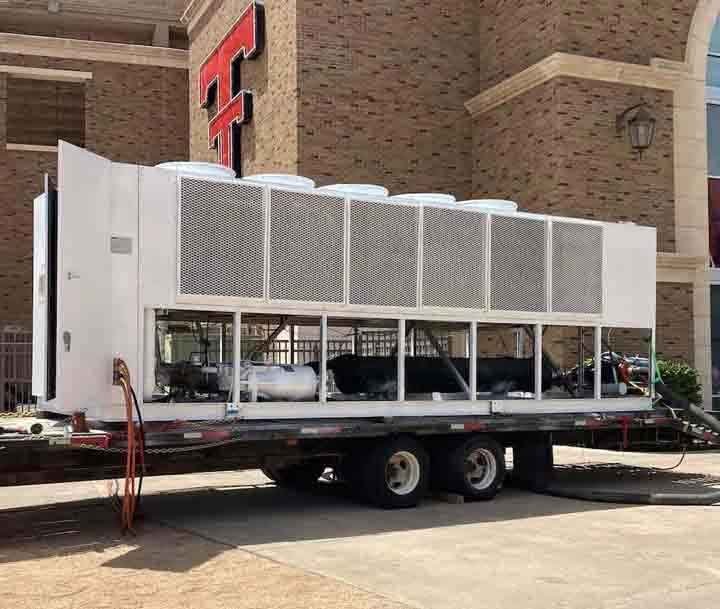
Cooling is a critical operating requirement for many businesses in the UAE. Commercial buildings, hotels, manufacturing facilities, warehouses, healthcare facilities, data-related operations, and other sites can depend on reliable cooling to maintain suitable working conditions or protect temperature-sensitive processes and equipment.
But businesses do not always need permanent cooling capacity. A chiller may need to be replaced temporarily, a facility may require additional capacity during a peak period, or a project may need cooling before its permanent HVAC system is ready.
In these situations, rental chillers in the UAE can provide a practical alternative to purchasing additional permanent equipment.
The business case for renting a chiller is mainly about flexibility. Instead of committing capital to equipment that may only be needed for a limited period, a company can obtain temporary cooling capacity for a defined requirement. Rental suppliers may also provide services such as installation, site assessment, monitoring, and technical support, depending on the rental agreement.
However, renting is not automatically the cheapest option for every business. The right decision depends on the duration of the requirement, cooling load, equipment efficiency, installation conditions, energy costs, and total lifecycle cost.
What Is a Rental Chiller?
A rental chiller is a temporary cooling system hired for a specified period rather than purchased as a permanent asset.
Chillers remove heat from a building or industrial process and provide chilled water for cooling applications. Rental systems can be used as temporary primary cooling, supplementary capacity, or backup equipment when an existing cooling system is unavailable.
Modern rental fleets can include modular air-cooled chillers in different capacities. For example, Atlas Copco’s UAE rental operation currently lists modular air-cooled chillers from 50 kW to 720 kW per unit and describes applications including emergency breakdowns, planned maintenance, peak demand, backup cooling, and bridging the waiting period for permanent equipment.
The exact equipment and configuration should always be selected according to the site’s cooling requirements rather than simply choosing the largest available machine.
Why Would a Business Rent a Chiller?
There are several situations where temporary cooling can make commercial sense.
1. Avoiding a Large Upfront Equipment Investment
Purchasing a permanent chiller requires capital expenditure. The total investment may include the equipment itself as well as installation, pipework, electrical infrastructure, controls, commissioning, and other associated works.
If a business only needs additional cooling for a few weeks or months, investing in permanent equipment may not be appropriate.
Rental provides access to cooling capacity without purchasing the complete asset.
This can be particularly useful for:
Temporary projects
Construction sites
Seasonal requirements
Planned shutdowns
Emergency situations
Short-term increases in production
Temporary facilities
However, businesses should compare the total rental cost with the expected cost of ownership. For a permanent requirement lasting many years, purchasing may still provide better long-term value.
2. Providing Cooling During Chiller Breakdown
An unexpected chiller failure can become a serious operational issue.
If the existing cooling system cannot operate, the business may have to wait for diagnosis, spare parts, repairs, or replacement equipment. Depending on the application, this interruption can affect employees, customers, production processes, equipment, or temperature-sensitive materials.
A rental chiller can provide temporary cooling while permanent equipment is repaired.
Current industrial cooling-rental providers specifically identify emergency breakdowns as an application for temporary chillers and describe rapid deployment as part of their service model.
This does not replace preventive maintenance, but it can provide another layer of business continuity.
3. Supporting Planned Maintenance
Chillers sometimes need to be taken offline for inspection, servicing, refurbishment, or major maintenance.
The difficulty is that the building or industrial process may still require cooling while the permanent equipment is unavailable.
A rental chiller can bridge this gap.
For example, a facility could:
- Schedule maintenance on its permanent chiller.
- Install temporary cooling before the shutdown.
- Transfer the required cooling load to the rental system.
- Complete maintenance work.
- Return the permanent system to operation.
- Remove the rental equipment.
This approach can help businesses plan maintenance without necessarily shutting down every cooling-dependent operation.
4. Handling Peak or Seasonal Cooling Demand
Cooling requirements can change throughout the year.
A business may have sufficient permanent capacity under normal conditions but experience higher demand during particularly hot periods or during temporary increases in occupancy or production.
Installing another permanent chiller solely to cover occasional peak demand may result in equipment being underutilized for much of the year.
Rental capacity provides another option.
The business can add temporary cooling when demand rises and remove it when the additional capacity is no longer required. Rental providers identify seasonal and peak-demand applications as one of the uses for temporary cooling equipment.
5. Keeping Capital Available for Core Business Activities
Capital allocation is an important consideration for businesses.
If a company purchases equipment that will only be used temporarily, a significant amount of capital can be tied up in an asset with limited long-term use.
Renting can allow the business to obtain the required cooling without owning the equipment.
The financial benefit depends on the individual project, but the principle is straightforward: temporary requirements do not always justify permanent assets.
A company can then allocate capital toward areas more closely connected to its core operations, provided the rental cost makes financial sense.
Rental Chillers and Energy Efficiency
Energy efficiency is an increasingly important consideration in the UAE.
Dubai’s Demand Side Management Strategy 2050 aims for savings of at least 30% by 2030 and 50% by 2050 compared with business-as-usual consumption. Efficient cooling is one of the strategy’s specific programmes.
Dubai Municipality’s Building Code also includes requirements and calculation resources related to areas such as thermal performance and air-conditioning equipment.
This means businesses should not evaluate a rental chiller solely by its daily or monthly rental price.
A more useful comparison considers:
Cooling capacity
Chiller efficiency
Expected operating hours
Ambient temperature
Chilled-water temperature
Part-load performance
Electrical consumption
Maintenance requirements
Rental duration
A cheaper rental unit can potentially become more expensive to operate if it consumes significantly more electricity.
Therefore, businesses should ask suppliers for technical information that allows the expected operating cost to be evaluated.
Renting Does Not Automatically Mean Lower Energy Consumption
This distinction is important.
A rental chiller is not automatically more energy efficient simply because it is rented.
Efficiency depends on the equipment, operating conditions, load profile, controls, maintenance, and system design.
Dubai’s efficient-cooling programme focuses on improving the efficient delivery of cooling across technologies, reinforcing the importance of looking at actual cooling performance rather than the rental model alone.
For businesses, the objective should be to select the right-sized and appropriately efficient equipment for the required application.
Rental Chillers Can Help Reduce Downtime Risk
For cooling-dependent businesses, downtime can have costs beyond the repair bill.
Depending on the industry, cooling failure may affect:
- Production
- Employee comfort
- Customer experience
- Equipment
- Inventory
- Temperature-sensitive products
- Data-related environments
- Building operations
Temporary cooling can therefore be considered as part of a broader business-continuity plan.
The value is not necessarily that the rental chiller eliminates every risk. Rather, it provides an additional option when permanent cooling capacity becomes unavailable.
Useful for Construction and Temporary Projects
Construction projects often have changing requirements.
A project may need temporary cooling for site offices, completed areas awaiting permanent HVAC commissioning, temporary facilities, or particular stages of construction.
Buying a permanent industrial chiller for a temporary requirement can create unnecessary expenditure and logistical complications.
A rental unit can be brought to the site for the required period and removed when the project reaches the next stage.
This can be especially useful where the permanent HVAC system has not yet been commissioned.
Bridging the Gap Between Old and New Equipment
Another practical application is when a business is replacing an existing chiller.
There may be a period between:
Removing the old equipment
Preparing the site
Installing the new equipment
Connecting utilities
Commissioning the new system
Achieving stable operation
A rental chiller can potentially cover this transition period.
Current rental providers specifically describe temporary cooling as a way to bridge waiting periods for permanent equipment installation.
Flexible Capacity for Changing Business Requirements
Business requirements can change faster than permanent infrastructure.
A company might expand production, increase occupancy, open another area, or temporarily increase its cooling load.
Instead of permanently increasing the installed chiller capacity immediately, the business can consider temporary capacity while determining whether the increased demand is permanent.
This can provide management with more time to evaluate future infrastructure requirements.
However, temporary equipment should not be used as a substitute for proper long-term capacity planning if the additional cooling demand becomes permanent.
What Industries Can Benefit From Rental Chillers?
Rental chillers can be relevant to a wide range of UAE applications.
Commercial Buildings
Offices, retail properties, and other commercial facilities may require temporary cooling during HVAC maintenance, refurbishment, or capacity shortages.
Hotels and Hospitality
Hotels have significant comfort-cooling requirements. Temporary cooling may be useful during equipment failures, renovations, or periods of unusually high demand.
Manufacturing
Manufacturing processes can depend on controlled temperatures or chilled water. Temporary equipment can provide backup during maintenance or unexpected equipment failure.
Food and Beverage
Cooling can be important for production and processing environments. A temporary system may provide backup capacity when permanent cooling is unavailable.
Pharmaceutical and Process Industries
Certain industrial processes require carefully controlled temperatures. Rental cooling may be considered as contingency capacity where technically appropriate.
Construction
Temporary offices, completed sections of buildings, and project facilities may require cooling before permanent systems are ready.
Events and Temporary Facilities
Temporary venues can have short-duration cooling requirements that do not justify permanent infrastructure.
The appropriate chiller type and configuration will vary significantly between these applications.
How to Decide Whether Renting Makes Financial Sense
Businesses should avoid making the decision based solely on the rental price.
Instead, compare the expected cost of renting with the total cost of purchasing and operating a permanent system.
Consider:
Rental Costs
Equipment rental
Delivery
Installation
Removal
Accessories
Maintenance
Technical support
Operating Costs
Electricity
Water, where applicable
Pumping
Additional equipment
Operating personnel
Ownership Costs
For a purchased system, consider:
Equipment purchase
Installation
Commissioning
Financing
Maintenance
Repairs
Spare parts
Depreciation
Replacement
Future disposal
The correct comparison is therefore total cost of ownership versus total cost of rental, not purchase price versus monthly rental price.
What Should You Ask a Chiller Rental Supplier?
Before signing a rental agreement, businesses should request clear technical and commercial information.
Cooling Capacity
Confirm the required capacity in the appropriate engineering units and make sure the proposed equipment can meet the actual load.
Chilled-Water Conditions
Ask the supplier to confirm the expected supply and return water temperatures and flow requirements.
Ambient Conditions
Because UAE summer conditions can be demanding, confirm that the equipment’s rated performance is appropriate for the expected outdoor temperature.
Electrical Requirements
Check voltage, frequency, connection requirements, electrical load, and any temporary power infrastructure required.
Installation
Clarify whether the quotation includes:
Delivery
Positioning
Pipework
Pumps
Electrical connections
Commissioning
Removal
Monitoring and Support
Ask whether the rental package includes remote monitoring, maintenance, emergency support, or replacement equipment.
Some current UAE rental providers offer site assessment, installation, and 24/7 remote monitoring as part of their cooling-rental service.
Do not assume these services are included in every rental contract.
Compliance and Site Planning
Businesses should also consider the requirements applicable to the specific location.
Dubai’s Building Code establishes minimum requirements relating to health, safety, welfare, building design, and sustainable development.
Temporary cooling equipment may also require appropriate electrical connections, safe access, suitable placement, drainage, pipework, and other site arrangements.
The precise requirements depend on the equipment, application, facility, and emirate. Businesses should therefore confirm applicable requirements with their project consultant, facility-management team, utility provider, and relevant authority where necessary.
Common Mistakes Businesses Should Avoid
Choosing Capacity Without a Load Assessment
A larger chiller is not automatically better. Oversizing can increase cost and may result in inefficient operation.
Comparing Only Rental Prices
A low rental price may not include installation, accessories, technical support, transportation, or other charges.
Ignoring Electricity Consumption
Energy costs can represent a significant portion of the operating cost.
Waiting Until an Emergency
Emergency rental can be more difficult to arrange than planned temporary cooling. Businesses with critical cooling requirements should consider contingency planning before a failure occurs.
Failing to Check Site Requirements
A chiller may require sufficient space, electrical capacity, pipework, access, and appropriate connections.
Treating Temporary Cooling as a Permanent Solution
If additional cooling is required continuously, the business should evaluate whether permanent capacity expansion is more economical.
Rental Chillers vs. Buying: A Simple Comparison
| Factor | Renting a Chiller | Buying a Chiller |
|---|---|---|
| Upfront capital | Generally lower | Higher |
| Temporary projects | Well suited | May be excessive |
| Emergency backup | Practical | Requires ownership of standby equipment |
| Long-term use | May become expensive over time | Can offer long-term value |
| Flexibility | High | Lower |
| Ownership responsibility | Usually reduced, depending on contract | Business responsibility |
| Capacity changes | Easier to adjust | Requires additional investment |
| Maintenance | May be included depending on contract | Owner’s responsibility |
| Asset ownership | No | Yes |
This table is a general commercial comparison. Actual economics depend on the equipment, rental terms, operating hours, energy consumption, and project duration.
When Is Renting a Chiller the Better Choice?
Renting may be particularly appropriate when:
A permanent chiller has failed
Planned maintenance requires temporary cooling
A project is short-term
Cooling demand is seasonal
Additional capacity is needed temporarily
A facility is waiting for permanent equipment
A business needs contingency cooling
Management wants to avoid purchasing short-term capacity
Buying may be more appropriate when the cooling requirement is permanent, predictable, and expected to continue for many years.
The decision should be based on the specific business case rather than a blanket assumption that rental is always more economical.
Final Thoughts
The business case for renting chillers in the UAE is strongest when cooling requirements are temporary, uncertain, seasonal, or connected to an emergency or planned shutdown.
A rental chiller can provide access to additional cooling without requiring the business to purchase another permanent asset. It can also help bridge equipment replacement periods, support planned maintenance, and provide additional capacity when demand temporarily increases.
At the same time, businesses should look beyond the rental price. Equipment efficiency, cooling capacity, electricity consumption, installation requirements, operating conditions, support services, and contract terms all affect the real cost.
Dubai’s current energy-efficiency strategy places specific emphasis on efficient cooling, while Dubai Municipality’s Building Code includes requirements and technical resources related to building and cooling performance.
For businesses operating in the UAE, the smartest approach is therefore not simply to ask “Is renting cheaper than buying?” Instead, ask “Which option provides the required cooling capacity, reliability, flexibility, and total cost for this particular project?”
For short-term and contingency requirements, rental chillers can provide a practical answer. For permanent, predictable demand, a properly designed and efficient permanent cooling system may remain the better long-term investment.