

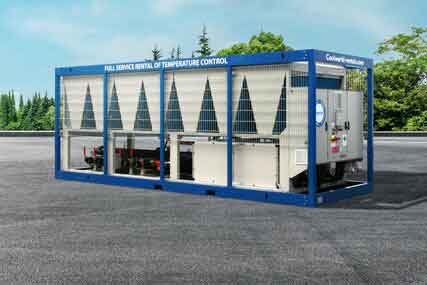
Reliable cooling is essential for many commercial, industrial, construction and event applications. When a permanent cooling system is unavailable, under maintenance, being upgraded or simply unable to meet a temporary increase in demand, a temporary chiller can provide a practical way to maintain the required cooling capacity.
Unlike standalone air-conditioning units, chillers produce chilled water or another secondary coolant that can be circulated to air-handling units, fan-coil units or process equipment. ASHRAE describes liquid-chilling systems as systems that cool water, brine or other secondary coolants for air-conditioning and refrigeration applications.
For businesses operating in demanding climates such as the UAE, temporary chillers can be particularly useful when cooling needs change quickly. However, reliable cooling does not come simply from renting the largest available machine. The chiller must be correctly sized, installed and operated according to the actual cooling requirements.
What Is a Temporary Chiller?
A temporary chiller is a portable or rental cooling system used to provide chilled water for a limited period.
It can be deployed when a permanent chiller is:
Undergoing maintenance
Being repaired
Being replaced
Awaiting installation
Temporarily overloaded
Unable to meet peak demand
Not yet commissioned
Temporary chillers can also support applications where cooling is required only for a particular project or phase.
Depending on the application, a temporary cooling arrangement may include the chiller itself along with pumps, hoses or temporary pipework, control equipment and air-side equipment.
The exact configuration depends on what the customer needs to cool.
Why Use Temporary Chillers for Reliable Cooling?
The main advantage of temporary cooling is flexibility.
Instead of making a permanent investment in additional cooling equipment for a short-term requirement, a business can deploy rental capacity for the period it is needed.
This can be useful for:
Construction projects
Commercial buildings
Industrial facilities
Manufacturing operations
Hotels
Events
Data and technical facilities
Warehouses and temperature-sensitive areas
Planned HVAC shutdowns
Emergency cooling situations
Temporary chillers can also provide additional capacity when the existing cooling plant cannot keep up with demand.
Temporary Cooling Can Help Reduce Downtime
A cooling-system failure can affect operations well beyond the HVAC department. Depending on the facility, inadequate cooling can affect employees, equipment, production processes, tenants or customers.
Having a temporary cooling option available can help reduce the duration of a planned or unexpected cooling interruption.
For critical facilities, however, temporary equipment should be treated as part of a properly engineered contingency plan rather than simply as emergency equipment kept on standby.
Start With the Actual Cooling Load
One of the most important factors in achieving reliable cooling is selecting the correct capacity.
ASHRAE states that cooling-load size is a major factor in liquid-chiller ownership cost and recommends accurately calculating the required capacity. It specifically cautions against simply adding an arbitrary percentage to the estimated load because unnecessary oversizing can increase equipment and operating costs and can create operating problems at low loads.
The cooling requirement may depend on:
Building size
Outdoor conditions
Indoor temperature requirements
Occupancy
Lighting
Electrical equipment
Process heat
Fresh-air requirements
Solar gains
Operating schedule
Heat generated by machinery
A professional assessment should therefore determine the actual load before a temporary chiller is selected.
Bigger Does Not Always Mean Better
It may seem safer to rent a chiller with significantly more capacity than required.
However, an oversized unit can operate inefficiently at low loads and may experience cycling or other operational issues. ASHRAE specifically identifies low-load operating difficulties as one potential consequence of oversized equipment.
The objective should be sufficient capacity under the actual operating conditions, not simply maximum available capacity.
Consider the Chilled-Water Requirements
The chiller capacity is only one part of the cooling system.
The project should also establish:
Chilled-water supply temperature
Return-water temperature
Required water flow
Pressure requirements
Operating hours
Number of cooling terminals
Required temperature stability
ASHRAE notes that equipment ratings should be considered with reference to actual operating conditions rather than relying only on standard published ratings.
This is particularly important when temporary equipment is connected to an existing chilled-water system.
The rental provider should understand the operating conditions before recommending equipment.
Choose the Appropriate Chiller Arrangement
Temporary chillers can be arranged in different configurations depending on the required capacity and level of reliability.
A single larger chiller may be suitable for a straightforward application.
However, multiple smaller chillers can provide additional flexibility.
ASHRAE notes that multiple-chiller systems can offer operational flexibility and standby capacity. If one machine requires maintenance, other units can continue providing cooling. Multiple units can also allow capacity to be matched more closely to changing loads.
For applications where cooling interruption could be particularly disruptive, the project team should evaluate whether redundancy is appropriate.
Air-Cooled vs Water-Cooled Temporary Chillers
Another important consideration is the method used to reject heat.
Air-Cooled Chillers
Air-cooled chillers reject heat directly to the surrounding air.
They can be attractive for temporary applications because they can avoid the need for a separate cooling tower and condenser-water system.
This can simplify deployment where site infrastructure is limited.
However, the equipment must be selected for the actual ambient conditions under which it will operate.
Water-Cooled Chillers
Water-cooled chillers use condenser water to reject heat and typically require supporting equipment such as cooling towers and pumps.
They may be appropriate for larger applications or sites where the necessary water-side infrastructure already exists.
For temporary projects, the additional equipment, installation requirements, water management and space requirements should be included in the evaluation.
The best choice depends on the required capacity, site infrastructure, operating conditions and project duration.
Reliable Cooling Depends on More Than the Chiller
A temporary chiller cannot operate effectively if the supporting system is incorrectly configured.
Depending on the project, the temporary cooling package may require:
Chilled-water pumps
Flexible hoses
Temporary pipework
Valves
Strainers
Air-handling units
Fan-coil units
Expansion arrangements
Electrical connections
Controls
Cooling towers for water-cooled systems
ASHRAE emphasizes that chiller plants involve interconnected equipment and that piping, pumps, controls and other components must be considered as part of the overall system.
For this reason, it is better to evaluate the temporary cooling installation as a complete system instead of looking only at the chiller’s tonnage.
Check the Available Power
Before deploying temporary cooling equipment, verify that the site can supply the required electrical power.
The electrical assessment should consider the complete temporary installation, including:
Chiller compressors
Fans
Chilled-water pumps
Condenser-water pumps
Cooling-tower fans, where applicable
Controls
Other associated equipment
If the site is powered by generators, the generator capacity should also be checked against the chiller’s electrical requirements.
A chiller that is technically suitable but cannot be adequately powered will not provide reliable cooling.
Plan for UAE Summer Conditions
For projects in the UAE, outdoor temperature is an important consideration.
The chiller’s rated capacity should be checked against the expected operating conditions rather than relying solely on its nominal rating.
ASHRAE explains that published chiller ratings are provided for specified combinations of operating conditions, including chilled-water and condenser conditions or ambient conditions for air-cooled models.
Therefore, when requesting a temporary chiller for UAE use, ask the supplier to confirm the expected performance at the project’s actual ambient conditions.
This is more meaningful than comparing nominal capacities alone.
Temporary Cooling and Worker Heat Protection
Temporary cooling can also contribute to worker welfare in appropriate areas, but it should not be considered a substitute for a complete occupational heat-safety programme.
The UAE’s Occupational Heat Stress Prevention Policy is applied annually from 15 June to 15 September, with the midday break prohibiting work under direct sunlight and in open areas from 12:30 pm to 3:00 pm during the applicable period. MoHRE describes the policy as part of the UAE’s occupational health and safety framework for protecting workers from high-temperature risks.
Where temporary cooling is provided for enclosed welfare areas, offices or other facilities, it should be planned alongside the project’s wider heat-stress controls.
Cooling equipment alone does not replace requirements relating to work scheduling, hydration, shaded rest areas and other applicable measures.
Use Temporary Chillers During Planned Maintenance
Planned maintenance is one of the most straightforward situations in which temporary chillers can be useful.
Instead of shutting down an entire cooling system while a permanent chiller is serviced, temporary equipment can potentially provide cooling to the required areas.
This can be particularly valuable for:
Hotels
Hospitals and healthcare facilities
Commercial buildings
Industrial plants
Manufacturing facilities
Data and technical environments
The exact temporary arrangement should be engineered according to the facility’s existing chilled-water system.
Use Temporary Chillers During Chiller Replacement
Replacing a permanent chiller can take time.
There may be a period between removing the old equipment and commissioning the new system.
A temporary chiller can bridge this gap and allow cooling to continue while permanent equipment is installed.
The temporary system should be planned before the permanent chiller is removed so that connections, access, electrical requirements and commissioning can be coordinated with the project schedule.
Temporary Chillers for Construction Projects
Construction projects can have changing cooling requirements.
A partially completed building may need temporary cooling during:
Interior fit-out
Testing and commissioning
Equipment installation
Building handover
Occupancy preparation
The cooling requirement can increase as additional areas become enclosed and operational.
ASHRAE’s guidance on chilled-water plant design emphasizes that understanding load profiles and how cooling demand changes over time is important when determining plant capacity.
For construction projects, this supports a staged approach in which temporary cooling capacity is adjusted according to project requirements.
Maintenance Is Essential for Reliability
Rental equipment still needs proper operation and maintenance.
Before accepting a temporary chiller, establish:
Who is responsible for routine maintenance?
How frequently will the unit be inspected?
Who responds to alarms?
What happens if the chiller fails?
Are spare parts available?
Is emergency technical support included?
How quickly can replacement equipment be provided?
ASHRAE identifies maintenance requirements and life-cycle costs among the factors that should be considered when evaluating cooling equipment.
A rental agreement that includes technical support can therefore be more valuable than a lower equipment-only price.
Monitor the Temporary System
Reliable cooling should be monitored rather than assumed.
Depending on the installation, monitoring can include:
Supply-water temperature
Return-water temperature
Water flow
Pressure
Compressor operation
Electrical consumption
Alarm conditions
Indoor temperatures
Early identification of abnormal operating conditions can give technicians an opportunity to investigate a problem before cooling performance is seriously affected.
Compare Total Cost, Not Just Rental Price
A temporary chiller’s rental rate is only one component of its cost.
The complete cost may include:
Equipment rental
Transportation
Installation
Pumps
Hoses
Temporary pipework
Electrical connections
Commissioning
Maintenance
Technician support
Energy consumption
Dismantling
Return transportation
ASHRAE recommends life-cycle cost thinking when selecting chiller systems, taking factors such as energy, maintenance, standby arrangements and peripheral equipment into account.
The same principle is useful when comparing temporary cooling options.
Temporary Chiller Reliability Checklist
Before renting a temporary chiller, confirm:
Required cooling capacity
Actual cooling load
Chilled-water supply temperature
Return-water temperature
Required flow rate
Expected ambient conditions
Available electrical power
Air-cooled or water-cooled configuration
Pump requirements
Hose or pipe requirements
Installation location
Site access
Rental duration
Maintenance responsibility
Emergency response arrangements
Backup or redundancy requirements
Commissioning requirements
Total rental and operating cost
Final Thoughts
Temporary chillers can provide a practical way to maintain reliable cooling when permanent equipment is unavailable, insufficient or undergoing maintenance.
However, reliable cooling depends on choosing and installing the right complete system, not simply renting a high-capacity chiller.
Start with the actual cooling load. Define the required chilled-water conditions. Check the site’s power and infrastructure. Evaluate the operating conditions, supporting equipment, maintenance arrangements and need for redundancy.
ASHRAE guidance emphasizes accurate load calculation, appropriate equipment selection and consideration of the complete chilled-water system.
For UAE projects, these technical considerations become even more important during periods of high outdoor temperatures. A properly planned temporary cooling system can provide the flexibility needed to maintain operations while permanent cooling equipment is being repaired, replaced, expanded or commissioned.
Ultimately, the goal of temporary cooling should not simply be to rent a chiller. It should be to create a reliable temporary cooling solution that matches the project’s actual requirements and remains supportable throughout the rental period.