

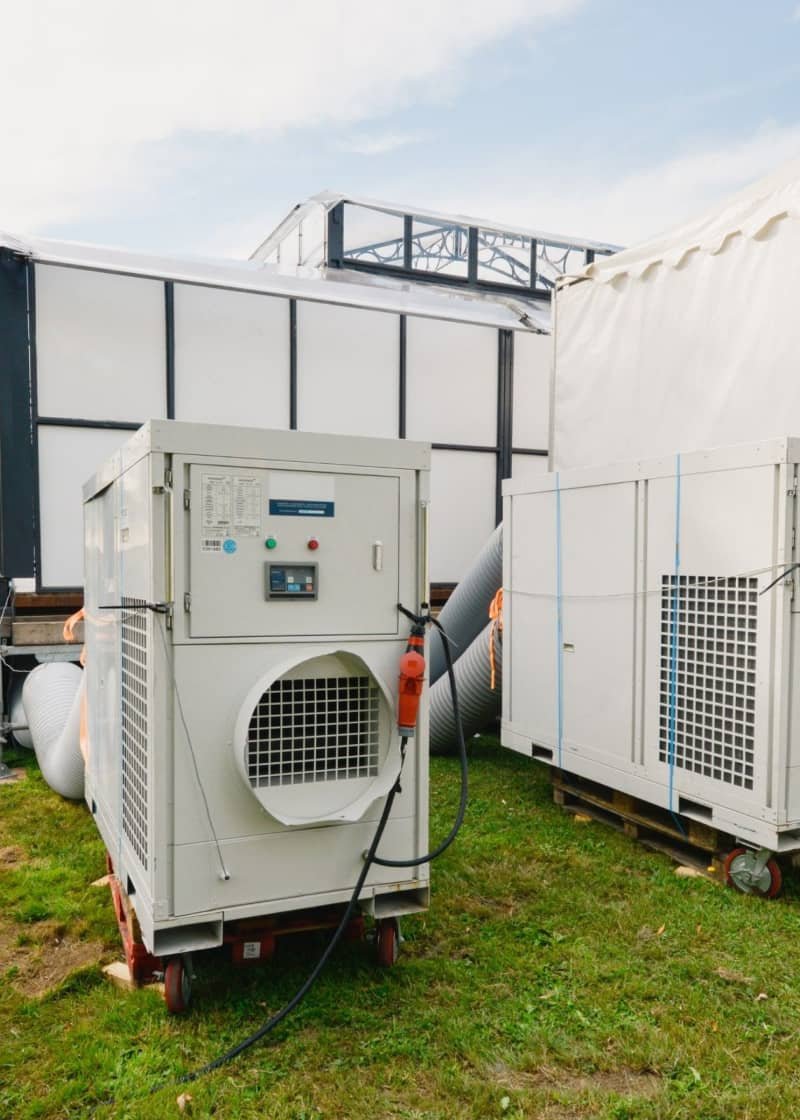
Commercial HVAC cooling rental services in the UAE provide businesses with temporary air-conditioning and cooling equipment when their existing system cannot provide enough capacity, is undergoing maintenance, has failed unexpectedly, or is not practical to install permanently. Instead of purchasing and installing a complete cooling system, a business can rent equipment for a defined period and have it delivered, installed, commissioned, operated, and removed when the requirement ends.
This approach is used across commercial buildings, warehouses, construction projects, industrial facilities, hotels, events, data centres, temporary facilities, and other environments where dependable temperature control is important. UAE rental providers commonly offer equipment such as air-cooled chillers, water-cooled chillers, air-handling units, rental chillers packaged air conditioners, portable air conditioners, spot coolers, pumps, hoses, control equipment, and other accessories required to create a temporary cooling system.
The basic concept is straightforward: determine the site’s cooling requirement, select equipment with sufficient capacity, deliver the equipment to the site, connect it to the appropriate electrical and chilled-water or air-distribution systems, test and commission it, and provide support throughout the rental period. However, a commercial HVAC rental project involves considerably more than simply placing an air conditioner inside a building.
What Are Commercial HVAC Cooling Rental Services in the UAE?
Commercial HVAC cooling rental services are temporary cooling solutions supplied to businesses for a specific operational requirement or period. The rental company provides suitable cooling equipment instead of the customer purchasing a permanent HVAC installation.
The exact equipment depends on the application. A small office or temporary workspace may require packaged or portable air-conditioning equipment, while a large commercial building or industrial facility may require chillers connected to air-handling units and chilled-water distribution. Some projects may need only additional cooling capacity, while others require a complete temporary cooling arrangement during a major HVAC replacement or shutdown.
Current UAE rental providers describe applications including commercial buildings, warehouses, construction sites, industrial facilities, events, data centres, process cooling, emergency cooling, planned maintenance, and temporary projects.
Commercial HVAC cooling rental can therefore be understood as a temporary climate-control service rather than simply an equipment rental. The provider may be responsible for equipment selection, transportation, installation, commissioning, technical support, maintenance, monitoring, and eventual removal.
Why Do UAE Businesses Use Temporary HVAC Cooling?
Cooling requirements in the UAE can be particularly demanding because facilities may need air conditioning for comfort, equipment protection, production processes, storage, or other operational purposes. When a permanent cooling system becomes unavailable, businesses may need an alternative without waiting for a major replacement project to finish.
One of the most common reasons for rental cooling is an unexpected HVAC failure. A temporary chiller or air-conditioning system can provide cooling while the permanent equipment is repaired or replaced. Rental cooling is also used during planned maintenance when an existing chiller or HVAC system needs to be taken offline. Daikin’s Middle East guidance specifically identifies system failure, planned shutdowns, and events requiring additional cooling as situations where rental HVAC can provide temporary capacity.
Another situation is a temporary increase in cooling demand. A building may require additional capacity during a seasonal peak, a major event, a temporary expansion, or a project phase before permanent HVAC infrastructure is available.
This makes temporary cooling useful for businesses that need additional capacity without committing to a permanent installation.
How Do Commercial HVAC Cooling Rental Services Work?
The rental process normally begins with an assessment of the customer’s cooling requirement. The provider needs information about the building or facility, cooling load, operating conditions, available electrical supply, existing HVAC infrastructure, installation location, access conditions, required temperatures, and rental duration.
Once these requirements are understood, engineers select an appropriate combination of cooling equipment and supporting components.
A typical commercial HVAC cooling rental process can be divided into several stages.
1. Cooling Requirement Assessment
The first step is determining how much cooling the facility actually requires.
Cooling capacity cannot be selected reliably from floor area alone. Providers may consider heat generated by occupants and equipment, the building or process application, indoor and outdoor conditions, required temperatures, existing HVAC equipment, and other site conditions.
For chiller rental, the required cooling capacity is commonly expressed in tons of refrigeration, or TR. However, the number should be determined from the actual cooling requirement rather than selecting a unit simply because its nominal capacity appears suitable.
Al Shola’s UAE rental guidance, for example, states that equipment selection considers factors such as heat load, airflow, target temperature, power availability, placement, and rental duration. Its Abu Dhabi chiller service also identifies cooling load, leaving-water temperature, ambient conditions, electrical supply, pumping arrangement, pipe routing, and operating period as factors in chiller selection.
2. Equipment Selection
After the requirement is assessed, the rental provider selects the appropriate equipment.
Commercial HVAC cooling rental equipment can include:
- Air-cooled chillers
- Water-cooled chillers
- Air-handling units
- Packaged air-conditioning units
- Portable air conditioners
- Spot coolers
- Chilled-water pumps
- Flexible chilled-water hoses
- Distribution headers
- Control panels
- Electrical cables and distribution equipment
- Buffer tanks and other accessories where required
Not every project needs all of these components. A commercial building with an existing chilled-water distribution system may require a temporary chiller, while a temporary event or isolated workspace may be better suited to packaged or portable air-conditioning equipment.
UAE providers such as Al Shola and Foster International list combinations of chillers, AHUs, packaged units and portable units for different temporary cooling applications.
3. Site Preparation and Delivery
Once the equipment configuration has been selected, the rental company arranges transportation to the site.
Site access matters because commercial cooling equipment can be considerably larger than conventional room air conditioners. The installation team may need to consider access routes, lifting requirements, equipment placement, ventilation, electrical connections, chilled-water pipe routes, and safe working space.
A proper site assessment can therefore prevent problems that might otherwise occur when equipment arrives but cannot be positioned or connected as planned.
Andrews Sykes, for example, describes site surveys as part of its temporary cooling approach and notes that the position of chillers, air handlers, and fan coils requires careful consideration.
4. Installation and Connection
After delivery, the equipment is installed and connected to the required systems.
For a chiller-based system, this can involve chilled-water supply and return connections, pumps, hoses, valves, electrical connections, controls, and connection to existing AHUs or other heat-transfer equipment.
For packaged or portable air-conditioning equipment, installation may instead involve flexible ducting, electrical supply, condensate arrangements, and appropriate airflow paths.
The configuration depends on the building and the type of temporary cooling required. The rental provider should confirm the required connections before deployment rather than assuming that every commercial facility uses the same arrangement.
5. Testing and Commissioning
Installation is followed by testing and commissioning.
The purpose is to verify that the equipment is correctly connected and operating as expected. Depending on the system, technicians may check electrical connections, water flow, controls, temperatures, pressure conditions, airflow, alarms, and system integration.
Stout Energy describes its rental process as site assessment followed by deployment and installation and then operation and support. HVAC Clinic similarly describes site assessment, equipment selection, delivery and installation, and testing and commissioning as stages in its rental service.
6. Operation and Technical Support
The rental service does not necessarily end when the equipment starts operating.
Commercial cooling equipment may require monitoring, maintenance, troubleshooting, adjustment, or technical intervention throughout the rental period. This is especially relevant when the equipment supports an important facility or production process.
Rental providers commonly advertise technical support and maintenance as part of their service. Foster International, for example, describes its HVAC rental service as including supply, installation, operation and removal, while Stout Energy describes operational support, monitoring and maintenance throughout the rental period.
7. Demobilisation and Equipment Removal
When the permanent HVAC system is restored or the project ends, the temporary equipment can be disconnected and removed.
This is one of the main differences between a rental solution and permanent HVAC installation. The temporary infrastructure is designed around the period for which cooling is required.
For businesses dealing with a short maintenance shutdown, temporary project, event, or emergency replacement, this flexibility can be important.
What Types of Equipment Are Used for Commercial Cooling Rental?
Commercial HVAC cooling rental is not limited to one type of machine. The equipment is selected according to the size, application, temperature requirement, installation conditions, and available infrastructure.
Air-Cooled Chillers
Air-cooled chillers remove heat from the chilled-water system and reject it to the surrounding air. They can be useful for temporary applications where a cooling tower and associated condenser-water infrastructure are not desirable or available.
UAE rental providers list air-cooled chillers for commercial, industrial, construction, event, emergency, and temporary cooling applications. Al Shola currently lists air-cooled rental chillers in capacities from 50 TR to 400 TR on its UAE service pages, although the appropriate capacity for a project must be established from the actual load and operating conditions.
Water-Cooled Chillers
Water-cooled chillers use condenser water and typically operate with associated cooling-tower and water-circulation equipment.
They can be appropriate for larger cooling requirements where the required water infrastructure is available or can be installed as part of the temporary system.
Rental providers serving commercial and industrial markets offer both air-cooled and water-cooled configurations for temporary cooling applications.
Air-Handling Units
An air-handling unit, or AHU, can distribute conditioned air through a building or temporary space.
AHUs can be combined with rental chillers to create a temporary chilled-water HVAC arrangement. They may be useful when a project requires large volumes of conditioned air or when temporary cooling needs to be distributed across a larger space.
Al Shola lists AHU rental alongside chillers and other temporary cooling equipment and describes applications including commercial buildings, warehouses, construction sites, factories and events.
Packaged Air Conditioners
Packaged AC units provide a more self-contained temporary cooling option for certain commercial and project applications.
Al Shola currently lists packaged AC rental units in the 10 TR to 30 TR range and describes their use in commercial spaces, warehouses, construction sites, labour accommodations, tents and events.
Portable and Spot Cooling Units
Portable air conditioners and spot coolers are generally used where cooling is required in a particular room, zone, workstation or equipment area rather than throughout a large building.
They can be useful for offices, server rooms, temporary work areas and other locations where targeted cooling is needed. Al Shola lists portable AC units in the 3 TR to 8 TR range and describes them as suitable for offices, server rooms, construction cabins, tents and events.
Where Are Commercial HVAC Cooling Rental Services Used?
Commercial cooling rental has applications across several UAE industries.
Commercial Buildings
Offices, retail facilities and other commercial buildings may need temporary HVAC capacity during chiller maintenance, system replacement, unexpected breakdowns or building modifications.
A temporary cooling system can provide an alternative source of capacity while permanent work is taking place.
Hotels and Hospitality Facilities
Hotels and hospitality properties have substantial comfort-cooling requirements. Temporary cooling may be considered during planned HVAC maintenance, equipment replacement, renovation work or unexpected system problems.
Rental cooling providers list hotels and hospitality among the applications for temporary chiller and HVAC equipment.
Warehouses and Industrial Facilities
Warehouses may require temporary temperature control for people, equipment, products or specific operational areas. Industrial facilities can also require process cooling where temperature control is part of production.
Rental cooling providers describe temporary systems for warehouses, manufacturing environments and industrial operations.
Construction and Fit-Out Projects
Construction and renovation projects can require temporary cooling before the permanent HVAC system is ready or while existing systems are unavailable.
Temporary cooling can also support specific project stages where maintaining suitable environmental conditions is necessary.
Both Al Shola and Andrews Sykes identify construction and building-related applications for temporary HVAC and cooling equipment.
Events and Temporary Venues
Events, exhibitions, temporary structures and outdoor venues can require temporary cooling because a permanent HVAC system may not exist at the location.
Rental providers offer portable AC, packaged AC, chillers, AHUs and other equipment for event and temporary-venue applications.
Data Centres and Critical Cooling Applications
Some facilities require continuous temperature control because equipment can be sensitive to environmental conditions.
Temporary cooling can be used as additional capacity, during maintenance, or as part of a contingency plan. UAE providers specifically list data centres and critical environments among applications for temporary cooling.
When Should a Business Rent Commercial HVAC Cooling?
There is no single situation in which every business should rent cooling equipment. The decision depends on the duration, urgency, cooling requirement, existing system and economics of the project.
Common situations include unexpected HVAC breakdowns, planned maintenance, temporary capacity requirements, seasonal demand, building renovations, construction projects, events and temporary facilities.
Daikin’s rental cooling guidance identifies system failures during periods of high cooling demand, planned shutdowns that extend beyond expectations, and events where standard infrastructure is insufficient as examples of temporary HVAC requirements.
Rental can also be considered when purchasing permanent equipment would not make sense for a short-duration requirement.
Commercial HVAC Cooling Rental for Planned Maintenance
Planned HVAC maintenance can require equipment to be taken offline.
For a facility that cannot simply stop using cooling during the maintenance period, temporary HVAC equipment can provide an alternative source of cooling.
This approach can allow technicians to work on the permanent system while the temporary equipment maintains the required cooling capacity.
Rental cooling is therefore not only an emergency service. It can be incorporated into planned maintenance and replacement strategies.
Andrews Sykes specifically describes temporary chillers as suitable for bypassing existing systems during planned maintenance, breakdowns and disaster-recovery situations.
Emergency Commercial HVAC Cooling Rental
An unexpected chiller or HVAC failure can create an immediate requirement for temporary cooling.
In an emergency, the process typically starts with identifying the failed system and estimating the cooling capacity that needs to be restored. The rental provider then determines what equipment can be deployed and how it can be connected to the facility.
The speed of deployment depends on equipment availability, site access, required capacity, electrical infrastructure, connection requirements and the complexity of installation.
This is why emergency commercial HVAC cooling is not simply a matter of delivering the largest available chiller. The temporary system must be compatible with the site’s technical requirements.
How Is Commercial Cooling Rental Capacity Determined?
Correct sizing is one of the most important parts of a commercial HVAC rental project.
The required cooling capacity depends on the actual thermal load and operating requirements of the facility. Factors can include:
Cooling load: The amount of heat that needs to be removed from the building or process.
Building size and layout: The physical characteristics of the space affect the cooling requirement.
Occupancy: People contribute heat to a conditioned space.
Equipment heat: Machinery, computers, lighting and other equipment can add to the cooling load.
Required temperature: The target temperature influences system requirements.
Ambient conditions: Outdoor conditions affect the performance and capacity of cooling equipment.
Process requirements: Industrial applications may have specific temperature or flow requirements that differ from comfort cooling.
Existing HVAC infrastructure: The temporary system must be compatible with the available connection points and distribution system.
Electrical power: The available electrical supply needs to support the selected equipment.
Al Shola’s current UAE rental information specifically identifies heat load, target temperature, power availability, placement, airflow and rental duration as selection factors. Its Abu Dhabi chiller information additionally identifies leaving-water temperature, ambient conditions, pumping arrangements and pipe routing.
Because these variables differ from one facility to another, published equipment ranges should not be treated as a substitute for engineering assessment.
Air-Cooled vs Water-Cooled Chiller Rental
The choice between air-cooled and water-cooled chillers depends on the application and available infrastructure.
An air-cooled chiller rejects heat directly to the surrounding air. This can simplify temporary installation because the system does not depend on a cooling tower and condenser-water circuit.
A water-cooled chiller uses condenser water and is normally associated with additional water-side equipment.
Portable Air and Power describes air-cooled chillers as suitable where additional heat discharge does not need to be separately managed, while water-cooled chillers use water supplied from a cooling tower.
The correct choice therefore depends on the site’s cooling load, available utilities, installation conditions, operating environment and project requirements.
What Affects the Cost of Commercial HVAC Cooling Rental in the UAE?
There is no single commercial HVAC cooling rental price that applies to every UAE project.
Rental cost can vary according to:
- Required cooling capacity
- Type of cooling equipment
- Rental duration
- Number of units
- Transportation requirements
- Site location
- Installation complexity
- Pumps and accessories
- Hoses and piping
- Electrical requirements
- AHUs or other air-distribution equipment
- Monitoring and technical support
- Emergency mobilisation requirements
Rental Power’s UAE chiller information identifies tonnage, rental duration, delivery distance, accessories, hoses, power source and installation complexity among the factors that influence rental pricing.
For this reason, businesses should provide as much technical information as possible when requesting a quotation.
Short-Term vs Long-Term Commercial HVAC Rental
Commercial cooling rental can be arranged for different periods depending on the provider and project.
Short-term rental can suit emergency breakdowns, events, maintenance periods and temporary projects. Longer rental periods can suit construction projects, industrial operations, seasonal requirements or extended HVAC replacement programmes.
UAE rental providers currently describe daily, weekly, monthly and longer-term arrangements, although the exact rental periods available depend on the supplier and equipment.
The right rental duration should correspond with the actual project requirement rather than selecting a contract period solely according to equipment availability.
What Should Businesses Check Before Renting HVAC Cooling Equipment?
Before arranging commercial HVAC cooling rental services in the UAE, businesses should prepare the technical information needed by the rental provider.
Important information may include:
- Site location
- Application of the cooling system
- Required cooling capacity or known heat load
- Required supply and return temperatures
- Available electrical supply
- Existing chilled-water connections
- Pipe or hose routing
- Available installation area
- Equipment access and lifting requirements
- Required rental duration
- Required start date
- Operating hours
- Whether emergency or standby support is required
Al Shola’s current UAE chiller guidance asks customers to provide information such as required capacity or heat load, supply and return temperatures, flow, power availability, connection points, site access, location and expected rental duration.
Providing this information early can help the rental company determine the appropriate equipment configuration before delivery.
What Are the Benefits of Commercial HVAC Cooling Rental?
The main benefit of commercial HVAC cooling rental is flexibility.
Businesses can obtain temporary cooling without purchasing a permanent system for a requirement that may only last days, weeks or months.
Rental can also provide access to additional capacity when an existing HVAC system is insufficient. During planned maintenance or equipment replacement, temporary cooling can help maintain operations while permanent work continues.
Other potential benefits include:
Reduced upfront capital requirement: Renting avoids purchasing a permanent cooling system for a temporary need.
Flexible duration: Equipment can be rented according to the project timeline.
Rapid temporary capacity: Rental equipment can provide an alternative source of cooling when permanent capacity is unavailable.
Scalability: Depending on the equipment and provider, cooling capacity can be configured using different unit sizes or multiple units.
Technical support: Many commercial rental services include installation, commissioning, maintenance and technical support.
However, the benefits depend on selecting equipment that is correctly sized and compatible with the site.
How Does Temporary HVAC Compare With Buying a Permanent System?
Buying permanent HVAC equipment and renting temporary cooling serve different purposes.
A permanent system is designed for long-term operation and becomes part of the facility’s fixed infrastructure. It may make sense where the cooling requirement is continuous and predictable.
Rental cooling is designed around temporary or changing requirements. It can be particularly relevant when a business needs cooling only during maintenance, construction, emergency replacement, seasonal demand or a temporary increase in capacity.
The choice should therefore consider the expected duration of the requirement, capital budget, installation timeline, available infrastructure and long-term cooling strategy.
Why UAE Climate Conditions Matter for Rental Cooling
The UAE’s hot climate makes equipment selection particularly important for temporary cooling projects.
Rental equipment needs to be selected according to the conditions in which it will operate. High ambient temperatures can influence cooling performance and equipment requirements.
Some UAE suppliers specifically market high-ambient equipment for GCC conditions. Al Shola, for example, currently lists high-ambient air-cooled screw chillers designed for operation in demanding GCC temperatures and identifies operation up to 55 degrees Celsius for specified equipment, subject to project design and operating conditions.
This does not mean every rental chiller has the same operating capability. Businesses should confirm the manufacturer’s operating range and the supplier’s proposed equipment configuration for the actual site conditions.
How to Choose a Commercial HVAC Cooling Rental Company in the UAE
Businesses should look beyond the equipment nameplate when evaluating a rental provider.
A suitable provider should be able to understand the site’s cooling requirement, recommend appropriate equipment, explain connection requirements, arrange delivery and installation, commission the system and provide support throughout the rental period.
It is also useful to confirm whether the supplier provides the supporting equipment required for the project. A chiller alone may not be sufficient if the site also needs pumps, hoses, AHUs, controls, electrical distribution or other components.
The provider’s ability to support the equipment throughout the rental period can also matter, particularly for critical facilities and emergency applications.
Current UAE suppliers such as Al Shola, Stout Energy and Foster International describe combinations of equipment supply, installation, commissioning, maintenance and technical support rather than equipment-only rental.
Frequently Asked Questions About Commercial HVAC Cooling Rental Services in the UAE
What are commercial HVAC cooling rental services?
Commercial HVAC cooling rental services provide temporary air-conditioning and cooling equipment to businesses for a defined period. Depending on the application, the service can include chillers, AHUs, packaged AC units, portable air conditioners, pumps, hoses, controls, installation, commissioning and technical support.
How does commercial HVAC cooling rental work?
The provider first assesses the cooling requirement and site conditions. Suitable equipment is selected, delivered and installed, then tested and commissioned. The equipment operates for the agreed rental period before being disconnected and removed when it is no longer required.
When should a business rent commercial HVAC equipment?
Businesses commonly rent HVAC cooling equipment during unexpected breakdowns, planned maintenance, HVAC replacement, construction, temporary projects, events, seasonal demand increases and situations where additional cooling capacity is required.
Can I rent a chiller for a commercial building in the UAE?
Yes. UAE rental providers offer chillers for commercial buildings as well as industrial facilities, warehouses, construction projects, events and other applications. The correct chiller capacity and configuration should be established from the building’s cooling requirements and available infrastructure.
What types of cooling equipment can be rented?
Depending on the supplier, options can include air-cooled chillers, water-cooled chillers, AHUs, packaged AC units, portable AC units, spot coolers, pumps and supporting accessories.
How long can commercial HVAC equipment be rented?
Rental periods vary by provider and project. Short-term, weekly, monthly, seasonal and longer-term rental arrangements are available in the UAE market. The appropriate period depends on how long the temporary cooling requirement exists.
How is chiller rental capacity calculated?
Chiller capacity is determined from the cooling load and operating requirements rather than simply the building’s floor area. Factors can include heat load, required temperatures, ambient conditions, flow requirements, equipment heat and existing HVAC infrastructure. A site assessment is recommended for accurate selection.
Can rental chillers work with an existing HVAC system?
Yes, temporary chillers can be configured to connect with suitable existing HVAC infrastructure. The connection arrangement depends on the building’s chilled-water system, AHUs, pumps, pipework, controls and other site conditions.
Is commercial HVAC rental available for emergency situations?
Yes. Emergency cooling is one of the documented applications for UAE HVAC rental services. Providers offer temporary cooling for unexpected equipment failures and other situations where cooling needs to be restored quickly.
Is air-cooled or water-cooled chiller rental better?
Neither is universally suitable for every project. Air-cooled and water-cooled chillers have different infrastructure requirements. The appropriate option depends on the cooling load, available utilities, site conditions, installation requirements and project duration.
Conclusion
Commercial HVAC cooling rental services in the UAE provide businesses with a flexible way to obtain temporary cooling capacity without installing a permanent HVAC system for every short-term requirement. The service can support emergency breakdowns, planned maintenance, construction, events, seasonal demand, temporary facilities and additional commercial or industrial cooling requirements.
The process normally involves assessing the cooling load, reviewing site conditions, selecting suitable equipment, delivering and installing the system, testing and commissioning it, and providing technical support throughout the rental period. Depending on the application, the solution may involve chillers, AHUs, packaged AC units, portable air conditioners, pumps and other accessories.
For businesses considering commercial HVAC cooling rental in the UAE, the most important step is to define the actual cooling requirement before selecting equipment. Capacity, temperature requirements, power availability, connection points, site access, ambient conditions and rental duration all influence the final configuration.
A properly assessed temporary cooling system can provide the additional or replacement capacity required while a permanent HVAC system is maintained, repaired, upgraded or installed.