

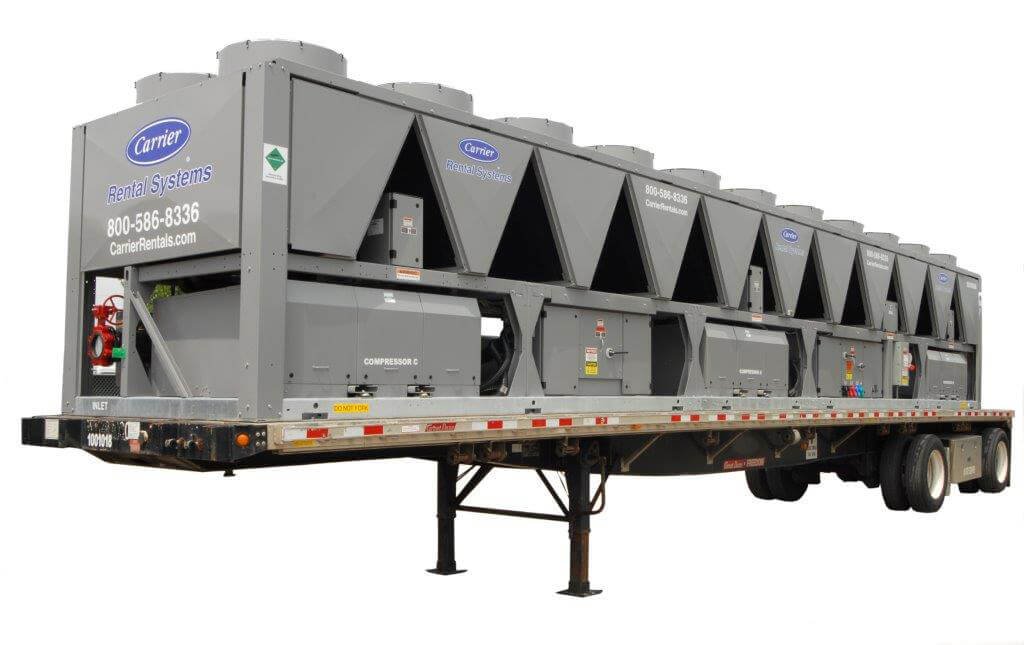
Portable chiller rental for UAE projects is a temporary cooling solution used when a building, industrial facility, construction project, event, or process needs chilled-water capacity without installing or purchasing a permanent chiller rental in UAE unit can be delivered to the site, connected to an existing chilled-water system or temporary cooling loop, commissioned, operated for the required period, and removed when the project no longer needs it.
This type of temporary cooling can be particularly useful when an existing chiller is being repaired, a facility is undergoing planned maintenance, a project needs additional cooling capacity, or a temporary site has no permanent cooling plant. UAE rental providers offer both air-cooled and water-cooled equipment, with solutions ranging from relatively compact portable units to larger systems assembled to provide substantial temporary cooling capacity.
The basic principle is the same as a permanent chilled-water system: the chiller removes heat from water or another circulating fluid, and the cooled fluid is then circulated to the equipment or spaces that require cooling. The difference is that the equipment is supplied temporarily and configured around the requirements of the particular project.
For UAE projects, the engineering assessment is important because the correct rental chiller depends on cooling load, ambient conditions, available electrical capacity, water availability, installation space, required temperatures, project duration, and the way the temporary system will connect to the existing installation.
What Is Portable Chiller Rental?
A portable chiller is a mobile or easily deployable cooling unit designed to provide temporary chilled-water or process-cooling capacity. Depending on the equipment design and application, portable systems can be skid-mounted, packaged, containerised, or otherwise configured for transportation and rapid deployment.
Portable chiller rental means obtaining this equipment for a defined period instead of purchasing and permanently installing a chiller.
Rental arrangements are commonly used for emergency cooling, planned maintenance, temporary facilities, construction projects, industrial processes, seasonal capacity requirements, events, and HVAC replacement work. UAE providers advertise temporary and portable chiller solutions for commercial, industrial, construction, hospitality, healthcare, events, manufacturing, oil and gas, and other applications.
A rental system may consist of more than the chiller itself. Depending on the site, the temporary package can include pumps, flexible hoses, electrical connections, control equipment, buffer tanks, cooling towers for water-cooled arrangements, generators where site power is insufficient, and other accessories needed to complete the installation.
This is why a project should not select a portable chiller only by looking at its nominal cooling capacity. The complete temporary cooling arrangement has to work as one system.
How Does Portable Chiller Rental Work?
The basic operation starts with a cooling requirement. The rental provider first needs to understand what the project is cooling, how much heat must be removed, what temperatures are required, and how the temporary equipment can be connected.
Once the cooling requirement is established, the appropriate equipment is selected and transported to the project location.
A typical rental process involves several stages.
1. Site Assessment and Cooling Load Evaluation
Before equipment is selected, the project requirements need to be evaluated.
The required cooling capacity depends on the building or process heat load rather than simply the floor area. Factors such as equipment heat, occupancy, outdoor conditions, insulation, process requirements and the existing HVAC arrangement can affect the load.
Trane’s rental guidance similarly recommends starting with the total heat load and considering factors such as the space, equipment, people and insulation when determining chiller capacity.
For a UAE project, engineers may also need to review the expected outdoor conditions, available space, electrical supply, chilled-water temperatures, pipe sizes, connection points and access for delivery equipment.
2. Selecting the Chiller
After the requirements are established, the rental provider selects a suitable unit or combination of units.
The choice can involve:
- Cooling capacity
- Air-cooled or water-cooled configuration
- Required chilled-water temperature
- Flow requirements
- Electrical supply
- Available installation area
- Indoor or outdoor placement
- Project duration
- Noise considerations
- Access and transportation requirements
- Process or comfort-cooling requirements
For larger projects, multiple chillers can also be combined to provide the required cooling capacity or provide operational flexibility. Andrews Sykes, for example, describes temporary chiller arrangements involving multiple units connected in parallel for large-scale applications.
3. Delivery and Positioning
Once the equipment is selected, it is transported to the project site.
The location needs to provide sufficient space for the chiller and adequate access for airflow, servicing and safe operation. For air-cooled equipment, the condenser section needs appropriate exposure to ambient air because heat is rejected directly to the surroundings.
The site also needs suitable access for delivery vehicles and, where necessary, lifting equipment.
4. Temporary Pipe and Electrical Connections
The rental chiller is then connected to the required cooling circuit.
Depending on the project, this may involve connecting the rental unit to an existing chilled-water loop or installing a temporary loop using hoses, pumps, manifolds and related equipment.
Electrical connections must also match the equipment requirements and the site’s available power infrastructure.
If the project does not have enough electrical capacity, a suitable generator package may be considered as part of the temporary cooling arrangement. Rental providers in the UAE advertise combined power and cooling solutions for sites where grid power is unavailable or insufficient.
5. Testing and Commissioning
The temporary system should be checked before normal operation.
This can include checking connections, water flow, pressures, electrical parameters, controls, temperature readings and safety systems.
The purpose is to make sure the rental chiller is operating correctly and that the temporary cooling system is delivering the required conditions before the project depends on it.
6. Cooling During the Rental Period
After commissioning, the chiller operates according to the project’s requirements.
The system removes heat from the circulating fluid and rejects that heat through its condenser system. The chilled fluid then returns to the building or process to absorb additional heat.
The cycle continues while cooling is required.
7. Removal After the Project
When permanent cooling has been restored or the temporary requirement has ended, the rental equipment can be isolated, disconnected and removed.
This is one of the main differences between a rental solution and a permanent cooling installation. The temporary system can be deployed for the duration of the requirement without becoming a permanent part of the building infrastructure.
How Does a Chiller Actually Produce Cooling?
To understand portable chiller rental, it helps to understand the basic refrigeration cycle.
A conventional vapor-compression chiller uses a refrigerant, compressor, evaporator, condenser and expansion device.
First, heat from the building’s chilled-water loop or process fluid is transferred to the refrigerant inside the evaporator. The refrigerant absorbs this heat and changes state.
The compressor then raises the refrigerant pressure and temperature.
Next, the refrigerant enters the condenser. The condenser removes the absorbed heat from the refrigerant. In an air-cooled chiller, fans move ambient air across condenser coils to reject the heat. In a water-cooled chiller, water carries heat away from the condenser before it is ultimately rejected through the associated heat-rejection system.
The refrigerant then passes through an expansion device, where its pressure and temperature decrease. It returns to the evaporator and the cycle starts again.
This refrigeration-cycle explanation is consistent with technical descriptions from Trane for both air-cooled and water-cooled chillers.
The important point is that a chiller does not simply blow cold air into a building. In a chilled-water HVAC application, it produces cooled water, which is then used by air-handling units, fan-coil units or other heat-transfer equipment to remove heat from the required space.
How Is Portable Chiller Cooling Connected to a UAE Project?
The connection method depends on the existing infrastructure.
For a commercial building with a chilled-water system, a temporary rental chiller may be connected to the building’s chilled-water circuit at an appropriate connection point.
For a construction or temporary facility, a separate temporary chilled-water loop may be created.
For an industrial process, the rental equipment can be configured around the required process-fluid temperatures and flow conditions.
The temporary installation may require flexible hoses, pumps, valves, manifolds, electrical cables and control equipment. Rental providers commonly describe these accessories as part of turnkey temporary cooling installations.
This makes site assessment particularly important. The rental chiller has to be compatible with the project’s actual hydraulic, electrical and temperature requirements.
Air-Cooled vs Water-Cooled Portable Chillers
One of the important decisions for a portable chiller rental for UAE projects is whether an air-cooled or water-cooled system is appropriate.
Air-Cooled Chillers
An air-cooled chiller rejects heat directly into the surrounding air through condenser coils and fans.
Because it does not require a cooling tower and condenser-water loop, the installation can be simpler. Trane identifies the absence of a cooling tower as one of the key characteristics of air-cooled chillers and notes that packaged portable configurations can be suitable for temporary or emergency cooling.
Air-cooled rental chillers can therefore be useful when rapid deployment, simpler installation or limited water infrastructure is important.
They are commonly considered for temporary cooling, construction sites, emergency applications, events, commercial facilities and projects where establishing a cooling-tower system would be impractical.
However, air-cooled equipment rejects heat directly to outdoor air. High ambient temperatures can affect chiller performance, so equipment selection needs to account for the actual operating environment.
Water-Cooled Chillers
Water-cooled chillers transfer heat from the refrigerant to condenser water. The condenser-water system then rejects the heat through a cooling tower or another heat-rejection arrangement.
Water-cooled systems can provide high efficiency and are widely used in large commercial and industrial facilities. Trane describes them as particularly suitable for large-scale commercial buildings and industrial processes requiring substantial and consistent cooling.
The trade-off is that a water-cooled temporary installation generally requires more supporting infrastructure, including condenser-water piping, pumps and heat rejection equipment.
The U.S. Department of Energy also notes that air-cooled systems eliminate the need for cooling towers and can reduce installation and maintenance requirements, while water-cooled systems generally provide higher efficiency.
Therefore, neither configuration is automatically suitable for every UAE project. The correct selection depends on the project’s load, duration, available space, water resources, electrical infrastructure, ambient conditions and operational requirements.
Why Do UAE Projects Use Portable Chiller Rental?
There are several situations in which temporary cooling can make practical sense.
Emergency Chiller Breakdown
A failed permanent chiller can create an immediate cooling problem.
Instead of waiting for a major repair or replacement project to be completed, a temporary rental chiller can provide interim cooling while permanent equipment is restored.
Rental companies operating in the UAE specifically market temporary chillers for emergency breakdowns and planned maintenance.
Planned Chiller Maintenance
A facility may need to shut down one or more permanent chillers for inspection, cleaning, repair or scheduled maintenance.
If the building or process cannot operate without cooling, temporary chiller capacity can help maintain operations during the maintenance period.
HVAC Replacement Projects
Replacing a major chiller can take time because the project may involve equipment procurement, delivery, mechanical work, electrical work, testing and commissioning.
A temporary rental system can bridge the period between removal of the old equipment and commissioning of the replacement.
Additional Cooling Capacity
A building may temporarily experience higher cooling demand because of an expansion, seasonal conditions, increased occupancy or additional equipment.
Instead of immediately investing in a larger permanent plant for a temporary requirement, a rental chiller can provide additional capacity for the required period.
Construction Projects
Construction and infrastructure projects may need temporary cooling before the permanent HVAC plant becomes operational.
Temporary cooling equipment has also been used for specialized construction and underground works in the Middle East, including applications combining chillers and air-handling equipment.
Industrial Process Cooling
Some manufacturing and industrial processes require controlled cooling for equipment, fluids or production operations.
A temporary chiller can be integrated into a process loop where additional or replacement cooling capacity is needed.
Industrial rental providers describe applications covering manufacturing, food and beverage, pharmaceuticals, plastics, data centers and other process environments.
Events and Temporary Facilities
Large events, exhibitions and temporary facilities can require substantial cooling capacity for a limited period.
Portable and temporary systems allow the cooling infrastructure to be installed for the event and removed afterward rather than creating a permanent cooling plant.
Portable Chiller Rental for Construction Projects in the UAE
Construction sites have changing cooling requirements.
During different stages of a project, temporary offices, enclosed workspaces, equipment areas, underground works or completed sections of a building may require cooling before the permanent HVAC system is available.
Portable chillers can be useful where a chilled-water solution is required and the project has suitable space and power infrastructure.
The equipment can be positioned according to the site layout and connected to a temporary distribution system or suitable project infrastructure.
For large construction projects, several temporary cooling units may also be operated together when the required load exceeds the capacity of a single machine. Andrews Sykes documents temporary chiller applications for construction and other exposed project environments in the Middle East.
Portable Chiller Rental for Industrial Projects
Industrial projects can have very different cooling requirements from conventional office buildings.
A factory may require process cooling rather than comfort cooling. The required fluid temperature, flow rate, operating hours and heat load can therefore become more important than the size of the occupied area.
Temporary industrial chillers may be used during production expansion, planned shutdowns, equipment replacement, process changes or emergency failures.
Some rental systems can also be configured for low-temperature applications using suitable fluids and equipment. Industrial Rental Co, for example, describes temporary chiller solutions for process cooling and low-temperature glycol applications.
For industrial applications, the rental provider should understand the process requirements before selecting the equipment.
Portable Chiller Rental for Commercial Buildings
Commercial buildings can use temporary chillers when permanent cooling equipment is unavailable or when additional capacity is required.
Applications can include offices, hotels, shopping facilities, healthcare buildings, data centers and other large conditioned spaces.
Chilled water from the temporary chiller can be circulated through existing air-handling or cooling equipment where the hydraulic system allows the temporary connection.
The objective is not simply to install the largest available chiller. The temporary system must be matched to the building’s actual cooling load and existing infrastructure.
ASHRAE has specifically examined chilled-water design for high-rise buildings in hot, humid climates, including a case study based on a high-rise building in Abu Dhabi. Its analysis highlights the relationship between chilled-water supply temperature, cooling load, dehumidification and system energy consumption.
How Much Portable Chiller Capacity Does a UAE Project Need?
There is no universal portable chiller size that works for every UAE project.
Capacity should be established through an engineering assessment of the cooling load.
For comfort cooling, relevant factors can include building area, occupancy, equipment heat, solar gains, insulation, ventilation and outdoor conditions.
For process cooling, the calculation may instead depend heavily on process temperature, fluid flow, production equipment and the amount of heat generated by the process.
Rental suppliers commonly describe equipment in terms of tons of cooling capacity, although the actual range varies significantly between portable, commercial and industrial equipment. For example, Industrial Rental Co describes compact portable/process units in the approximate range of one to fifty tons, while its broader temporary-chiller network covers substantially larger capacities.
The figures should not be treated as a universal UAE rental standard. Available capacity depends on the supplier’s fleet and the project requirements.
Oversizing can increase rental and operating costs, while undersizing may leave the project without enough cooling during peak conditions.
What Should Be Checked Before Renting a Portable Chiller?
Before requesting a quotation, project managers should gather the technical information required for proper equipment selection.
Important information can include:
Required cooling capacity: Determine the expected cooling load rather than choosing equipment based only on building size.
Required temperature: Identify the required chilled-water supply and return temperatures or process-fluid temperatures.
Flow rate: Confirm the required water or fluid flow through the cooling system.
Available electrical supply: Check voltage, phase, frequency and available capacity.
Connection points: Identify where the temporary system can connect to existing pipework.
Installation area: Confirm that the proposed location provides adequate space and access.
Outdoor conditions: For air-cooled systems, consider the expected ambient conditions because heat rejection occurs directly to the surrounding air.
Rental duration: Determine whether the equipment is needed for a few days, several weeks, months or an extended project period.
Access: Confirm whether delivery vehicles, cranes or lifting equipment can reach the installation location.
Operating requirements: Identify whether the equipment will operate continuously, during specific shifts or according to changing loads.
Backup requirements: Consider whether standby equipment or additional capacity is required for critical operations.
These details allow the rental provider to propose equipment that is technically compatible with the project rather than simply supplying a unit based on a requested tonnage.
What Equipment May Be Included in a Portable Chiller Rental Package?
The exact rental package varies according to the supplier and application.
A simple installation may require the chiller and basic connections.
A more complex temporary cooling project may require:
Portable or packaged chiller: The primary cooling equipment.
Pumps: Used to circulate chilled water or process fluid where integrated pumps are not sufficient.
Flexible hoses: Used to create temporary connections between the chiller and the project cooling loop.
Manifolds and valves: Used to control and distribute fluid.
Electrical cables and distribution equipment: Required to connect the equipment safely to the available electrical supply.
Buffer tank: May be required in some applications to provide additional system volume and improve operational stability.
Cooling tower: Potentially required for a water-cooled temporary system.
Generator: May be considered when the project does not have adequate electrical power.
Controls and monitoring: Used to monitor temperatures, pressures, alarms and operating conditions.
Trane’s commercial rental information also describes rental chillers with integrated pumps and equipment designed for rapid deployment, while UAE rental providers describe complete temporary packages containing pumps, hoses, power connections and other accessories.
What Factors Affect Portable Chiller Rental Cost in the UAE?
Portable chiller rental pricing is normally project-specific rather than a single standard UAE rate.
The cooling capacity is one of the most important factors. A larger cooling requirement generally requires larger or multiple machines.
Rental duration also affects the commercial arrangement. A short emergency rental and a long-term project rental can have different pricing structures.
Other potential cost factors include:
- Chiller type
- Cooling capacity
- Number of units
- Delivery distance
- Installation requirements
- Pipe and hose lengths
- Pumps and accessories
- Electrical requirements
- Generator requirements
- Cooling tower requirements
- Site access
- Commissioning
- Technical support
- Maintenance requirements
- Emergency response requirements
Current UAE rental information confirms that capacity, rental duration, location and additional equipment can influence the final quotation.
For this reason, a project-specific quotation is more useful than relying on a generic advertised daily price.
Portable Chiller Rental vs Buying a Chiller
Buying a permanent chiller can make sense when a facility has a long-term, predictable cooling requirement and the project is designed around permanent HVAC infrastructure.
Rental becomes more relevant when the requirement is temporary, uncertain or linked to a specific project period.
For example, a business may not want to purchase a permanent replacement chiller simply to cover a two-month maintenance period. Similarly, a construction project may require cooling before its permanent HVAC plant becomes operational.
Rental can provide access to cooling capacity without turning a temporary requirement into a permanent capital asset.
The decision should nevertheless consider the total rental period, expected future demand, operating costs, infrastructure requirements and the cost of purchasing and maintaining permanent equipment.
What Are the Main Benefits of Portable Chiller Rental?
Flexible Rental Periods
Temporary chillers can be hired for short-term emergency requirements or longer project periods. UAE providers advertise arrangements ranging from short-term rentals to monthly, seasonal and project-based contracts.
Faster Deployment
A rental solution can avoid some of the lead time associated with purchasing and permanently installing a new chiller.
This is especially relevant during emergency failures or planned shutdowns.
Reduced Permanent Infrastructure
Packaged air-cooled systems can avoid the need for a permanent cooling tower and associated condenser-water infrastructure.
Temporary Additional Capacity
Rental equipment can supplement existing cooling capacity when the permanent plant cannot meet a temporary increase in demand.
Support During Maintenance
Temporary cooling can allow maintenance or replacement work to proceed without completely removing cooling from the facility.
Scalable Cooling
For larger projects, multiple units can potentially be combined to achieve the required cooling capacity.
What Are the Challenges of Portable Chiller Rental in the UAE?
Portable cooling is not simply a matter of delivering a machine and switching it on.
The UAE environment creates specific engineering considerations.
Air-cooled equipment rejects heat into outdoor air, so high ambient conditions need to be considered during equipment selection.
Chilled-water distribution also needs to be correctly sized. Poor flow, unsuitable pipe connections or insufficient pumping capacity can prevent the system from delivering its expected performance.
Electrical capacity is another important consideration. A project may have enough power for normal building operations but insufficient spare capacity for a large temporary chiller.
Space and access can also become limitations, particularly on congested construction sites, rooftops or industrial facilities.
These factors reinforce why site assessment and proper equipment sizing are important parts of a professional rental project.
How Does UAE Climate Affect Temporary Chiller Selection?
The UAE has a hot climate, so cooling equipment can operate under demanding outdoor conditions.
For air-cooled chillers, the condenser must reject heat to the ambient environment. As outdoor temperature rises, the operating conditions of the refrigeration system can change.
Trane specifically notes that hot weather can reduce air-cooled chiller performance, making correct application and equipment selection important.
The selection should therefore account for the actual expected ambient conditions rather than assuming that the rated capacity of a machine will remain unchanged under every condition.
This is particularly important for projects that need reliable cooling during periods of high outdoor temperature.
When Is Air-Cooled Portable Chiller Rental a Practical Choice?
Air-cooled equipment can be practical when a project needs a relatively straightforward temporary installation and does not have the infrastructure required for a water-cooled system.
It can be considered for:
- Emergency cooling
- Construction projects
- Commercial buildings
- Temporary facilities
- Events
- Industrial applications with suitable loads
- Sites with limited water infrastructure
- Short-term HVAC support
The main attraction is the simpler heat-rejection arrangement. Air-cooled chillers do not require a cooling tower or condenser-water circuit, which can simplify temporary deployment.
When Is Water-Cooled Rental Chiller More Appropriate?
Water-cooled chillers can become attractive for large and continuous cooling loads where efficiency and available infrastructure justify the additional system complexity.
They are commonly associated with large commercial buildings, hospitals, industrial processes and other facilities requiring substantial cooling capacity.
A temporary water-cooled installation may require a cooling tower, pumps, condenser-water connections and water-management arrangements.
Therefore, the choice should be based on the complete project rather than simply comparing the nominal efficiency of two individual machines.
What Industries Use Portable Chiller Rental in the UAE?
Portable and temporary chillers can support many different industries.
Construction: Temporary site cooling, completed building sections, underground work and project-stage cooling.
Manufacturing: Process cooling, production support and temporary replacement capacity.
Oil and gas: Temporary cooling for facilities and specialized project requirements.
Healthcare: Backup or temporary cooling during maintenance and equipment failures.
Hospitality: Hotels and other facilities requiring cooling continuity during HVAC work.
Events: Temporary cooling for exhibitions, events and temporary structures.
Data and technology facilities: Temporary or supplemental cooling where maintaining controlled conditions is important.
Food and beverage: Process and temperature-control applications where suitable equipment is selected.
Andrews Sykes identifies construction, manufacturing, oil and gas, healthcare, hospitality, logistics and food and beverage among the environments served by temporary climate and chiller rental solutions in the Middle East.
How Long Can a UAE Project Rent a Portable Chiller?
The rental period depends on the supplier and project.
Short emergency requirements can last only a few days, while maintenance projects may require equipment for several weeks. Construction, industrial expansion and seasonal projects can require cooling for months or longer.
UAE rental providers advertise both short-term and long-term chiller rental arrangements.
The rental agreement should clearly establish the equipment duration, delivery and collection arrangements, technical support, maintenance responsibilities and any extension terms.
What Should a Portable Chiller Rental Quote Include?
A detailed quotation should make it clear what is included in the temporary cooling package.
This prevents the project team from comparing two quotations that appear similar but actually contain different levels of equipment and service.
How to Choose a Portable Chiller Rental Company in the UAE
The equipment itself is only one part of the temporary cooling solution.
A project should consider whether the rental provider can support the full process from site assessment through installation and removal.
Look for evidence of experience with the relevant application, suitable equipment for the required cooling load, technical support, installation capability and appropriate accessories.
For urgent projects, response time and equipment availability can be particularly important.
For long-term projects, maintenance arrangements and technical support may become more significant.
The provider should also be able to explain how the selected chiller will integrate with the existing HVAC or process system and what site information is required before deployment.
Frequently Asked Questions
What is portable chiller rental for UAE projects?
Portable chiller rental is the temporary hire of mobile or packaged chiller equipment to provide cooling for a defined project period. The equipment can support emergency cooling, maintenance, construction, industrial processes, events, HVAC replacement and additional temporary capacity.
How does a portable chiller work?
A portable chiller uses a refrigeration cycle to remove heat from circulating water or another suitable fluid. The cooled fluid is then circulated to the building or process requiring cooling, while the absorbed heat is rejected through an air-cooled or water-cooled condenser.
Can a portable chiller connect to an existing HVAC system?
Yes, where the existing system has suitable connection points and the temporary equipment is correctly matched to the hydraulic and control requirements. The exact connection method needs to be assessed by qualified engineers.
Is an air-cooled or water-cooled rental chiller better?
Neither is universally better. Air-cooled systems generally simplify temporary installation because they do not require a cooling tower and condenser-water circuit. Water-cooled systems can provide higher efficiency and are often used for large continuous loads. The correct option depends on the project requirements.
Can portable chillers be used during a chiller breakdown?
Yes. Temporary chillers are commonly used to provide interim cooling during permanent chiller failures, repairs and replacement projects.
Can a portable chiller support a construction project?
Yes. Temporary chiller systems can be used for construction and infrastructure applications where cooling is required before the permanent HVAC system is operational or where specialized temporary cooling is needed.
How is portable chiller capacity determined?
Capacity should be based on the actual cooling load, required temperatures, flow rate, application and site conditions. Building size alone is not enough to determine the correct chiller capacity.
Do portable chillers require electricity?
Most electric rental chillers require an appropriate electrical supply. If the project does not have sufficient grid power, a compatible generator can potentially be incorporated into the temporary cooling package, subject to engineering assessment.
Can portable chillers be rented for a few days?
Yes. Rental providers offer short-term arrangements as well as longer project-based rentals. Availability and minimum rental periods vary by supplier and equipment.
What information should I provide when requesting a rental chiller?
Useful information includes the required cooling capacity, application, required temperatures, location, available electrical supply, existing chilled-water connections, expected rental period, site access and whether the cooling requirement is for comfort cooling or an industrial process.
Conclusion
Portable chiller rental for UAE projects provides a flexible way to obtain temporary cooling without purchasing and permanently installing a new chiller for a short-term requirement. It can support projects during emergency breakdowns, planned maintenance, HVAC replacement, construction, industrial expansion, seasonal demand and temporary facilities.
The system works by using a refrigeration cycle to remove heat from circulating water or process fluid. Depending on the project, the rental solution may use an air-cooled or water-cooled chiller and can include pumps, hoses, controls, electrical equipment, cooling towers or temporary power.
For UAE applications, correct equipment selection is especially important because ambient conditions, site infrastructure, cooling load and available power can all affect performance. Technical sources and current UAE rental providers consistently emphasize the importance of matching the chiller to the project’s cooling requirements and installation conditions.
For a project manager, the most useful starting point is therefore not simply asking for a particular chiller size. It is providing the rental company with the project’s cooling load, required temperatures, flow requirements, site location, available power, connection details and rental duration. With this information, engineers can determine whether an air-cooled, water-cooled, single-unit or multi-unit temporary cooling arrangement is appropriate.