

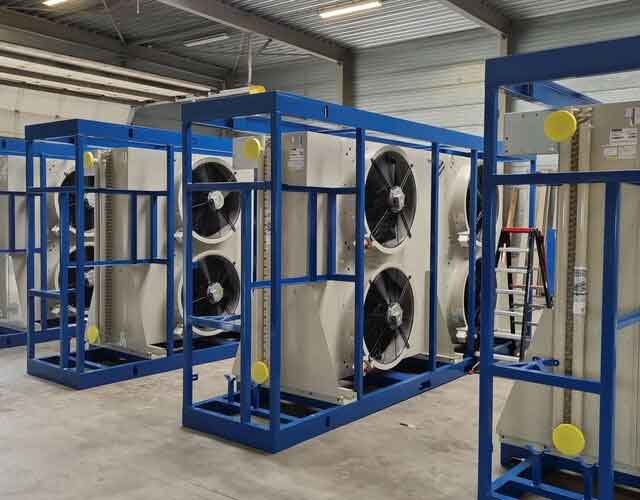
Large commercial buildings, industrial plants, warehouses, data centres, hotels, construction projects and other high-demand facilities can experience cooling requirements that exceed the capacity of their existing HVAC systems. In these situations, installing permanent equipment is not always practical, particularly when the additional cooling is needed temporarily.
Rental chillers for large cooling requirements provide a flexible way to add substantial cooling capacity without committing to a permanent chiller installation. Depending on the project, rental systems can be deployed for emergency cooling, planned maintenance, seasonal demand, temporary capacity increases and industrial process cooling.
Current UAE rental providers offer air-cooled chillers in capacities reaching approximately 400 TR, while other suppliers provide larger systems or combine multiple units to achieve higher capacities. Al Shola, for example, lists 50–400 TR air-cooled chillers for temporary, industrial, commercial and emergency applications.
What Are Rental Chillers for Large Cooling Requirements?
Rental chillers are temporary cooling systems supplied for a defined project or operating period. Instead of purchasing and permanently installing a chiller plant, a business rents the required equipment and associated components.
For large applications, the rental solution may include more than the chiller itself. A complete temporary cooling system can involve:
Air-cooled or water-cooled chillers
Chilled-water pumps
Flexible chilled-water hoses
Temporary pipework
Headers and valves
Air-handling units
Electrical distribution equipment
Control and monitoring systems
Heat exchangers where required
Installation and commissioning
Technical support and maintenance
Some UAE rental providers specifically offer accessories such as chilled-water pumps, VFD panels, supply and return headers, flexible hoses, valves, cables and monitoring systems as part of temporary cooling solutions.
When Do Businesses Need Large Rental Chillers?
Large temporary cooling systems can be useful when the permanent cooling infrastructure cannot meet the current demand or becomes temporarily unavailable.
Emergency Chiller Replacement
A sudden chiller failure can affect building comfort, manufacturing processes, storage environments or other temperature-sensitive operations.
A rental chiller can act as a temporary replacement while the permanent system is repaired or replaced. UAE rental providers specifically market temporary chillers for emergency cooling and equipment breakdown situations.
Planned Maintenance and Shutdowns
Large facilities periodically need to shut down chillers for inspection, maintenance, refurbishment or replacement.
Removing a major cooling system from service can create a temporary capacity gap. A rental chiller can provide cooling during the maintenance period, allowing critical operations to continue.
Industrial rental companies also identify planned shutdowns and turnarounds as important applications for temporary cooling.
Seasonal Cooling Demand
The UAE’s hot climate can create significant cooling demand during peak periods.
Businesses that experience seasonal increases may not want to purchase permanent equipment that remains underutilised during lower-demand periods. Renting additional chiller capacity allows them to increase cooling capability when required.
Construction and Expansion Projects
New buildings, extensions and industrial facilities may require temporary cooling before their permanent HVAC systems are completed.
A rental chiller can bridge the gap between construction and commissioning, particularly when parts of a facility need to become operational before the final cooling infrastructure is ready.
How Much Cooling Capacity Can Rental Chillers Provide?
Large rental chillers are available in different capacities, allowing suppliers to configure systems around the actual cooling load.
Current UAE examples include air-cooled rental chillers from approximately 50 TR to 400 TR. Foster International lists air-cooled rental chillers from 100 TR to 250 TR, while North Pole Technical states that its rental fleet includes centrifugal, screw and reciprocating compressor systems from 30 to 600 tons.
For requirements beyond the capacity of a single machine, multiple chillers can be connected in parallel. This approach allows cooling capacity to be scaled according to the project instead of depending on one very large unit. Al Shola states that its units can be configured in series or parallel to achieve higher cooling capacities.
Air-Cooled vs Water-Cooled Rental Chillers
Choosing between air-cooled and water-cooled equipment depends on the application and available site infrastructure.
Air-Cooled Chillers
Air-cooled chillers reject heat directly to the surrounding air and generally do not require a cooling tower or condenser-water circuit.
They can be practical for:
Construction sites
Temporary commercial cooling
Events
Warehouses
Emergency applications
Sites with limited water availability
Temporary industrial cooling
One advantage is relatively straightforward deployment because the temporary system does not require a separate cooling tower arrangement. UAE rental suppliers currently offer high-ambient air-cooled equipment specifically for temporary and industrial applications.
Water-Cooled Chillers
Water-cooled systems can be considered for larger or specialised applications where suitable condenser-water infrastructure is available.
They can be relevant for:
Large industrial facilities
Process cooling
Major commercial installations
Continuous-duty applications
Large-scale cooling plants
The final selection should consider cooling load, site infrastructure, water availability, operating temperatures, efficiency requirements and installation space.
Why High-Ambient Performance Matters in the UAE
A rental chiller operating in the UAE must be selected for the actual ambient conditions at the project location.
High outdoor temperatures can affect chiller performance and available capacity. Equipment designed for high-ambient operation can therefore be important for maintaining reliable cooling during periods of extreme heat.
Some UAE rental providers advertise air-cooled chillers designed to operate in ambient temperatures up to 55°C.
This is particularly important for outdoor temporary installations because the rated capacity of a chiller should be considered alongside the ambient temperature at which that capacity is available.
How Large Rental Chiller Systems Are Installed
A large rental chiller cannot simply be delivered and switched on. Proper planning is required to integrate it with the facility’s cooling system.
A typical deployment involves:
1. Cooling Load Assessment
The supplier reviews the required cooling capacity, target temperatures, operating hours and heat sources.
2. Equipment Selection
The appropriate chiller type and capacity are selected based on the project’s technical requirements.
3. Site Assessment
The installation team checks available space, access routes, electrical supply, connection points and chilled-water pipe routes.
4. Delivery and Positioning
The equipment is transported to the site and positioned in a suitable location with adequate airflow and safe access for operation and maintenance.
5. Hydraulic Connections
Temporary hoses or pipework are connected to the existing chilled-water system or directly to the required cooling equipment.
6. Electrical Connections
The chiller and associated equipment are connected to an appropriate electrical supply or temporary power system.
7. Testing and Commissioning
The complete installation is checked before operation. Flow, pressure, temperatures, controls and connections should be verified.
Rental companies may provide complete supply, installation, commissioning and removal services rather than supplying equipment alone.
What Information Is Needed to Select a Large Rental Chiller?
Providing accurate information to the rental company can make equipment selection faster and more reliable.
Useful information includes:
Required cooling capacity
Existing chiller capacity
Chilled-water supply temperature
Chilled-water return temperature
Required flow rate
Operating hours
Indoor or outdoor installation
Available electrical supply
Available installation area
Existing pipe sizes
Connection type
Number and type of AHUs
Process cooling requirements
Required rental duration
Project location
Emergency or planned requirement
The more complete the information, the easier it is for the supplier to design a temporary cooling package rather than simply recommending the largest available chiller.
Why Oversizing a Rental Chiller Is Not Always Better
It may seem logical to select the biggest available chiller for a large cooling requirement, but oversizing can create unnecessary expense and operational complications.
Chiller capacity should be matched to the actual load as closely as practical.
The cooling requirement can be affected by:
Building size
Occupancy
Equipment heat
Outdoor temperature
Solar heat gain
Process loads
Air infiltration
Required indoor temperature
Operating schedule
For variable loads, multiple smaller rental chillers can sometimes provide greater flexibility than one oversized unit. Modular systems can also allow individual units to be serviced while other equipment continues operating.
Large Rental Chillers for Industrial Process Cooling
Industrial facilities often have cooling requirements that differ from conventional building air conditioning.
Manufacturing equipment, production lines, process fluids, compressors, moulding machines and other machinery can generate substantial heat.
Temporary chillers can provide process water cooling during:
Plant expansion
Equipment replacement
Planned shutdowns
Production increases
Chiller breakdowns
Commissioning
Temporary production requirements
Industrial rental fleets include equipment intended for process cooling and other specialised applications. Atlas Copco, for example, describes temporary cooling for chemical, pharmaceutical, food and beverage, and manufacturing operations, as well as emergency and planned-maintenance applications.
Rental Chillers for Data Centres and Critical Facilities
Data centres require reliable temperature control because IT equipment generates continuous heat.
Temporary chillers can provide additional or backup cooling during:
HVAC maintenance
Cooling system upgrades
Capacity expansion
Equipment failure
Commissioning
Temporary infrastructure gaps
The cooling system should be designed around the facility’s redundancy and operational requirements. For critical environments, the rental strategy should consider standby capacity, monitoring, power availability and rapid technical response.
Large permanent data-centre chillers can themselves reach substantial capacities; Daikin UAE, for example, lists data-centre-oriented chiller systems with capacities reaching approximately 1,950 kW and higher configurations in its portfolio.
This illustrates why large cooling projects may require a coordinated temporary system rather than a single standard portable unit.
Benefits of Renting Large Chillers
Lower Capital Commitment
Businesses can obtain additional cooling capacity without purchasing a permanent chiller plant.
Faster Deployment
Rental equipment can often be mobilised more quickly than designing and constructing a permanent cooling installation.
Flexible Capacity
Multiple units can be combined when the required cooling capacity is substantial or changes over time.
Temporary Backup
Rental chillers can provide a bridge during breakdowns, maintenance or equipment replacement.
Reduced Long-Term Commitment
Businesses do not have to retain temporary equipment after the project requirement ends.
Technical Support
Many rental providers offer installation, commissioning, maintenance and technical support alongside the equipment.
What Should a Large Chiller Rental Package Include?
Before accepting a quotation, confirm exactly what is included.
A complete package may include:
Chiller equipment
Pumps
Flexible hoses
Headers
Valves and fittings
Electrical distribution
Cables
AHUs
Ducting
Controls
Monitoring
Transportation
Installation
Commissioning
Maintenance
Emergency support
Removal and demobilisation
Not every supplier includes all these components as standard, so the scope should be clearly documented before the equipment arrives on site.
Final Thoughts
Rental chillers for large cooling requirements provide a practical solution for businesses that need substantial temporary cooling without investing in permanent infrastructure.
In the UAE, rental fleets currently include high-capacity air-cooled equipment reaching around 400 TR, while some providers offer larger systems and modular configurations for significantly greater requirements.
The right solution depends on more than nominal tonnage. Cooling load, ambient temperature, chilled-water conditions, electrical supply, installation space, process requirements, redundancy and rental duration all need to be considered.
For a large project, the safest approach is to provide the rental company with detailed technical information and request a complete temporary cooling proposal covering equipment, accessories, installation, commissioning and support. This helps ensure that the rental system delivers the required cooling capacity reliably throughout the project.