

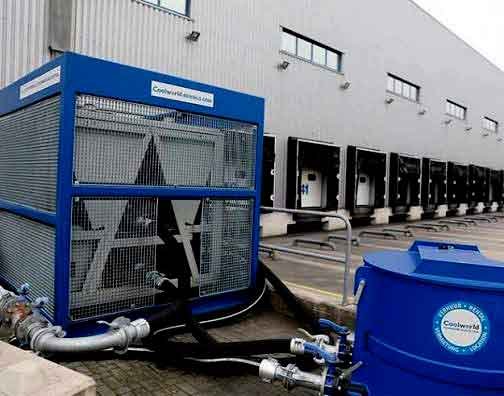
Cooling requirements can change quickly. A commercial building may need additional capacity during a period of high occupancy, an industrial facility may require temporary process cooling during maintenance, or a permanent chiller may fail unexpectedly. In these situations, purchasing and installing a new permanent cooling system is not always practical.
Chiller rental for temporary cooling requirements provides businesses with a way to add cooling capacity for a defined period without making the capital commitment associated with a permanent installation.
The concept is particularly relevant in hot climates such as the UAE, where reliable cooling is essential for commercial and industrial operations. Dubai’s Regulatory and Supervisory Bureau states that cooling represents almost half of the emirate’s total electricity demand.
What Is a Temporary Chiller?
A chiller removes heat from water or another secondary coolant so that the cooled fluid can be circulated through an air-conditioning or industrial process system. ASHRAE describes liquid-chilling systems as being widely used for building air conditioning as well as industrial processes and refrigeration applications.
A temporary chiller is essentially a chiller deployed for a limited period rather than installed as a permanent part of a facility’s cooling plant.
Depending on the application, a temporary cooling package may include:
Chiller units
Pumps
Flexible hoses or temporary pipework
Buffer tanks
Heat exchangers
Air handling units
Electrical equipment
Control systems
Monitoring equipment
The equipment required depends on the existing cooling infrastructure and the specific temperature and flow requirements of the application.
Why Do Businesses Need Temporary Cooling?
Temporary cooling is generally used when normal cooling capacity is unavailable, insufficient, or needed only for a limited period.
Common situations include:
Emergency Chiller Failure
A failed chiller can create an immediate operational problem for a building or industrial facility.
If repairing the permanent equipment takes several days or weeks, a rental chiller can provide interim cooling while technicians work on the original system.
Rental cooling providers specifically identify emergency breakdowns as a common application for temporary chillers.
Planned Maintenance
Major chiller maintenance may require equipment to be taken offline.
Rather than shutting down cooling completely, businesses can install temporary capacity before the maintenance begins. This can help maintain operations while the permanent system is unavailable.
Temporary rental solutions are also used during planned maintenance and plant turnarounds.
Seasonal Peak Demand
Some businesses experience significantly higher cooling requirements during particular periods.
Instead of purchasing permanent equipment that may be underused after the peak period, additional rental capacity can provide a more flexible option.
This approach is particularly relevant where the additional cooling requirement is temporary or difficult to predict.
Construction and Commissioning
New buildings and industrial facilities can require cooling before their permanent HVAC systems are fully operational.
Temporary chillers can bridge the period between construction and permanent-system commissioning. Rental providers also identify commissioning and testing as applications for temporary cooling systems.
Production Expansion
Manufacturing facilities sometimes increase production without immediately expanding their permanent utility infrastructure.
Additional temporary cooling can support the increased load while a permanent expansion is being designed or installed.
Temporary Cooling for Commercial Buildings
Commercial facilities depend on stable indoor temperatures for occupants, equipment, and business operations.
Temporary chillers can be considered for:
Office buildings
Hotels
Retail facilities
Shopping centres
Exhibition venues
Healthcare facilities
Educational buildings
Large residential developments
For a commercial application, the rental system may need to connect with an existing chilled-water loop and work alongside air handling units or fan coil units.
The objective is therefore not simply to place a chiller at the site. The temporary equipment needs to work with the building’s existing HVAC arrangement.
Temporary Chillers for Industrial Applications
Industrial cooling can be more demanding because temperature control may directly affect production.
Temporary process cooling can support applications such as:
Manufacturing
Food and beverage production
Pharmaceutical facilities
Chemical processing
Petrochemical operations
Process-water cooling
Data centres
Marine and offshore applications
Industrial rental providers describe temporary process cooling as a way to maintain stable temperatures for manufacturing and temperature-sensitive operations. Complete temporary systems can incorporate chillers, pumps, buffer tanks, heat exchangers, and power integration.
For these applications, the required temperature, flow rate and cooling capacity need to be established before selecting equipment.
Air-Cooled and Water-Cooled Temporary Chillers
Temporary chillers are available in different configurations, and the appropriate type depends on the site.
Air-Cooled Chillers
Air-cooled chillers reject heat directly into the surrounding air.
They can be useful for temporary installations because they can simplify deployment where a suitable condenser-water system or cooling tower is unavailable.
Some current UAE rental fleets offer modular air-cooled chillers, including individual units in the 50 kW to 720 kW range, with multiple units capable of operating together for larger cooling requirements. Availability and specifications vary by supplier.
Water-Cooled Chillers
Water-cooled chillers reject heat through a condenser-water system, generally requiring associated cooling-tower and pumping infrastructure.
They can be suitable where the facility already has compatible infrastructure.
The choice should therefore be based on the site’s available utilities, cooling requirements, installation conditions, and operating environment rather than simply choosing the most powerful available chiller.
How to Determine the Required Chiller Capacity
Selecting a rental chiller based solely on the size of a building or process can result in an inappropriate system.
The required cooling capacity should be assessed from the actual load.
Important factors include:
Current cooling load
Peak cooling demand
Chilled-water supply temperature
Return-water temperature
Required water flow
Operating hours
Ambient conditions
Existing pumps
Pipework configuration
Heat-exchanger requirements
Electrical supply
Dubai’s cooling regulator has highlighted the importance of accurately estimating cooling loads, noting that excessive contracted cooling capacity can contribute to inefficient operation and higher costs.
This is an important point for temporary rentals as well: more cooling capacity is not automatically better.
A properly engineered system should match the actual application as closely as practical.
Why Chilled-Water Temperature Matters
The required chilled-water temperature is another important consideration.
Different applications can operate at different temperatures, and the temperature requirement affects chiller selection and overall system performance.
ASHRAE notes that chiller controls need to account for operating limits such as minimum flow and minimum temperature.
In hot and humid climates, chilled-water design can also affect energy performance and dehumidification. An ASHRAE Journal article discussing chilled-water systems in hot, humid climates explains that chilled-water supply temperature and temperature differential influence both cooling performance and energy use.
Therefore, the rental provider should understand the application’s required supply and return temperatures before selecting the equipment.
What Equipment May Be Needed Alongside the Chiller?
A chiller is not always a complete temporary cooling system by itself.
Depending on the application, the installation may also require:
Pumps
Temporary pumps may be needed to circulate chilled water between the rental equipment and the building or industrial process.
Hoses and Pipework
Flexible hoses or temporary pipework can connect the rental chiller to the existing system.
Buffer Tanks
A buffer tank may be used where the system requires additional water volume or more stable operation.
Heat Exchangers
A heat exchanger can allow the temporary cooling system to interface with a process or existing circuit where direct connection is unsuitable.
Air Handling Units
For certain temporary comfort-cooling applications, air handling equipment may be combined with chillers to distribute conditioned air.
UAE rental providers offer air handling units that can be combined with chillers and other temporary temperature-control equipment.
Benefits of Chiller Rental for Temporary Requirements
Faster Access to Additional Capacity
A rental solution can provide access to cooling equipment without waiting for a permanent plant expansion.
Lower Long-Term Commitment
If additional cooling is only required for a short period, renting can avoid purchasing equipment that may later sit unused.
Support During Maintenance
Temporary equipment can maintain cooling while permanent chillers are serviced or refurbished.
Emergency Backup
Rental chillers can help businesses respond to unexpected cooling failures.
Flexible Capacity
Multiple modular units can sometimes be combined when the required load is larger or changes over time. Current rental offerings demonstrate this approach for multi-megawatt applications.
Temporary Project Support
Construction, commissioning and production projects can use cooling equipment without making it part of the permanent plant.
What Should a Chiller Rental Service Include?
A professional temporary cooling project should involve more than equipment delivery.
A typical process can include:
- Site assessment
- Cooling-load evaluation
- Equipment selection
- Connection planning
- Equipment delivery
- Installation
- Commissioning
- Performance monitoring
- Maintenance and technical support
- Removal after the rental period
Some industrial rental providers explicitly offer site assessment, installation, commissioning and remote monitoring as part of their temporary cooling services.
For critical applications, this complete-service approach can be more useful than simply renting a machine and arranging the rest independently.
How Long Can a Chiller Be Rented?
The rental period depends on the supplier and project.
Temporary cooling may be required for:
A few days during an emergency
Several weeks during maintenance
A few months during construction
A seasonal peak
A longer period while permanent equipment is being manufactured or installed
The rental period should be defined before the equipment is mobilised, but businesses should also ask about extension terms in case the permanent cooling system takes longer than expected to return to service.
What to Check Before Renting a Chiller
Before signing a rental agreement, confirm the following:
| Requirement | What to Check |
|---|---|
| Cooling capacity | Required kW/TR and expected load |
| Water temperature | Supply and return requirements |
| Flow rate | Required chilled-water flow |
| Chiller type | Air-cooled or water-cooled |
| Power | Voltage, phase and available capacity |
| Connections | Hose, pipe and flange requirements |
| Space | Equipment footprint and clearance |
| Access | Delivery and lifting requirements |
| Operating period | Start date, end date and extension terms |
| Support | Emergency and technical assistance |
| Monitoring | Local or remote monitoring availability |
| Accessories | Pumps, tanks, hoses, AHUs and other equipment |
| Installation | Whether setup and commissioning are included |
Getting these details confirmed in advance can prevent delays during installation.
Temporary Cooling and Energy Efficiency
Renting a chiller does not automatically make a cooling system energy efficient.
The equipment needs to be correctly selected and operated for the required load.
Dubai’s regulator identifies reliable and energy-efficient cooling as an important part of the emirate’s sustainability objectives, while its reporting has also highlighted the importance of system-level energy performance.
ASHRAE similarly identifies opportunities to improve chilled-water-system efficiency through appropriate supply temperatures, temperature differentials, controls and system design.
For a temporary project, this means businesses should consider:
Actual cooling load
Part-load operation
Chilled-water temperatures
Pumping requirements
Equipment efficiency
Operating schedule
Regular monitoring
Rental Chiller vs Buying a Permanent Chiller
A rental chiller is not intended to replace every permanent cooling system.
Purchasing may make more sense when cooling requirements are permanent, predictable and substantial over the long term.
Rental can be more appropriate when the requirement is temporary.
| Situation | Rental Chiller | Permanent Chiller |
|---|---|---|
| Emergency breakdown | ✓ | Usually slower |
| Planned maintenance | ✓ | — |
| Short-term project | ✓ | Often unnecessary |
| Seasonal demand | ✓ | Fixed capacity |
| Temporary production increase | ✓ | May be excessive |
| Long-term cooling requirement | Depends on economics | ✓ |
| Permanent facility expansion | Temporary option | ✓ |
The decision should be based on the duration of the requirement, cooling load, available infrastructure and long-term plans.
When Is Chiller Rental the Right Choice?
Temporary chiller rental is particularly worth considering when:
A permanent chiller has unexpectedly failed.
Planned maintenance requires shutdown.
Cooling demand temporarily exceeds installed capacity.
A facility is being constructed or renovated.
A production line needs temporary process cooling.
A permanent replacement chiller is still being manufactured.
A business requires seasonal cooling capacity.
Commissioning or testing requires temporary temperature control.
These applications are consistent with the temporary cooling uses identified by industrial rental specialists, including emergency breakdowns, planned maintenance, seasonal demand, backup cooling, bridging permanent installations and commissioning.
Final Thoughts
Chiller rental for temporary cooling requirements gives commercial and industrial users a flexible way to maintain cooling when permanent capacity is unavailable or additional capacity is required for a limited period.
The key is to treat temporary cooling as an engineered system rather than simply hiring a chiller. Cooling capacity, water temperature, flow rate, electrical requirements, connection arrangements, site access and supporting equipment all influence whether the solution will work properly.
For businesses operating in Dubai and other hot-climate environments, this planning is particularly important because cooling is a major part of overall energy demand.
A properly assessed rental system can provide emergency backup, support planned maintenance, accommodate temporary capacity increases and bridge the gap until a permanent cooling solution is ready.